
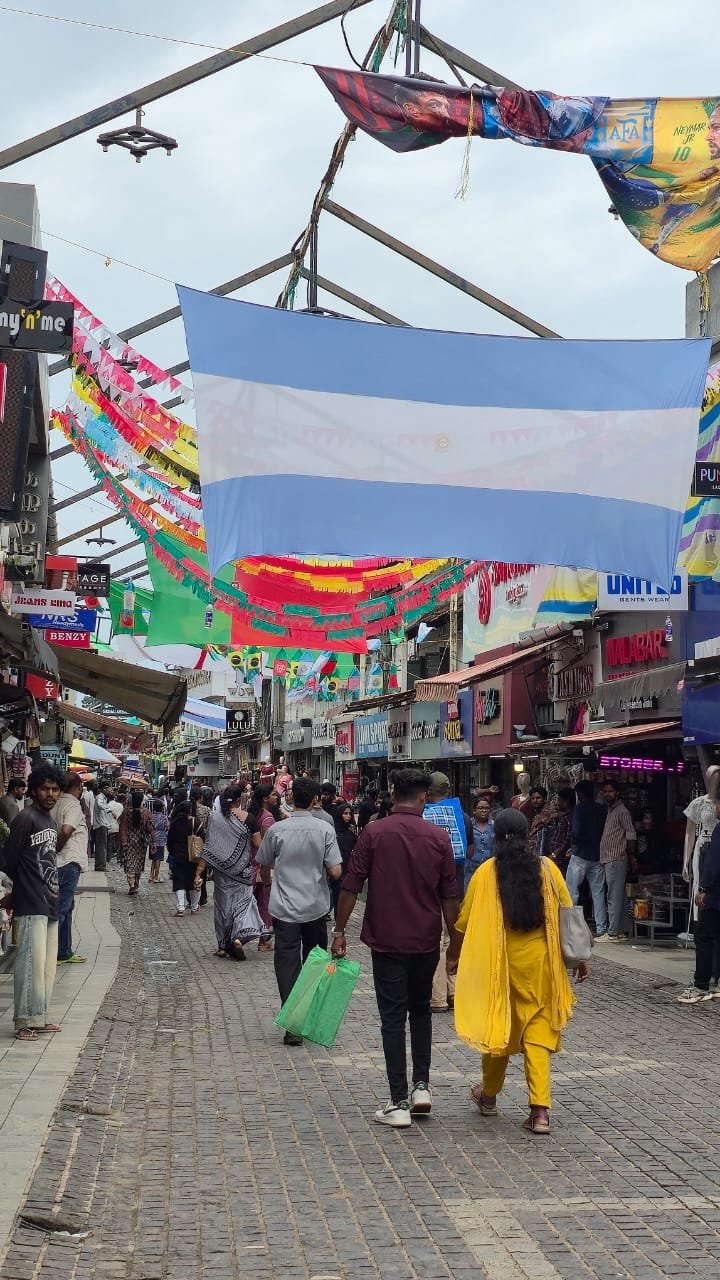
Across the Iruvanjipuzha river in Mukkam, Kozhikode, a giant Argentine flag stretches across the sky. Walk through Kozhikode’s historic Sweet Meat Street during the FIFA World Cup and the sky almost disappears behind a sea of flags. Even on India’s Independence Day or Republic Day, it is difficult to recall seeing the national tricolour displayed in such numbers or on such a scale.
Today, the colours of football’s global powers have become part of everyday life across Kerala. Argentina’s blue and white adorn tea shops. Brazil’s green and yellow decorate school gates. Portugal’s red and green flutter across villages and towns. Giant cut-outs of Lionel Messi, Neymar and Cristiano Ronaldo dominate junctions, while football-themed public art installations have become a familiar sight in districts such as Malappuram.
This is not a recent phenomenon. Kerala’s emotional connection with world football has evolved over decades. Football has become a cultural language that cuts across religion, caste and politics. When Argentina won the 2022 FIFA World Cup, the country’s official X account thanked supporters in Kerala with the message: “Thank you Kerala, India.” During the current World Cup as well, Kerala’s celebrations have drawn the attention of international media.
There is nothing wrong with any of this. Sporting passion remains one of the most uplifting forms of collective expression in any society.

For many people, the Iruvanjipuzha river evokes memories of writer S. K. Pottekkatt, playwright Surasu, filmmaker Salam Karassery and B. P. Moideen, whose life story later inspired the acclaimed Malayalam film Ennu Ninte Moideen. The river carries the history, literature and human stories of the region.
Today, it is also overshadowed by a 60-metre Argentine flag.
There is nothing unusual about admiring great footballers or supporting world-class teams. The question is different.
Why have the national flags of foreign countries become some of the most visible public symbols during football season in Kerala?
Kerala’s attachment to Argentina remains almost entirely a fan phenomenon. Argentina has occasionally acknowledged it — most notably when its official X account thanked “Kerala, India” after the 2022 World Cup win — but the relationship has never grown into anything institutional: no exchange programs, no youth academies, no formal ties between the state and the football federation. That absence hasn’t dimmed the enthusiasm on the ground.
Portugal draws a similar devotion, despite its colonial history in parts of India, seen here purely through the lens of football rather than empire.
At times, this passion spills over into violence. During the 2022 World Cup, clashes broke out between Brazil and Argentina supporters in Shaktikulangara. Following the final, incidents of violence were reported from Kannur, Thalassery and Kochi. Such episodes demonstrate the intensity of football fandom built around foreign national teams.
One reason is obvious. Kerala possesses an extraordinary passion for football, but India remains absent from the sport’s biggest stage.
The contrast is striking.
During the current World Cup, Cape Verde, a nation of just 530,000 people, held European champions Spain to a goalless draw and pushed Argentina to the brink of elimination before losing 3-2 in extra time. Population alone does not determine footballing success. Small countries have repeatedly shown that long-term planning, strong institutions and sustained investment can build internationally competitive teams.
India, with a population exceeding 1.4 billion, has yet to achieve that.
The problem is neither a lack of talent nor a lack of passion. Kerala, along with several other Indian states, has no shortage of gifted footballers or devoted supporters.
What India has struggled to build is a national football system capable of translating that passion into sustained international success. Administrative instability, uneven infrastructure, inadequate youth development and the absence of long-term planning have been recurring weaknesses. Decisions that shape the future of Indian football often appear to be made far away from the football pitch itself.
Many countries regulate the public display of foreign national flags, though usually for reasons of public order or national identity politics rather than sporting fandom itself. Singapore restricts the display of foreign emblems under law. Montenegro fines citizens for flying another country’s flag without a permit. Kuwait’s interior ministry now requires authorisation to raise any foreign flag — though tellingly, it explicitly exempts regional and international sports tournaments hosted in the country, treating football fervour as a case apart from ordinary displays of foreign allegiance. The French city of Nice imposed a similar ban in 2014, though that measure was a response to clashes tied to Algeria’s matches rather than to football enthusiasm on its own. India has no comparable restrictions, allowing foreign national flags to become a routine feature of public spaces during major tournaments.
Yet the larger question is not about flags.
If India had a national football team capable of competing regularly at the FIFA World Cup, would much of this passion not naturally find its way toward the Indian team?
Kerala would still admire Messi. There would still be loyal supporters of Brazil and Argentina.
But perhaps the most celebrated flag during football season would no longer belong to another country.
It might well be India’s own tricolour.