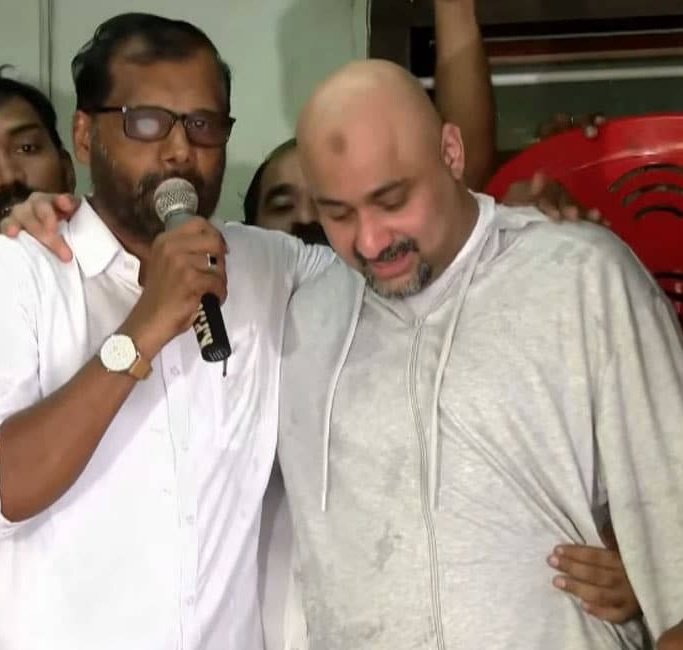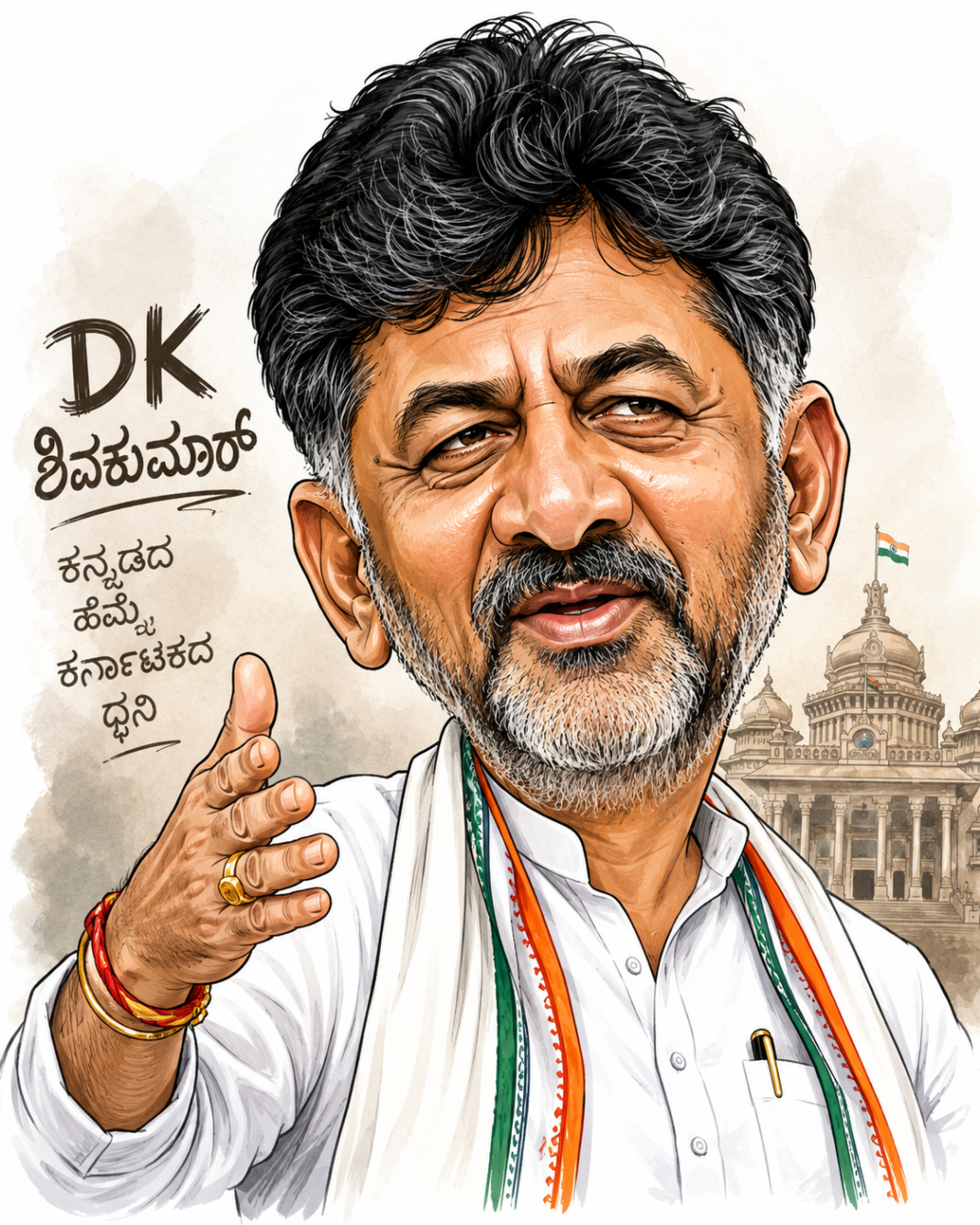
AFTER three years of waiting, maneuvering, and barely concealed impatience, Doddaalahalli Kempegowda Shivakumar has finally arrived at the destination he believed was always his. Karnataka’s most tenacious political operator was elected leader of the Congress Legislature Party on May 30, paving the way for him to be sworn in as Chief Minister on June 3. The moment, confirmed at a CLP meeting held at Vidhana Soudha, was accompanied by chants of “DK, DK” from supporters who had gathered outside, a scene that captured the intensity of a political ambition three decades in the making.
Siddaramaiah, the outgoing chief minister who had governed for what became the longest single tenure in Karnataka’s history, formally proposed Shivakumar’s name at the meeting, a gesture laden with irony given the years of friction between the two men. The transition, overseen by AICC general secretaries KC Venugopal and Randeep Singh Surjewala, was swift once the Congress high command made its call. Shivakumar is also reported to have selected June 3 as his swearing-in date after consulting his long-time astrologer, Bellur Dwarakanath, a detail that speaks to the man’s persona as much as any political calculation.
The Man: A Short Biography
Shivakumar was born on May 15, 1962, in Doddalahalli village near Kanakapura, in the Old Mysuru region that forms the heartland of the Vokkaliga community. He was drawn into politics while still pursuing his undergraduate studies, joining the National Students’ Union of India in the early 1980s as a teenager. He eventually completed a Master’s degree in Political Science from Karnataka State Open University, reportedly writing his examinations while simultaneously serving as Urban Development Minister in SM Krishna’s cabinet in 2004, a biographical footnote that illustrates his relentless, unglamorous work ethic.
He first won a seat in the Karnataka Assembly in 1989, representing Sathanur, and has never lost an election since, making him an eight-time MLA, now from the Kanakapura constituency he shifted to in 2008. Party colleagues call him “Kanakapura Bande,” the rock of Kanakapura, a nickname that captures both his physical solidity and his political immovability. Over the years he accumulated portfolios spanning Energy, Urban Development, Irrigation and Medical Education, building administrative credibility alongside his reputation as the Congress party’s supreme crisis manager. When the Gandhi family needed 42 Gujarat MLAs sheltered from BJP poaching ahead of a Rajya Sabha election, it was Shivakumar they called, not the then chief minister. When a state government needed to be held together by sheer force of will, Shivakumar was dispatched.
In September 2019, the Enforcement Directorate arrested him in a money laundering case. He spent 50 days in Tihar Jail before the Delhi High Court granted bail. Far from breaking him, the experience appeared to harden his bond with the Congress high command. He later wept publicly recalling Sonia Gandhi’s visit to him in jail, a moment that crystallized his identity as the party’s most loyal soldier in Karnataka. His declared assets of over Rs 1,413 crore at the time of his 2023 nomination make him one of the wealthiest politicians in the state, with interests spanning mining, real estate, and education. That wealth has never been far from controversy, but it has also underwritten the expensive business of Karnataka politics.
The Personality: Believers, Builders, and Bulldozers
Where Siddaramaiah was a lawyer’s methodical mind wrapped in socialist conviction, Shivakumar is instinct, energy, and organizational muscle. He wears sacred threads on his wrists, consults the Panchanga before significant decisions, and is described by observers across party lines as a deeply devout man, despite also drawing fire from sections of the BJP for supporting a proposed 114-foot Jesus Christ statue in his constituency. He contains multitudes that Karnataka’s syncretic political culture tends to produce.
He is not an ideologue in any recognizable sense. Siddaramaiah built his career on the AHINDA coalition of minorities, backward communities and Dalits, giving Karnataka’s Congress a coherent social justice identity. Shivakumar is the Vokkaliga chieftain who plays caste arithmetic with the fluency of a seasoned trader and the aggression of a field commander. He understands that the Vokkaliga community, the second largest in Karnataka, had for years drifted toward the JD(S) and, in more recent cycles, toward the BJP-JD(S) alliance. His elevation is Congress’s most significant attempt in a generation to staple that community back into its fold.
He is also a man of demonstrable energy. He reportedly wakes before dawn, meets delegations and contractors through the morning, inspects infrastructure projects through the afternoon, and attends political functions through the night. His staff, officials, and contractors are known to be exhausted by his pace. Critics say this kinetic style produces announcements faster than outcomes. Supporters say Karnataka has not had a leader so viscerally engaged with the mechanics of governance in years.
Karnataka’s Reading of the Man
Public opinion in Karnataka on Shivakumar is not as simple as either his admirers or detractors suggest. Among Vokkaliga communities in the Old Mysuru belt, his elevation is being received with considerable warmth. The pontiff of the Vishwa Vokkaliga Mahasamsthana Mutt publicly demanded as recently as 2024 that Siddaramaiah step aside to make way for Shivakumar, a rare instance of religious leadership directly intervening in a succession debate. For that community, this is a moment long overdue.
Among Karnataka’s urban middle class, concentrated in Bengaluru’s technology corridors, the reception is more guarded but not hostile. Shivakumar has spent three years as Bengaluru Development Minister making the unglamorous arguments for infrastructure, confronting what he himself described as a city with “best talent, best weather, worst infrastructure.” That kind of blunt self-awareness plays well with a civic constituency exhausted by government spin. The question is whether the CM’s office gives him the authority to accelerate what the deputy’s office could only propose.
Among Siddaramaiah’s Kuruba community supporters and the AHINDA constituency, the mood is more ambivalent. Siddaramaiah’s tenure was defined by welfare commitments: the five guarantee schemes, the focus on backward communities, the muscular OBC identity politics that won Congress 135 seats in 2023. The concern in these quarters is whether Shivakumar, a man of instinctively different temperament and community orientation, will maintain the ideological continuity that drove that mandate.
A Different Kind of Chief Minister
The contrast between Shivakumar and Siddaramaiah is not merely one of personality. It reaches into their governing instincts, their relationships with Delhi, and their reading of Karnataka’s future.
Siddaramaiah was a man who changed parties, who spent time in the JD(S), who carried the ideological baggage of socialist conviction through decades of Karnataka politics. He was never purely a creature of the Congress high command, and that independence occasionally surfaced in quietly defiant ways. He governed as someone who believed in the transformative power of the state as a welfare provider.
Shivakumar, by contrast, never left Congress. His loyalty to the Gandhi family is total and visible. He built his career not through ideological positioning but through organizational mastery, electoral engineering, and the cultivation of personal networks that span the bureaucracy, the business community, and the party structure. His relationship with the Congress high command is one of genuine intimacy, not managed distance.
This means that under Shivakumar, Karnataka can expect a government more aligned with national Congress priorities, more responsive to signals from Delhi, and less likely to chart an independent course. That is a trade-off. It may bring greater coordination on central-state projects and a smoother working relationship with the party’s national leadership. It may also mean that the sharp Siddaramaiah-era welfare emphasis softens into something more entrepreneurial in tone, more focused on investment attraction and urban infrastructure than on the redistribution politics that animated the 2023 mandate.
The Fault Lines Within Congress
The transition, while formally smooth, has not eliminated the structural tensions that festered through three years of dual power. The Congress government in Karnataka was never truly unified. From cabinet formation in 2023, when Siddaramaiah and Shivakumar could not agree on ministerial berths and the swearing-in had to be drastically pruned, to repeated public episodes of barely suppressed rivalry, the two camps nursed parallel organizational structures, parallel networks of loyalists, and parallel ambitions.
Siddaramaiah’s supporters, many of them from the Kuruba community and the AHINDA coalition, have no particular enthusiasm for a Shivakumar government. They will watch closely to see whether the guarantee schemes are diluted, whether their people are sidelined in cabinet formation, and whether the broader ideological color of Karnataka’s Congress shifts from social justice toward something more politically centrist.
There is also the question of Parameshwara, the Home Minister and a Dalit leader who commanded his own camp of supporters who had publicly called for him to be made chief minister during the transition. That camp is not going away. Shivakumar will have to perform the same balancing act in reverse that Siddaramaiah once performed, keeping a powerful rival constituency satisfied while consolidating his own authority.
The Congress high command is betting that Shivakumar’s organizational skills, the same skills that delivered them 135 assembly seats in 2023, are strong enough to hold these fissures together for the two years remaining before the 2028 assembly election. That is not a small bet.
What Karnataka Can Expect: Development and Its Discontents
If there is one area where Shivakumar’s agenda is already visible in considerable detail, it is urban development and infrastructure, particularly in Bengaluru. His three years as Bengaluru Development Minister produced an ambitious, if not always delivered, pipeline of projects.
The Greater Bengaluru Authority, which replaced the sprawling BBMP structure, is his administrative legacy. He has championed a 120-km Bengaluru Business Corridor with a farmer-friendly land acquisition model. He has pushed for tunnel roads, double-decker corridors, and an underground vehicular East-to-West corridor estimated at Rs 25,000 crore. He has been publicly committed to expanding Bengaluru’s Metro network to 175 km by December 2027. He has repeatedly lobbied the Union Finance Ministry for central support for Bengaluru infrastructure, arguing the city’s status as India’s technology capital demands commensurate investment.
As chief minister, Shivakumar will command the full apparatus of state government rather than operating within the constraints of a deputy’s portfolio. That should, in theory, allow him to break logjams on inter-agency coordination, land acquisition disputes, and funding negotiations that have slowed projects in recent years. He has promised a major push on mobility in Bengaluru, and the city’s deeply frustrated commuters will hold him to that.
Outside Bengaluru, Shivakumar has spoken about irrigation, with the Mekedatu project, which would provide drinking water to Bengaluru and benefit his Kanakapura constituency, a cause he has championed for years, sometimes through physical padayatras along the route. Investment attraction, backed by Karnataka’s existing reputation as a technology destination, will likely be another early priority.
Whether the five guarantee schemes, which Siddaramaiah treated as sacrosanct, survive the fiscal pressures of an ambitious infrastructure agenda will be among the defining political questions of the Shivakumar era.
The BJP’s Response: Opportunity and Constraint
The BJP has wasted no time positioning itself to exploit the transition. Former chief minister Basavaraj Bommai was swift to declare that a change in CM would bring no relief for ordinary people, arguing the administration’s character reflects the party rather than the individual. It is a predictable line but not an ineffective one.
The BJP’s strategic challenge with Shivakumar is more complex than it was with Siddaramaiah. Shivakumar is harder to caricature. He is not an ideological opponent of the kind that BJP’s Hindutva mobilization machinery finds easy to target. He is a devout Hindu who is acknowledged even by BJP insiders as a pro-Hindu figure, which blunts one familiar axis of attack. He is also a grassroots organizer of considerable skill, which means the BJP cannot simply wait for Congress’s organizational weaknesses to surface. They will need to outwork him.
The BJP has historically tried to use the ED and income tax machinery against Shivakumar, and the unresolved legal questions hanging over his finances remain a potential line of attack. But weaponizing those cases has a credibility problem: Karnataka voters have already seen Shivakumar jailed and then returned to power stronger than before. The immunity that comes from surviving institutional pressure is now part of his political persona.
The more durable BJP opportunity lies in monitoring whether the Congress government’s internal contradictions translate into governance failures. Leader of the Opposition R Ashoka had noted during the Siddaramaiah era that the “one guarantee Congress has delivered is the guarantee of uninterrupted instability.” That line will be kept ready for deployment should the Shivakumar era begin with cabinet battles, factional walkouts, or policy reversals.
The BJP will also watch the Vokkaliga arithmetic carefully. Shivakumar’s elevation threatens to close off a community that the JD(S), now formally allied with the BJP, had long claimed as its natural constituency. How HD Kumaraswamy and the JD(S) respond to a Vokkaliga chief minister in Congress is a political subplot that will shape competitive dynamics across the Old Mysuru belt heading into 2028.
The Reckoning Ahead
DK Shivakumar takes office with roughly two years before Karnataka faces its next assembly election. He does not have the luxury of a long settling-in period. The guarantee schemes must be maintained or the social contract that produced 135 seats fractures. The infrastructure promises must show visible progress or the urban middle class that Congress needs to hold will drift back toward apathy or opposition. The factional truce within Congress must hold, or the party will hand BJP the narrative it has always wanted.
He arrives, as he has always operated, as a man who believes in the blunt force of political will. He survived jail, survived three years of playing second to a rival, and survived the most contentious leadership transition Karnataka has seen in a generation. His supporters would argue that if any Congress leader in Karnataka is equipped for what comes next, it is the man they call Kanakapura Bande.
Whether Karnataka agrees will be answered at the ballot box in 2028.
* With Additional research by the South Asia desk, Bengaluru*