

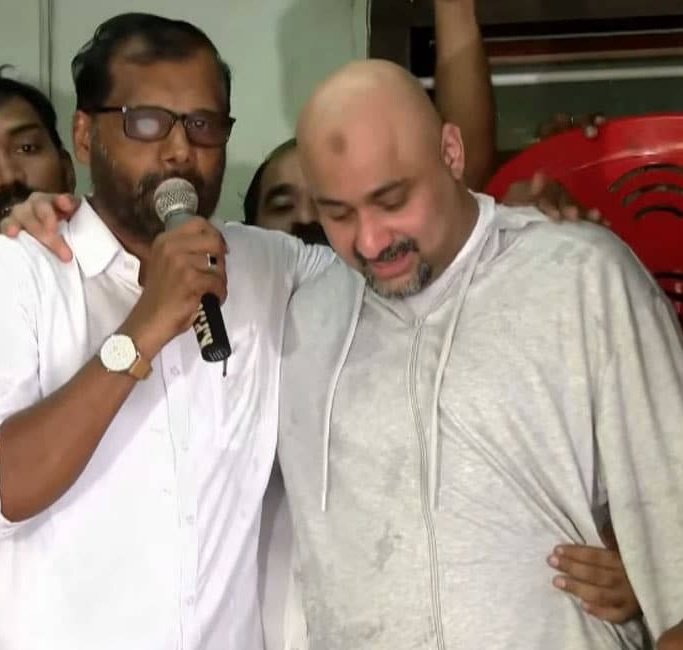
A Kerala auto-driver left home at 24 in search of a better life. Within weeks of landing in Saudi Arabia, he was behind bars, accused in the death of his sponsor’s disabled son. What followed were two decades of imprisonment, a death sentence, and one of the largest public crowdfunding campaigns linked to a legal case in Kerala. He is now home.
Key figures: 20 years imprisoned | Rs. 34 crore (about $ 4 million) raised in blood money | 13 court hearings before final verdict | Death sentence overturned July 2024 | Released and returned home May 28, 2026
THE MAN
From an auto-rickshaw stand to a Saudi prison cell
Machilakath Abdul Rahim grew up in Kodampuzha, a neighbourhood in Feroke, Kozhikode, a region long shaped by migration to the Gulf. Like thousands of young Malayalis before him, he travelled to Saudi Arabia hoping to support his family through overseas work. He had been working as an auto-rickshaw driver in Kozhikode when he left for Riyadh in November 2006. He was around 24 years old.
Rahim had secured a house-driver visa with Saudi national Faiz Abdullah Abdur Rahman Al-Shahri. According to accounts later presented by Rahim’s legal supporters, the job also involved assisting the sponsor’s 15-year-old son, Anas Al-Shahri, who was partially paralysed and dependent on a medical tube attached to his neck for breathing and feeding.
Back in Kozhikode, his mother Fathima waited for his return. That wait would stretch close to twenty years.
THE INCIDENT
December 26, 2006: what happened inside the car
The exact sequence of events that led to Anas Al-Shahri’s death remained central to the long legal dispute that followed. Rahim consistently maintained that the death was accidental.
According to accounts presented by the Abdul Rahim Legal Assistance Committee and reflected in media reports on the case, Rahim was driving with Anas when a commotion inside the vehicle led to the accidental dislodging of the boy’s life-support device. Anas lost consciousness and later died.
“While driving one day, a device that helped the boy breathe accidentally fell inside the car, causing the boy to lose consciousness and die. Despite it being an accident, Rahim was charged with murder and sentenced to death under Saudi law.” — Abdul Rahim Legal Assistance Committee
Rahim was arrested on December 26, 2006, barely weeks after arriving in Saudi Arabia. The victim’s family demanded the maximum punishment available under Saudi law.
LEGAL JOURNEY
A timeline of two decades in courtrooms and prison cells
November 2006
Rahim arrives in Riyadh on a house-driver visa and begins work with the Al-Shahri family.
December 26, 2006
The incident occurs during a car journey. Anas Al-Shahri dies after the medical device attached to him becomes dislodged. Rahim is arrested the same day.
2012
A Saudi court sentences Rahim to death. According to reports carried in Indian media at the time, the court proceeded under the Qisas framework of Islamic law, under which victim families retain significant influence in decisions involving retribution or financial settlement.
2018
The death sentence is formally upheld. Under Saudi law, the victim’s family could either insist on execution or agree to pardon in exchange for Diyah, or blood money. The Al-Shahri family initially declined settlement efforts.
2023–2024
The ‘Save Abdul Rahim’ campaign mobilises support across the Malayali diaspora and within Kerala. More than Rs. 34 crore (around USD 4 million), equivalent to nearly 15 million Saudi riyals, is raised through public contributions, according to organisers and Indian media reports. The funds are routed through an account facilitated by India’s Ministry of External Affairs.
July 2, 2024
The Riyadh Criminal Court overturns the death sentence after the victim’s family formally communicates its willingness to pardon Rahim and accept Diyah. However, a separate prison term linked to public rights provisions remains in force.
Late 2024 to early 2026
Multiple release hearings are postponed because of procedural and administrative delays, according to members of the Rahim Release Action Group.
May 19–20, 2026
Rahim completes his prison term. Saudi authorities approve his exit formalities and move him to a deportation centre ahead of travel.
May 28, 2026
After nearly twenty years, Abdul Rahim returns to India.
HE IS HOME
Tears, cameras and a mother who refused to stop waiting
On May 28, 2026, Abdul Rahim stepped onto Indian soil for the first time in two decades. He returned not as the young migrant worker who had left Feroke in 2006, but as a middle-aged man shaped by years of imprisonment, legal uncertainty and separation from family.
Television crews and photographers who had followed the case gathered as Rahim reunited with his mother Fathima. In earlier interviews, she had repeatedly said she wanted only one thing: to see her son again before her death.
Rahim thanked those who supported the campaign over the years, including donors across Kerala and the Gulf, legal volunteers and community groups that remained involved through repeated court proceedings and delays.
“Fathima has only one wish: to see her son before she dies.” — Ashraf Vengat, Rahim Release Action Group, speaking before Rahim’s return
Residents and well-wishers gathered in Kodampuzha to welcome him home. For many among the Malayali diaspora, the return marked the conclusion of a campaign that had stretched across years and continents.
Rahim now faces the difficult task of rebuilding a life interrupted at its beginning.
WHO STOOD BEHIND HIM
A global campaign built on solidarity
The campaign to secure Abdul Rahim’s release evolved into a large-scale community mobilisation effort involving Malayalis across the Gulf, India and other countries.
The Abdul Rahim Legal Aid Committee and the Rahim Release Action Group coordinated legal proceedings in Saudi Arabia and maintained communication with Saudi authorities and the Indian Embassy in Riyadh throughout the case.
Organisers also launched a mobile application titled SAVE ABDUL RAHIM to support fundraising efforts. According to campaign organisers, more than Rs. 30 crore was collected through the application, with additional support arriving through offline fundraising drives involving migrant workers, businesspeople and social activists.
India’s Ministry of External Affairs facilitated the transfer process for the Diyah amount through a designated account. The Indian Embassy in Riyadh also assisted in the final stages of documentation and release procedures, according to committee members.
Several political leaders in Kerala publicly acknowledged the campaign. Former Kerala Chief Minister Pinarayi Vijayan praised the collective efforts of Malayalis abroad, while former minister PA Mohammed Riyas described the mobilisation as an example of support cutting across political and religious divisions.
The Al-Shahri family, after years of refusing settlement efforts, eventually agreed to accept the compensation and formally pardon Rahim before the Riyadh court.
ALL SIDES OF THE STORY
Three perspectives on one tragedy
RAHIM’S PERSPECTIVE
Rahim has consistently maintained that Anas Al-Shahri’s death was accidental. Supporters argue that he entered a legal system whose language, procedures and social realities were unfamiliar to him as a newly arrived migrant worker. They also contend that the punishment imposed on him failed to sufficiently account for the circumstances surrounding the incident.
THE VICTIM’S FAMILY PERSPECTIVE
The Al-Shahri family lost a 15-year-old child who depended heavily on medical support. Their decision to pursue the maximum punishment available under Saudi law reflected the seriousness with which they viewed the case. Their eventual decision to pardon Rahim and accept Diyah became the turning point that made his release possible.
THE LEGAL AND SYSTEMIC PERSPECTIVE
Saudi Arabia’s legal framework, particularly the Qisas and Diyah provisions, gives victim families considerable influence in criminal cases involving death. Legal rights groups and migrant welfare organisations have long argued that low-income foreign workers remain vulnerable in such systems because of language barriers, limited legal access and lack of familiarity with local laws during the early stages of detention and trial.
Rahim’s case, which stretched across nearly two decades and multiple court proceedings, drew renewed attention to those concerns.
THE BIGGER PICTURE
How many more Indians are behind bars abroad?
Rahim’s case attracted unusual public attention, but Indian nationals continue to remain imprisoned in significant numbers across Gulf countries.
Indian parliamentary data released over recent years has shown Saudi Arabia among the countries with the highest numbers of incarcerated Indian citizens abroad. Government figures have also indicated that a substantial share of Indians imprisoned overseas are held in Gulf countries.
In 2019, Saudi Crown Prince Mohammed bin Salman ordered the release of 850 Indian prisoners during his visit to India following discussions with Prime Minister Narendra Modi, according to official statements issued at the time.
Rights groups and migrant support organisations have repeatedly called for stronger legal and consular intervention at the point of arrest, particularly for low-income migrant workers unfamiliar with local legal systems.
COMING HOME
Abdul Rahim left Kodampuzha as a young man hoping to build a future through Gulf migration. He returned after spending nearly twenty years inside Saudi prisons and detention facilities.
His homecoming has been widely viewed in Kerala as the result of an unusually sustained campaign involving legal volunteers, migrant workers, community groups and thousands of ordinary contributors. For supporters, the case demonstrated the extent to which collective mobilisation can influence even the most difficult legal battles abroad.
At the same time, the case has also drawn attention to the vulnerability of migrant workers facing criminal prosecution in foreign countries without strong financial or institutional support. Many Indians remain imprisoned overseas with far less public visibility or organised assistance.
Rahim’s return closes one of the longest-running and most emotionally followed legal campaigns involving a Malayali expatriate in the Gulf.
About the Author
Dr.KT Abdurabb is a Gulf-based journalist and writer focusing on UAE and Saudi Arabia for the last 35 years.