

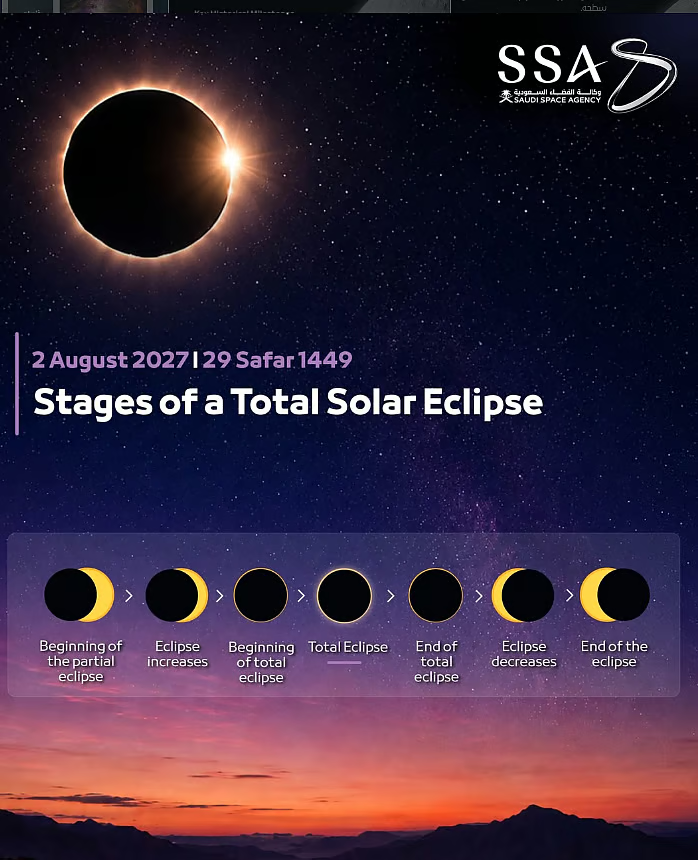
Saudi Arabia: Saudi Arabia is preparing for one of the most remarkable astronomical events of the 21st century, with a rare total solar eclipse set to cross the Kingdom on Aug. 2, 2027. The phenomenon is expected to plunge parts of western and southern Saudi Arabia into darkness for almost six minutes, making it one of the longest total eclipses recorded this century.
According to the Saudi Space Agency, the eclipse will be the first total solar eclipse visible across the Kingdom in more than 75 years, attracting scientists, astronomy enthusiasts and international visitors.
Why this eclipse is unusual
A total solar eclipse occurs when the Moon passes directly between the Earth and the Sun, completely blocking sunlight for observers within a narrow path known as the path of totality.
The 2027 event is expected to last longer than most total eclipses because the Moon will appear slightly larger than usual while the Sun will appear slightly smaller from Earth, extending the period of complete darkness.
Across parts of Saudi Arabia, totality is forecast to last between five minutes and 50 seconds and approximately six minutes, offering exceptional conditions for astronomical observations, including viewing the Sun’s outer atmosphere, known as the corona.
Which parts of Saudi Arabia will experience totality?
The Moon’s shadow is expected to cross western and southern regions of the Kingdom after moving through North Africa and Egypt.
Cities expected to experience a total eclipse include:
- Jeddah
- Mecca
- Taif
- Al Baha
- Khamis Mushait
- Jazan
- Najran
Numerous towns along the eclipse corridor are also expected to witness complete darkness.
Meanwhile, central, eastern and northern regions—including Riyadh—will experience a partial solar eclipse, with the amount of solar coverage varying by location.
Expected eclipse timings
The eclipse is expected to unfold over approximately three hours.
Current projections indicate:
- Partial eclipse begins around 11:41 a.m. (AST) in the region.
- Totality across Saudi Arabia is expected between approximately 1:21 p.m. and 1:44 p.m.
- The event concludes at roughly 3 p.m.
Local timings will differ slightly depending on the viewing location.
Best places to watch
Astronomers recommend positioning as close as possible to the center of the eclipse path to maximize the duration of totality.
Among the most favorable viewing locations are:
Jeddah and the Red Sea coast: Easily accessible with extensive tourism infrastructure, these locations are expected to experience nearly six minutes of darkness.
Abha and Khamis Mushait: Higher elevations could provide clearer viewing conditions while offering some of the longest eclipse durations within Saudi Arabia.
Taif and Al Baha: Mountainous terrain and cooler temperatures make these cities attractive alternatives for visitors.
Open desert areas: Wide horizons and minimal light pollution are expected to provide ideal conditions for photography and observation.
Public viewing events organized by astronomy organizations, including the Jeddah Astronomy Society, are also anticipated closer to the event date.
What will the UAE experience?
Residents across the UAE will also be able to witness the eclipse, although it will not reach totality.
Current projections indicate that Dubai will experience a partial solar eclipse, with the Moon covering roughly 53% of the Sun during the event. Western and southern parts of the UAE could see slightly greater coverage, approaching 60% in some areas.
Unlike locations within Saudi Arabia’s path of totality, the UAE will not experience complete darkness, visible stars during the day or the solar corona.
Viewing safety remains essential
Astronomical authorities continue to emphasize that observing the Sun without proper eye protection can cause permanent eye damage.
Anyone planning to watch the eclipse should:
- Wear ISO 12312-2 certified solar eclipse glasses.
- Never rely on ordinary sunglasses for protection.
- Use approved solar filters for telescopes, binoculars and cameras.
- Remove eclipse glasses only during totality—and only if observing from within the path of totality. Eye protection should be worn again immediately once sunlight reappears.
A major event for science and tourism
Beyond its scientific importance, the eclipse is expected to generate significant tourism across western Saudi Arabia as visitors travel to experience one of the longest total solar eclipses of the century.
For Gulf residents, particularly those in the UAE, the event offers a rare opportunity to witness a major celestial phenomenon close to home. Travelers hoping to experience complete darkness will need to position themselves within Saudi Arabia’s path of totality, while those remaining in the UAE can still observe a substantial partial eclipse using certified viewing equipment.
For updates closer to the event, residents can follow the Saudi Space Agency, the Jeddah Astronomy Society, and NASA’s Eclipse Explorer for official viewing maps, timing updates and safety guidance.