

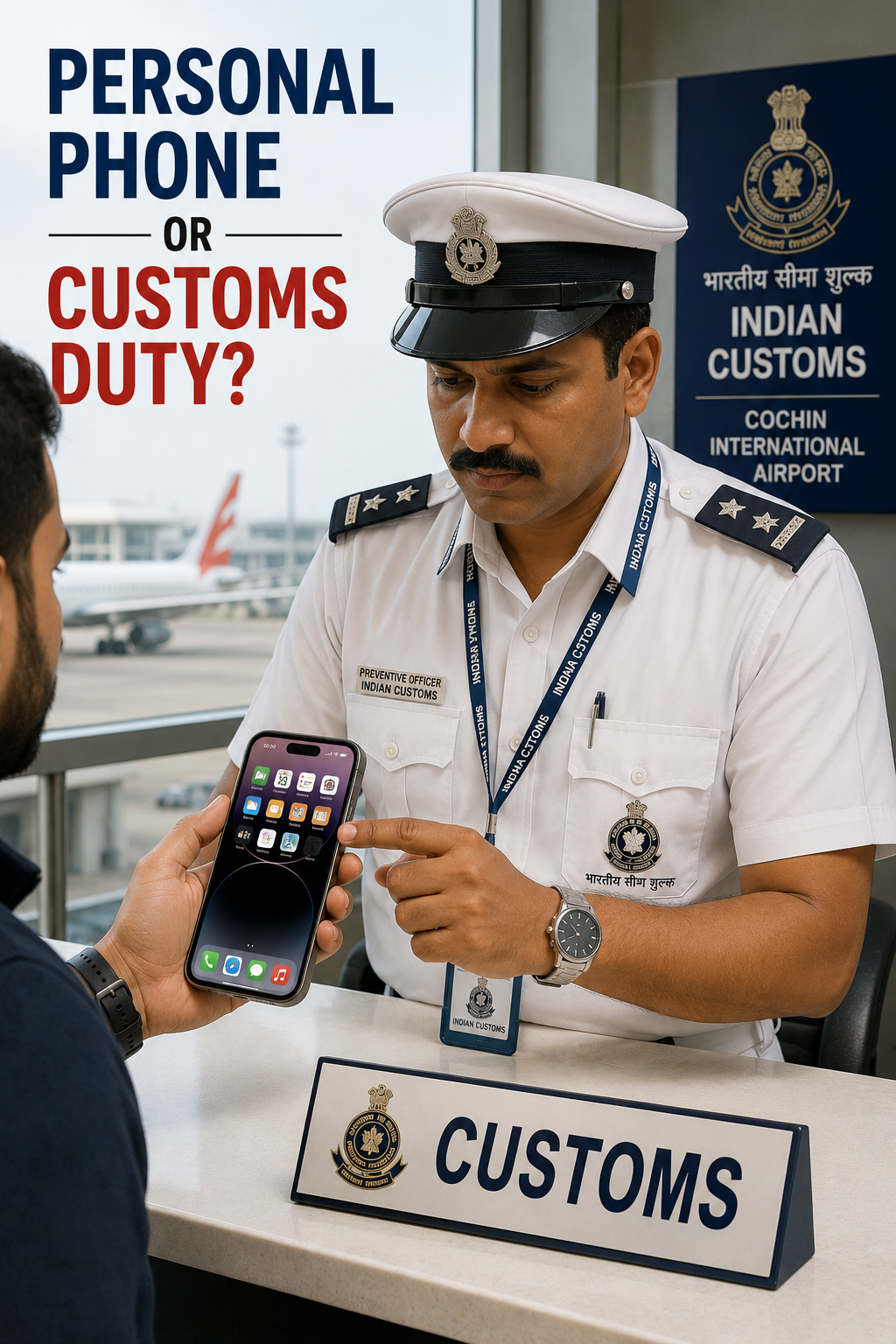
For thousands of Gulf expatriates, a trip home to Kerala is a long-awaited reunion with family. After months of work in the UAE, returning residents look forward to a few weeks with their loved ones. Yet, for some travellers, the arrival at the airport can bring an unexpected source of anxiety: a customs query over a mobile phone they have brought with them.
A recent complaint involving an expatriate arriving from Dubai at Cochin International Airport raises an important question. The passenger was reportedly stopped by Customs officials and asked to pay duty on a new iPhone that he was already using, with a SIM card inserted. The circumstances of the incident, including the precise grounds for the demand, have not been independently established. It would therefore be premature to conclude that the officials acted wrongly. Nevertheless, the complaint deserves closer examination because it touches on a wider concern among expatriates: how consistently and fairly are India’s baggage rules being applied?
The issue is not whether Customs officials should enforce the law. They must. The question is whether enforcement takes sufficient account of the difference between a personal possession and goods being brought into the country for commercial purposes.
What do the rules say?
India introduced new Baggage Rules in February 2026, replacing the 2016 framework. Under the new rules, eligible Indian residents and tourists of Indian origin arriving by air or sea can generally claim a duty-free allowance of up to ₹75,000 for eligible articles. Different limits and conditions apply to other categories of travellers, and certain goods are excluded from the general allowance.
A new laptop also has a specific exemption for eligible passengers aged 18 and above. There is no equivalent blanket exemption specifically for a newly purchased iPhone.
These distinctions matter. A passenger cannot assume that every item worth less than ₹75,000 is automatically exempt, nor does an item become dutiable simply because its value exceeds that amount. The applicable category of goods, the passenger’s eligibility and the relevant baggage provisions all need to be considered.
Personal effects intended for use during travel are treated differently from goods imported for commercial purposes. However, the distinction between a personal possession and a newly purchased article can sometimes become contentious, particularly when the item is expensive and appears almost new.
A phone that has been used for months as the passenger’s regular device presents a different factual situation from several newly purchased phones being carried in their original packaging. But a recently purchased phone can also be intended for genuine personal use. Its condition alone cannot settle every question.
Nor does inserting a SIM card automatically exempt a device from customs duty. It may support a claim that the phone is being used personally, but it is not conclusive proof of entitlement to an exemption.
Seizures are not the same as personal use
Indian Customs authorities have reported significant seizures of electronic devices at airports, including in Kerala. In August 2024, a report by Onmanorama described a seizure at Cochin International Airport involving gold and numerous electronic devices, including dozens of iPhones, brought by passengers arriving from Sharjah. The report put the value of the gold and electronic goods at approximately ₹1 crore.
In December 2023, the Press Information Bureau reported that Customs officials had intercepted 25 major smuggling cases across Kerala’s four international airports during the first fortnight of that month. The seizures included 19 iPhones, alongside gold and other items.
Such cases demonstrate why airport checks are necessary. Multiple high-value devices, particularly when carried in circumstances suggesting resale or undeclared importation, may reasonably attract closer scrutiny.
But there is a crucial distinction between a suspected smuggling operation involving numerous devices and a passenger carrying one phone for personal use. The existence of serious smuggling cases should not become a reason to treat every traveller with an expensive electronic device as a potential offender.
The facts of each case must determine the response.
The problem is not enforcement, but how it is experienced
For Gulf expatriates, a smartphone is rarely a luxury in the conventional sense. It is an essential tool for work, banking, communication, travel and keeping in touch with family across borders. Many purchase their devices in the UAE, where they live and work, and naturally carry them when travelling to India.
A passenger who is already using a phone may reasonably expect officials to consider that circumstance before deciding whether duty is payable. If a duty demand is made, the traveller should be able to understand the legal basis for it, how the value was assessed and whether any applicable exemption has been considered.
If the officials in the Cochin case followed the relevant rules and explained their decision properly, the demand may have been lawful. If, however, the passenger’s circumstances were not adequately considered, the incident would raise legitimate questions about the quality of enforcement.
Without the full facts, neither conclusion is justified.
This is precisely why transparency matters. Customs officials should explain the grounds for a duty assessment in clear terms. Passengers should be able to obtain the relevant documentation and challenge a decision through the established procedures if they believe it is incorrect.
A lawful inspection need not be an intimidating encounter. Firm enforcement and courteous treatment are entirely compatible.
A little clarity could prevent a great deal of resentment
The authorities could help reduce confusion by publishing straightforward guidance specifically addressing mobile phones and other personal electronics. Such guidance should explain the difference between a device already owned and regularly used by a passenger, a newly purchased device intended for personal use, and multiple devices that may attract scrutiny as potential commercial imports.
Airport signage and official online guidance should also make clear what documents travellers may need, when they should declare goods, how duty is assessed and where they can seek clarification.
Travellers, for their part, should retain purchase receipts where available, familiarise themselves with the current baggage rules and ask for a written assessment if Customs raises a duty demand. Carrying a phone in use should not be treated as an automatic guarantee of exemption, just as carrying a new phone should not, by itself, settle the question against the passenger.
The legal position must be established on the facts, not on assumptions.
Returning home should not become an ordeal
India has a legitimate interest in preventing smuggling, protecting revenue and ensuring that imported goods comply with the law. Customs officers have an important responsibility in this regard. No reasonable traveller would argue otherwise.
But the legitimacy of that responsibility also depends on how it is exercised. Rules that are difficult to understand, or decisions that are not adequately explained, can turn routine airport checks into sources of frustration and distrust.
Gulf expatriates contribute to the Indian economy through remittances, investment, family support and years of work abroad. They are not entitled to disregard customs regulations, nor should they expect preferential treatment. They are, however, entitled to clear rules, consistent decisions and respectful treatment.
The reported Cochin incident should therefore prompt a broader question: can India’s Customs system protect the country’s interests while making the rules easier for ordinary travellers to understand and follow?
The answer should be yes.
The measure of an effective Customs system is not simply how many goods it intercepts. It also depends on whether it can distinguish suspicion from evidence, enforce the law proportionately, and treat every passenger with dignity. For an expatriate returning home with a phone in hand, that distinction can make all the difference.