

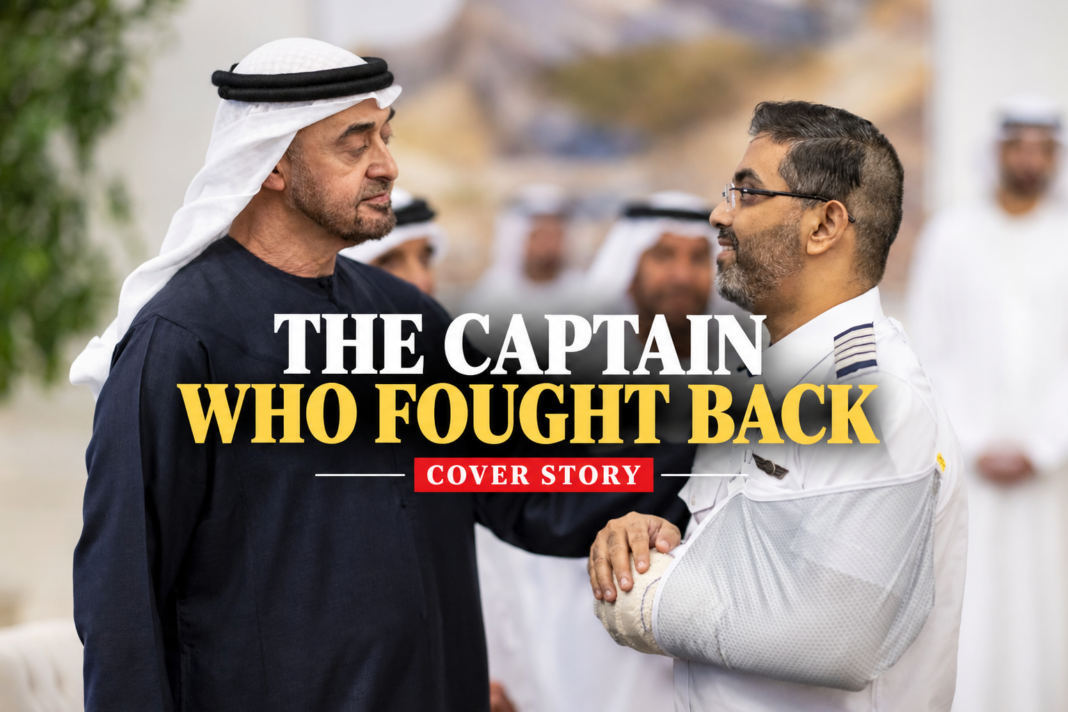
THE scars on the back of Captain Smit Machchhar’s head were still visible when UAE President His Highness Sheikh Mohamed bin Zayed Al Nahyan received him on Tuesday.
For the Indian pilot, it was a public moment of recognition after a month that began with a fight for survival thousands of feet above the Saudi desert.
On September 30, Machchhar was at the controls of flydubai flight FZ1073, travelling from Dubai to Tel Aviv, when his co-pilot attacked him with a cockpit crash axe. The aircraft went into a steep descent, putting the 174 people on board in danger.
The captain suffered serious head injuries. Crew members and passengers intervened, and the aircraft eventually landed safely in Tabuk, Saudi Arabia.
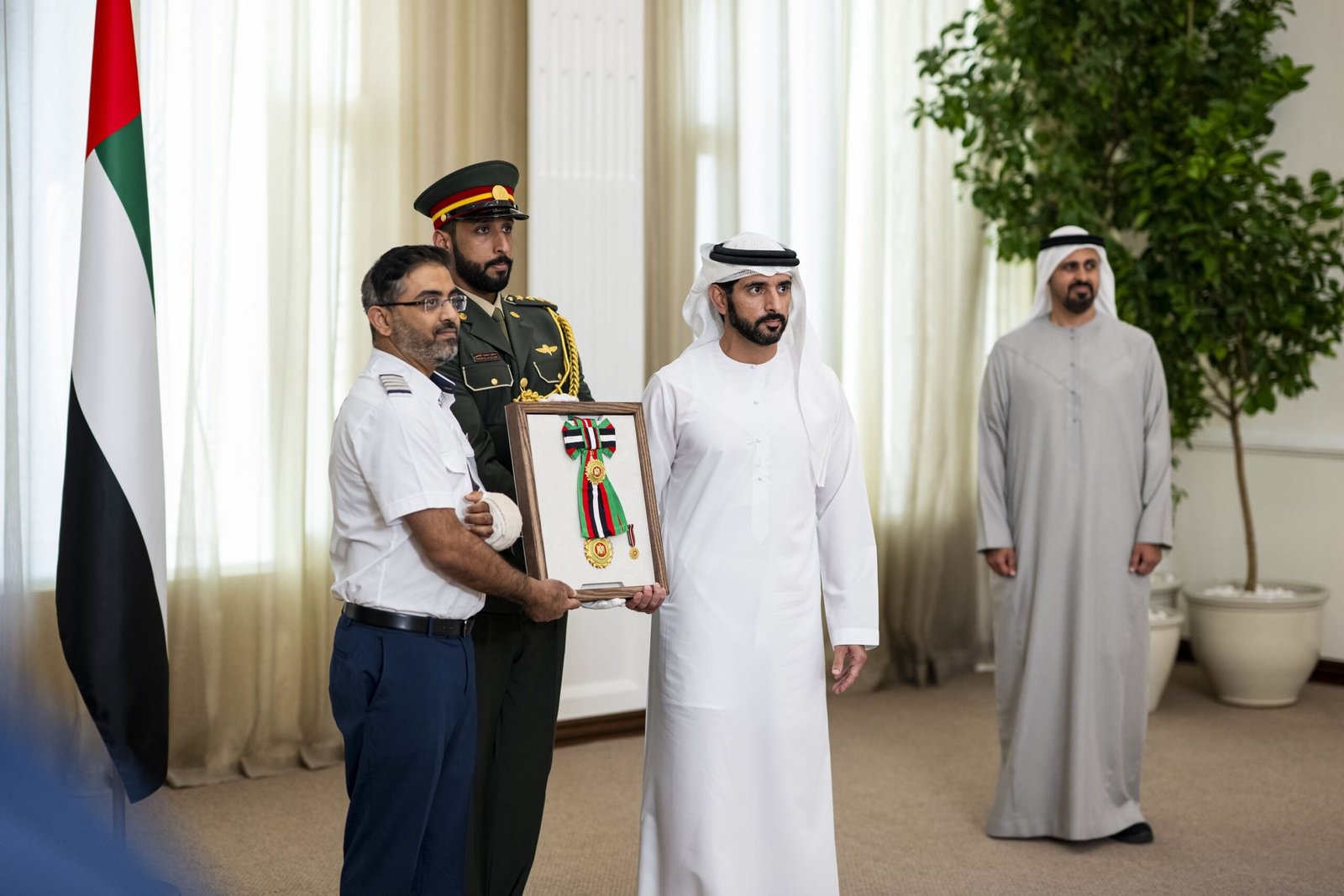
On October 27, Sheikh Mohamed conferred the First Class Order of Zayed II on Machchhar and fellow members of the flight crew in recognition of their courage and professionalism. His Highness Sheikh Hamdan bin Mohammed bin Rashid Al Maktoum, Crown Prince of Dubai, Deputy Prime Minister and Minister of Defence, presented the decorations (pictured above). His Highness Sheikh Mohammed bin Rashid Al Maktoum, Vice President, Prime Minister and Ruler of Dubai, also attended.
The honour marked the most visible moment yet in a month of tributes, official statements and competing accounts of the incident. But behind the photographs and headlines is a pilot still recovering from his injuries, and a flight whose safe landing depended on the actions of several people
The fight inside the cockpit
The flight had been underway for about two hours when the attack began.
According to UAE prosecutors and Machchhar’s own account to The National, the co-pilot struck him repeatedly on the head with the crash axe. A resolution later introduced in the US House of Representatives states that the aircraft lost more than 14,000 feet in under 30 seconds. The National has reported a total descent of about 17,000 feet.
Machchhar initially thought the first blow had come from part of the aircraft structure falling on him. He realised he was under attack only as further blows followed.
Despite his injuries, he managed to free himself and release the cockpit door. Once it opened, passengers and crew helped overpower the attacker.
According to UAE prosecutors, the captain and first officer rostered for the return flight, who were travelling on board, took control of the aircraft and landed it safely in Tabuk. Everyone on board survived.
On October 3, the UAE Attorney General, Hamad Saif Al Shamsi, said investigations had found that the co-pilot attempted to carry out a terrorist act. On October 9, a further statement said he had planned to crash the aircraft into the passenger terminal at Tel Aviv’s Ben Gurion Airport to cause the greatest possible loss of life.
That statement said signs of his radicalisation dated back to 2017, when he was studying in Australia, and that he had used two earlier flights to Tel Aviv to familiarise himself with the route. Prosecutors described him as a 29-year-old Omani national. He has been detained in the UAE.
Prosecutors also said he had met the airline’s professional and security requirements, and that none of those checks revealed any sign of extremist views. The allegations remain subject to the criminal process.
The moment he thought of his children
On October 17, The National published an exclusive interview with Machchhar, conducted by its editor-in-chief, Mina Al-Oraibi, at Zayed Military Hospital in Abu Dhabi.
It offered the clearest account yet of the captain’s experience, from the first blow in the cockpit to his recovery in the UAE.
Machchhar said he had met the co-pilot for the first time that morning and noticed nothing unusual during the flight.
He spoke of thinking about his son and daughter during the ordeal. The most frightening moment, he said, was realising the aircraft was going down.
His injuries required surgery in Saudi Arabia before he was transferred to Abu Dhabi for further treatment.
In the interview, he recalled being told that the UAE President had ordered his return to the country. Hearing that, he said, was when he smiled for the first time.
The words carried a meaning beyond the relief of reaching another hospital. Machchhar had been injured while doing a job that required him to protect everyone on board. He was now being brought back to the place he regarded as home.
He told The National that he considered the UAE his home, a sentiment that resonated with many Indians living and working in the country.
Who saved the aircraft?
The events inside the cockpit also produced competing accounts of who brought the aircraft under control.
Israeli passenger Yaniv Hayun, a plumber, received wide attention after describing how he helped pull the attacker from the cockpit and then pulled back the control column to level the aircraft. Israel’s President Isaac Herzog has said Hayun helped stabilise the controls during those moments.
Some social media posts went further and portrayed him as the man who landed the plane. That is not what happened. The aircraft was flown to Tabuk and landed by qualified flydubai pilots.
Machchhar, in his interview, credited the people on board collectively rather than turning the incident into a story about one individual.
The distinction matters. Passengers who act in an emergency can play a crucial role, and several clearly did. But recovering and landing a passenger aircraft requires trained flight crew.
The UAE’s decision to honour the crew alongside Machchhar reflected that collective effort.
Recognition from the UAE and beyond
The presidential honour capped a month in which Machchhar’s actions drew attention in India, Israel and the United States.
Indian Prime Minister Narendra Modi spoke to the captain by video call and praised his courage. Several Indian political figures and organisations have since called for him to receive the Ashoka Chakra.
In Israel, President Herzog wrote to Machchhar and said he planned to present him with the Presidential Award for Civilian Heroism after his recovery. Herzog has already presented that award to six Israeli civilians who acted on the flight. Prime Minister Benjamin Netanyahu has invited Machchhar, together with Modi, to light a torch at Israel’s next Independence Day ceremony.
In Washington, a bipartisan resolution introduced in the House of Representatives on October 5 sought to honour the captain, the crew and the passengers.
Gujarat, where his family has roots, announced the Vishisht Gujarat Garima Award for him, while Indian pharmaceutical company Mankind Pharma pledged Rs 1 crore.
The honours have placed the pilot at the centre of a story that has travelled far beyond the aviation industry. Yet the circumstances of the incident, and the work of those who helped bring the aircraft down safely, matter more than the number of tributes.
When a rescue becomes a political story
In India, the incident quickly entered the country’s polarised political debate.
Machchhar’s account that he recited the Hanuman Chalisa during the ordeal prompted devotional tributes and celebratory posts. Some supporters presented his survival as a story of faith as well as professional courage.
Other commentators used the alleged motivation of the co-pilot to advance broader arguments about extremism and identity. At the same time, misleading posts circulated about the suspect’s background and the roles played by people on board.
Fact-checkers also exposed fabricated material, including a deepfake video falsely attributed to the BBC that claimed an Indian passenger was behind the attack. The BBC confirmed it never broadcast such a report.
The competing narratives show how quickly a serious aviation incident can become a vehicle for political arguments. The danger is that speculation obscures the facts: a captain was seriously injured, people on board intervened, and trained pilots brought the aircraft safely to the ground.
For Machchhar, the immediate challenge is more personal. He must recover from his injuries and return to ordinary life after an experience that could have ended very differently.
The wider aviation questions
The incident has also put the spotlight on a less visible aspect of aviation safety: the risk posed by someone already trusted to operate an aircraft.
According to prosecutors, the co-pilot passed the required professional and security checks. That raises difficult questions about the limits of existing screening and whether warning signs can be identified before a person enters the cockpit.
The presence of a crash axe on the flight deck has also attracted attention. Such equipment is carried for emergencies, but its use in an attack has prompted questions about cockpit security and the procedures meant to protect flight crews.
Any changes will depend on the findings of the investigation and the assessment of aviation authorities. The incident should not, by itself, be taken as proof that existing procedures are inadequate everywhere.
There was also a substantial operational response. Flydubai’s services to Tel Aviv were suspended after the incident. Between October 2 and 5, the UAE’s General Civil Aviation Authority said 37 flights operated by Israeli carriers and Etihad Airways carried 7,479 passengers from Dubai to Tel Aviv.
Those measures dealt with the immediate disruption. The longer task is to establish exactly how the attack happened and what, if anything, needs to change to reduce the risk of it happening again.
A life beyond the headlines
Machchhar, who grew up in Mumbai, joined flydubai in 2022 after 11 years with SpiceJet. He has logged about 9,750 flying hours on the Boeing 737 and lives in Dubai with his wife and their two children.
Those details offer a glimpse of the life he is trying to return to. For his family, the incident was not a distant aviation story but a frightening period of uncertainty over whether he would survive.
The medals, invitations and tributes have recognised what he and his fellow crew members did. They have also brought the captain’s experience into the public eye while he is still recovering.
The significance of the flight’s safe landing lies not in any single heroic gesture but in the fact that, under extraordinary pressure, people on board acted and the aircraft reached the ground without loss of life.
For Machchhar, the next chapter will be quieter than the one that brought him before the UAE’s leadership. It will involve recovery, family and a gradual return to a life interrupted in the cockpit over the Saudi desert.
The world may remember September 30 as the day a pilot fought to survive an attack in mid-air. For the captain and his family, it will also be the day after which ordinary life had to begin again.
