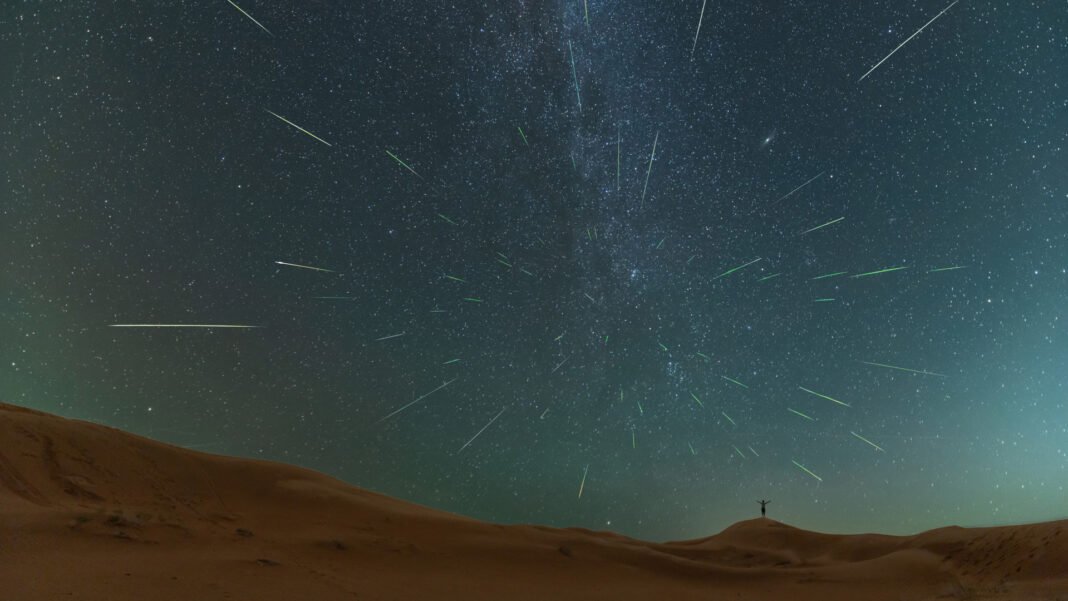
Dubai, United Arab Emirates: Residents across the UAE could witness one of the year’s most anticipated celestial events as the Perseid meteor shower reaches its peak during the night of Aug. 12 into the early hours of Aug. 13.
Astronomers say viewing conditions are expected to be especially favorable this year because the peak coincides with a new moon, reducing moonlight and allowing even faint meteors to stand out against darker skies. Under ideal conditions, observers may see up to 100 meteors per hour.
The annual Perseid meteor shower occurs when Earth passes through debris left behind by Comet Swift-Tuttle. As tiny particles enter Earth’s atmosphere at high speeds, they burn up and create the bright streaks commonly known as shooting stars.
Although the shower remains active from mid-July through late August, astronomers say the strongest activity is expected after midnight on Aug. 12 and before sunrise on Aug. 13, when the constellation Perseus rises higher above the horizon.
This year’s display is expected to benefit from some of the darkest viewing conditions in recent years because of the new moon, making it easier to spot dimmer meteors that would normally be obscured by moonlight.
Skywatchers may also have an opportunity to observe several other celestial objects during the same period. Saturn will be visible for much of the night, while Mars is expected to rise before dawn. Uranus and Neptune may also be observable with telescopes under favorable conditions.
In addition, Comet 10P/Tempel 2 is expected to be visible through binoculars or telescopes from sufficiently dark locations following its recent approach toward the sun.
For the best viewing experience, astronomy enthusiasts are encouraged to travel away from city lights, allow their eyes around 20 to 30 minutes to adjust to the darkness, and avoid looking at bright phone screens, which can reduce night vision.
No telescope is required to enjoy the meteor shower, although binoculars and telescopes may enhance views of planets and other celestial objects visible throughout the night.
The Dubai Astronomy Group is organizing a public observation event at Al Khatim Desert in Abu Dhabi on the night of Aug. 12. The overnight program will include guided stargazing, telescope observations of Saturn and Mars, constellation sessions, and opportunities to search for Comet 10P/Tempel 2.
Registration details and event information are available through the Dubai Astronomy Group at https://dubaiastronomy.com, while readers interested in learning more about the annual Perseid meteor shower can explore background information from NASA.
Photography enthusiasts hoping to capture the event are advised to use a tripod, wide-angle lens and long-exposure settings while manually focusing on a bright star or infinity. Extra batteries are also recommended, as long-exposure photography can quickly drain camera power.
With clear weather and exceptionally dark skies forecast during the peak, this year’s Perseid meteor shower is expected to offer one of the best opportunities in recent years for UAE residents to experience one of nature’s most spectacular nighttime displays.