
A new train service is rarely just about movement from one city to another. In the UAE, Etihad Rail’s first passenger line, connecting Abu Dhabi and Fujairah, is already shaping up as something bigger: a test of how passengers from many backgrounds adapt to one shared travel culture.
Travellers from across the country’s diverse communities have been quick to book seats, and demand has been strong from the start. In a country where people come from dozens of nationalities and bring different habits of travel with them, the railway is doing more than opening a new route. It is introducing a new code of conduct for a new kind of public space.
A rulebook for every passenger
Etihad Rail has set out clear passenger rules, with fines for violations ranging from Dh200 to Dh10,000 depending on the offence. The message is simple: safety, discipline and respect for fellow travellers are not optional.
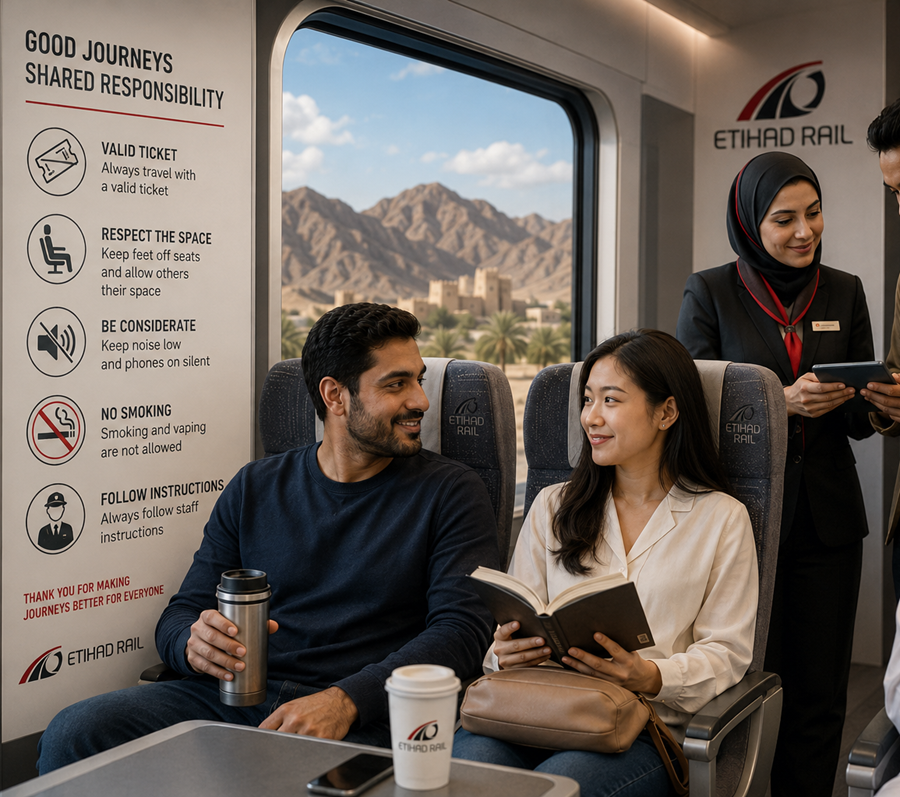
Minor infractions include travelling without a valid ticket, using a ticket issued in someone else’s name, placing feet on seats, occupying a reserved seat without permission, sitting in the wrong class or refusing to leave the platform when instructed. These can result in a Dh200 fine.
More serious offences, such as smoking or vaping, disruptive conduct, spitting, blocking train doors, or boarding and alighting while the train is moving, can lead to a Dh500 fine. At the top end are acts that endanger passengers and staff, including tampering with emergency systems or throwing objects from a moving train. These can carry fines of up to Dh10,000, and in some cases the matter may be referred to the Public Prosecution.
None of this is unusual by UAE standards. Dubai Metro and buses have long operated with similar expectations: no eating or drinking in restricted areas, no fare evasion, and clear rules for public behaviour. What is different now is that these rules apply to longer inter-emirate journeys, where passengers may be tempted to relax informal habits they have picked up elsewhere.
When travel habits collide
That is where the real adjustment begins. Every country develops its own rail culture, and not all of those habits travel well.
On crowded and overburdened railway systems, passengers often become used to flexibility: stretching out across seats when space allows, speaking loudly, or treating the train as a place where rules can be negotiated rather than followed. Those habits may be understandable in a different environment, but they do not fit a system built on order, punctuality and enforcement.
The UAE’s new railway has been designed for a different standard from the start. It is modern, structured and expected to run on clear rules. Behaviours that may be overlooked in some places are treated seriously here because the emphasis is on safety, comfort and consistency for everyone on board.
That applies to passengers from every background. Loud phone calls, for example, may seem harmless in one setting but can quickly become disruptive in a quieter carriage. Bringing food is not a problem in itself, but travellers are expected to be considerate of strong smells and shared space. The point is not to shame passengers for where they come from. It is to make clear that a new system requires a new level of awareness.
What disciplined travel looks like
If there is a model for this kind of passenger discipline, it can be found in places where rules and public behaviour have long worked together. Japan’s Shinkansen is known for its quiet carriages, punctual service and passengers who instinctively respect the space around them. Singapore’s MRT has also built a strong culture of compliance, supported by clear rules and consistent enforcement. In both cases, good behaviour became normal not because passengers were constantly warned, but because the system made expectations clear and predictable.
That is the challenge for Etihad Rail. The real success will not be measured only by how many fines are issued. It will be seen in whether passengers begin to follow the rules naturally, without needing reminders at every step.
The UAE advantage
The UAE has one important advantage: its residents are already used to adjusting to a shared civic code. People here regularly adapt to traffic rules, workplace standards and public behaviour norms that may be different from those in their home countries. The railway is simply the latest place where that adjustment is being tested.
Seen that way, the fine schedule is not just about punishment. It is about setting the tone early and helping passengers build habits that will define the railway for years to come. In time, what begins as enforcement may become etiquette.
So whether the last long-distance train you took was in India, Sri Lanka, the Philippines, Europe or anywhere else, the message is the same: keep your ticket ready, keep your feet off the seat, follow staff instructions and respect the shared space. On Etihad Rail, good manners are not only appreciated. They are part of the journey.