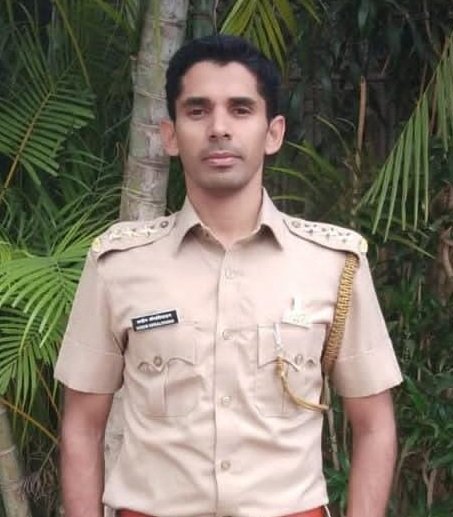
Aseem Koraliyadan was a customs inspector at Coimbatore airport and, for over a decade before that, a footballer whose career took him well beyond Kerala. He died this week on a Coimbatore road, struck by a truck as he was turning his scooter at a junction, according to the police account. His family sources say it was a hit-and-run. A driver, identified as Dinesh S, has been detained, but it remains unclear what charges, if any, have been filed against him, and journalists in Coimbatore have begun asking questions of their own about the circumstances of the accident. That gap, between what the family is saying and what the police are calling it, deserves as much attention as the accident itself.
The details of Aseem’s career are not in dispute. He played for Vasco Goa, Salgaocar, Mumbai FC, Mahindra United, East Bengal and Josco FC, appearing across nine seasons of the I-League as well as in the Federation Cup, the Durand Cup and the IFA Shield. He was the Governors Cup’s top scorer in 2006-2007, represented Kerala state’s junior team, and later played Santosh Trophy football for Maharashtra and, in 2013, for Tamil Nadu.
When he moved into customs work, colleagues describe an officer with a clean record, who had cleared his departmental examinations and was regarded as one of the more capable hands at a difficult posting.
It is worth stating plainly what that posting involved. Coimbatore’s airport has, in recent years, featured repeatedly in customs seizure reports: gold paste and foreign cigarettes intercepted off flights from the Gulf, hydroponic cannabis trafficked in from Bangkok, a multi crore gold smuggling case involving foreign couriers that is still before the courts. This is the environment in which Aseem worked. It does not, on its own, establish anything about how he died. But it is the context in which a case like this, involving a customs inspector, ought to be examined and properly explained, and it is reason enough for the investigation to be conducted with more than ordinary care.
There is also a wider point that bears making, one that goes beyond this single case. Aseem was Kerala’s, by birth, by upbringing, and by the pride Malappuram took in his career. But in the years that mattered most to his working life, it was Tamil Nadu he represented on the football field and Tamil Nadu he served as an officer of the Union government. He died on a Tamil Nadu road. That ought to place a particular obligation on the state’s institutions, not because his origin in Kerala is incidental, but because a state has a duty toward those who serve it, wherever they were born.
Tamil Nadu’s Chief Minister, Mr Vijay, built a public career, before he built a political one, playing characters who confronted precisely the kind of impunity this case now risks becoming an example of. That association carries no legal weight, and this piece does not suggest it should. But it does raise a fair expectation. Road deaths in India where the family’s account and the police’s account diverge have a well documented tendency to lose momentum once the initial coverage fades, particularly when the accused or those connected to the case have influence the victim’s family does not. Nothing here suggests that is happening in Aseem’s case. It is precisely to ensure that it does not that the investigation now needs to be visible, adequately resourced and allowed to run to a conclusion the public can see for itself.
What is being asked for is not extraordinary. It is a transparent inquiry into how Aseem Koraliyadan died, and a clear public answer on what, if anything, Dinesh is being charged with, conducted by the book, reported on as it proceeds, and not permitted to quietly close without an accounting. If the facts, once established, show this to be exactly what the police are currently calling it, that finding will carry more weight for having been arrived at and explained properly.
Sustained public attention has, in other cases, been enough to keep an investigation from quietly stalling, and there is no reason this one should be an exception. That attention need not fade simply because the news cycle moves on.
Media will be watching how Tamil Nadu handles the death of a man who spent his working life in its service. So, in all likelihood, will Tamil Nadu.
*This piece was updated on 14th August to reflect the Coimbatore police’s account of the accident, which differs from what was initially reported-editor