
MUSCAT, Oman: Oman has formally ratified its railway agreement with the UAE, clearing another regulatory milestone for the $2.5 billion Hafeet Rail project as construction continues on the planned cross-border network.
Oman’s Sultan Haitham bin Tarik issued Royal Decree No. 75/2026, approving the bilateral railway agreement signed by the two countries on June 21. The decree took effect Sept. 3.
The agreement provides the legal framework for developing the railway connection between Oman and the UAE, strengthening the foundation for a project expected to link major industrial, logistics and population centers in both countries.
238-kilometer link between Oman and UAE
Hafeet Rail will extend for approximately 238 kilometers, connecting Sohar in Oman with the UAE’s national railway network through Al Buraimi and Al Ain.
The project is being developed by Hafeet Rail, a joint venture involving Etihad Rail, Oman Rail and Mubadala Investment Company.
Beyond passenger travel, the railway is intended to establish a direct freight corridor between Sohar’s industrial and port facilities and the UAE’s wider logistics network.
The connection could provide businesses with another route for moving commodities, industrial materials and finished products between ports, production centers and regional markets.
Sohar to Abu Dhabi in about 100 minutes
Passenger trains are planned to operate at speeds of up to 200 kph, with each train designed to accommodate between 350 and 400 passengers.
The planned journey from Sohar to Abu Dhabi is expected to take about 100 minutes, while travel between Sohar and Al Ain could take approximately 47 minutes once services begin.
The project is also being designed around large-scale freight operations.
Freight trains are expected to reach speeds of up to 120 kph, with individual trains capable of transporting more than 15,000 tonnes of cargo, equivalent to roughly 270 standard containers.
Industries expected to benefit include mining, steel, petrochemicals, agriculture, food, retail and e-commerce.
Construction reaches 40%
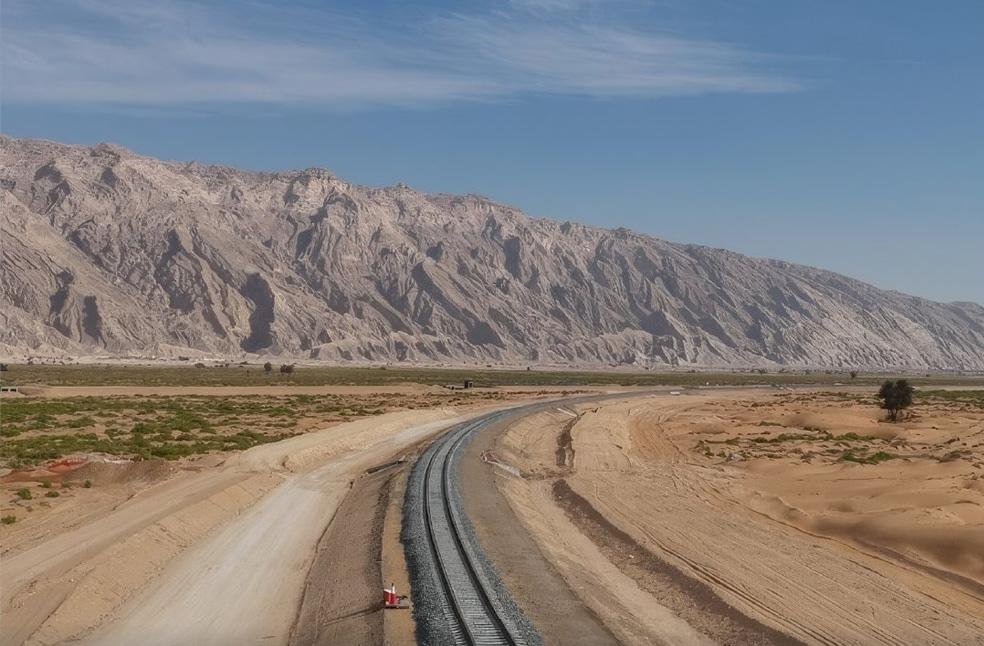
Construction on the railway had reached 40% by April, with works underway across Al Ain, Al Buraimi, Sohar and Wadi Al Jizzi.
The route presents significant engineering challenges, crossing developed urban areas, industrial zones and mountainous terrain. Construction includes earthworks, bridges, tunnels and infrastructure designed to protect the railway from flooding.
More than 27 million cubic meters of earthworks had been completed by the April milestone.
The project is expected to include around 2.5 kilometers of tunnels, in addition to numerous bridges and other major structures.
$1.5 billion financing secured
The overall project is valued at about $2.5 billion, with approximately $1.5 billion in financing secured from a consortium of regional and international banks.
The investment forms part of broader efforts by the UAE and Oman to strengthen cross-border transport infrastructure and integrate their logistics networks.
For businesses, the connection could improve access between Sohar Port, industrial areas in Oman and the UAE’s national rail network.
First direct rail connection between two GCC states
Hafeet Rail is positioned as a landmark step in Gulf railway integration and is expected to create a direct rail connection between two GCC countries.
The project took a major step toward implementation during Sultan Haitham’s visit to the UAE in April 2024, when agreements involving the project’s shareholders were signed, construction contracts were awarded and the venture adopted the Hafeet Rail name.
The name references Jebel Hafeet, the mountain near the UAE-Oman border and an important geographical feature along the railway corridor.
The latest ratification brings the project another step closer to its eventual operation, with construction continuing across both sides of the border. As work progresses, the railway is expected to play a growing role in passenger mobility, cross-border trade and the wider integration of Gulf transport networks.