
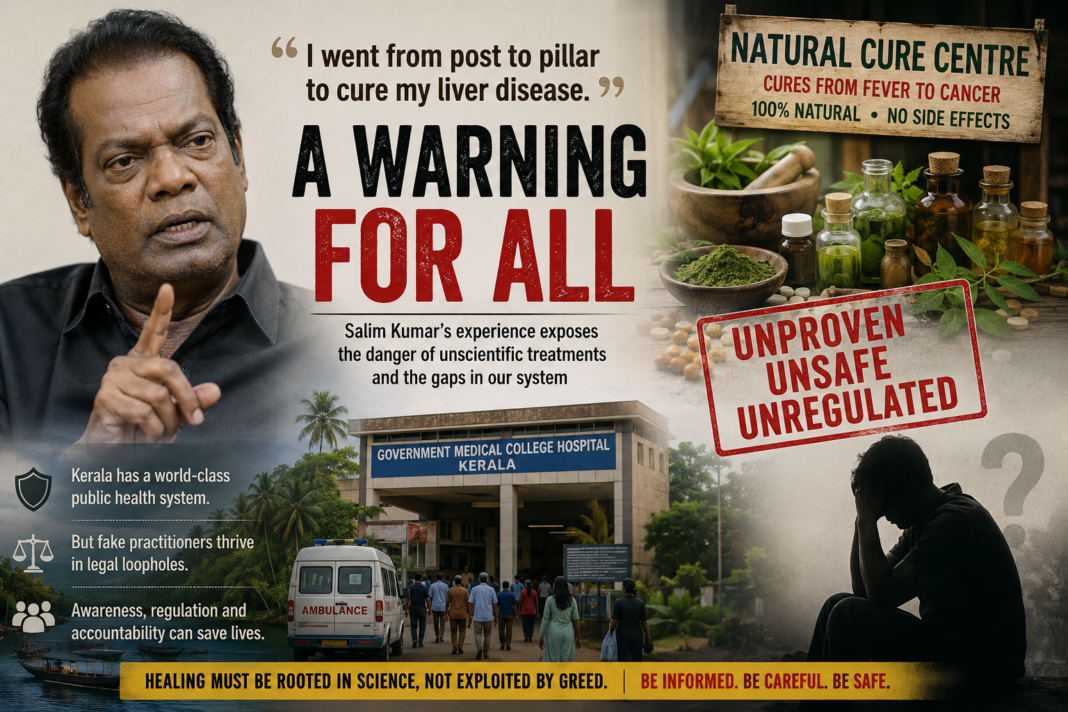
THE endless stream of videos that passes through our mobile phone screens rarely leaves a lasting impression. Yet one recently circulated speech by Malayalam actor and National Award winner Salim Kumar deserves serious attention. His words are not those of a medical expert or public health activist. They are the testimony of a patient who learned a painful lesson through personal experience.
The issue he raises is not new to Kerala. In fact, it is one of the most debated yet inadequately addressed public health concerns in the state: the unchecked growth of unqualified medical practitioners operating under the attractive labels of “natural cure,” “alternative healing,” and “back to nature” therapies.
In the video, Salim Kumar speaks candidly about his struggle with liver disease. Like many patients facing a serious diagnosis, he searched for remedies wherever hope seemed available. When conventional treatment offers limited options, it is only natural for patients and their families to seek alternatives. Fear, uncertainty, and the desire for recovery often drive people toward promises of miracle cures.
Salim Kumar was no exception. According to his own account, he explored various treatments in his quest for healing. Looking back, he concluded that some of those choices contributed to the deterioration of his condition. His warning is therefore not theoretical. It comes from lived experience.
Kerala today has multiple recognised systems of medicine. Modern medicine, Ayurveda, Homoeopathy, Siddha, and Unani all operate within regulatory frameworks and established educational systems. Patients have the freedom to choose among these recognised disciplines.
The real danger lies elsewhere.
Across the state, a growing number of self-styled healers and naturopathy centres claim to cure everything from common fever to advanced cancers. Many advertise extraordinary success rates, promise treatments rejected by mainstream medicine, and prey upon patients who have exhausted conventional options. Their claims are often supported by testimonials rather than scientific evidence.
Nature undoubtedly contains immense medicinal wealth. Many modern drugs trace their origins to plants, minerals, and other natural sources. Traditional knowledge has also contributed significantly to medical science. But every effective medicine, regardless of its origin, must undergo rigorous testing for safety and efficacy.
The fact that a substance is natural does not automatically make it beneficial. Nor does it guarantee that it can cure disease.
Yet this distinction is increasingly blurred in public discourse. The romantic appeal of “natural healing” often overshadows the basic requirement for scientific validation. Desperate patients may consume unknown substances, follow unverified regimens, and abandon evidence-based treatments in pursuit of miraculous recoveries.
What makes the situation particularly troubling is that many of these practitioners operate in a grey area. They may not belong to any recognised medical system. The ingredients of the medicines they dispense are often undisclosed. Their treatments are rarely subjected to independent testing. When complications arise, accountability becomes difficult.
The legal framework itself remains inadequate. While victims may seek legal remedies if harmed by negligent treatment, proving that a particular practice is unscientific or directly responsible for injury can be a daunting challenge. The law generally protects an individual’s freedom to choose a treatment method, but this freedom can unintentionally create space for fraudsters to flourish.
As a result, many questionable practices continue with little scrutiny.
This reality stands in sharp contrast to Kerala’s impressive public health achievements. The state has long been celebrated for health indicators comparable to those of many developed countries. Advanced medical facilities are accessible across urban and rural areas. Public hospitals, private healthcare institutions, and specialised medical centres together provide a network that remains the envy of much of India.
Unlike many Western countries where patients often face long waiting periods or prohibitive costs for specialist care, Kerala offers relatively quick access to healthcare services. This is an achievement built through decades of public investment, professional commitment, and social awareness.
Yet alongside this success exists a troubling paradox.
The most literate state in India continues to provide fertile ground for unqualified medical practitioners. Scientific literacy does not always translate into scientific thinking. Education alone does not shield people from fear, desperation, or false hope.
Salim Kumar’s message is therefore larger than his personal story. It is a reminder that illness makes all human beings vulnerable. When faced with life-threatening disease, even intelligent and informed individuals can be drawn toward promises that appear too good to ignore.
His warning should not be dismissed as merely another viral video. It should provoke a broader public conversation about regulation, patient awareness, and the responsibilities of the state. Protecting citizens from fraudulent medical claims is not an attack on traditional knowledge or alternative medicine. Rather, it is a defence of evidence, transparency, and patient safety.
Kerala can take pride in its healthcare achievements. But it must also confront the uncomfortable reality that pseudoscience and quackery continue to thrive in its midst.
The true tribute to Salim Kumar’s painful experience would be to ensure that fewer patients fall victim to the same false promises.