DUBAI: Delivery riders in the UAE cannot be compelled to work during the country’s midday summer ban, the Ministry of Human Resources and Emiratisation has clarified, as a nationwide network of more than 12,000 air-conditioned rest stations opens to help shield workers from extreme heat.
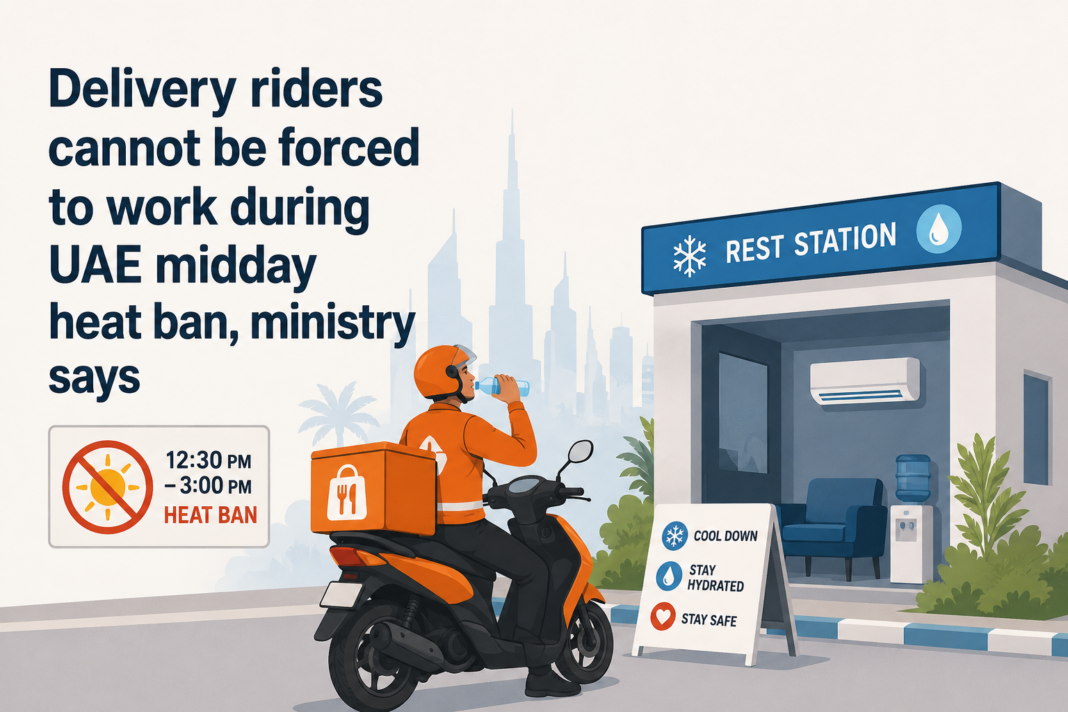
The ministry said riders may choose whether to continue working during the restricted hours from 12:30 p.m. to 3 p.m., provided the arrangement is coordinated with their employer, according to Al Bayan newspaper. The clarification addresses a gray area in the annual ban, which prohibits work under direct sunlight and in open areas but is difficult to apply uniformly to a workforce that is constantly on the move.
The midday break, now in its 22nd consecutive year, runs from June 15 to Sept. 15 and is designed to reduce the risk of heat-related illness during the hottest hours of the day, when temperatures across the Gulf routinely exceed 45 degrees Celsius.
Delivery work poses a particular challenge under the policy. Unlike construction crews, riders are not stationed at fixed sites, and many of the goods they carry, including food and medicines, require timely delivery. The ministry said the rest station network was built with this in mind, allowing riders to pull off the road and cool down at the nearest facility whenever needed, with locations accessible through interactive maps built into their delivery apps.
The stations, equipped with essential amenities, will remain open throughout the three-month heat protection period. This is the fourth consecutive year the ministry has provided rest facilities for delivery workers, in line with what it described as the country’s people-first approach to the labor market and its occupational health and safety standards.
The network was developed with public and private partners including Dubai’s Roads and Transport Authority, Abu Dhabi Mobility, economic departments across the emirates, the Emirates General Petroleum Corporation, and major delivery platforms Talabat, Deliveroo, Noon, Careem and Keeta. Restaurants, shopping centers, retail outlets and cloud kitchens have also opened their doors to riders.
Dalal Al Shehhi, assistant undersecretary for labour protection at the ministry, said when the ban was announced last month that the policy reflects the country’s focus on protecting workers and maintaining a balanced labor market that supports productivity while placing health and safety first.
In Dubai, the Roads and Transport Authority has completed maintenance on about 40 permanent rest areas for delivery riders in high-demand zones including Hessa Street, Al Khawaneej, Al Barsha, Al Satwa, Oud Metha, Al Karama and Arjan. The locations were selected using operational data and assessments of delivery demand conducted with delivery companies.
The authority has also allocated 23 temporary rest areas at bus and metro stations for the summer, a 53 percent increase from the 15 sites it operated last year. The temporary sites include Gold Souq, Al Satwa, Al Jafiliya, Al Qusais and Al Karama bus stations, and Centrepoint, Al Furjan, DMCC, BurJuman, Ibn Battuta and e& metro stations.
Ahmed Mahboob, CEO of the RTA’s Licensing Agency, said traffic safety remains the authority’s highest priority, with the rest areas intended to reduce accident risks during peak heat hours and give riders a comfortable place to wait for orders.
Riders using the bus station facilities will also receive ready-made hot meals supplied by the UAE Food Bank in cooperation with Deliveroo, a gesture of appreciation for a workforce that has become a growing part of the emirate’s daily logistics network amid rising demand for delivery services.