
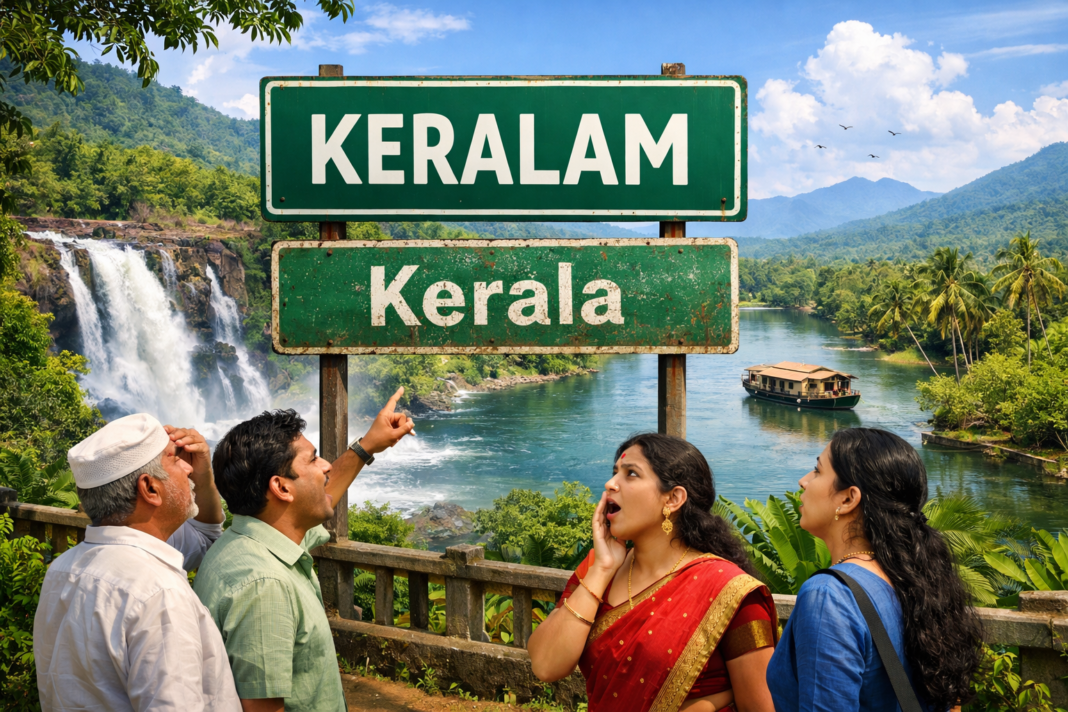
IN a country where names carry layers of history, pride, and sometimes a bit of politics, India’s “God’s Own Country” is on the cusp of a quiet but meaningful evolution: Kerala is edging closer to officially becoming Keralam.
Just yesterday, on February 24, 2026, the Union Cabinet—chaired by Prime Minister Narendra Modi—gave the green light to the long-standing proposal from the Kerala government. It’s a small tweak on paper: adding an “m” to make it match exactly how Malayalam speakers have always said it. But for the 35 million people who call this lush, spice-scented state home—and for the millions more in the diaspora—it feels like a long-overdue homecoming.
Think about it. When you speak to a Malayali in Abu Dhabi, Dubai, or anywhere from the Gulf to the US or UK, they’ve probably been saying “Keralam” all along. The name rolls off the tongue naturally in their mother tongue, rooted in ancient words that evoke land added from the sea or simply a place of coconuts. It’s poetic, fitting for a state of shimmering backwaters, whispering palms, and that unmistakable monsoon magic.
The push has been building for years. The Kerala Legislative Assembly passed unanimous resolutions in August 2023 and again in June 2024, with Chief Minister Pinarayi Vijayan leading the charge. Now, with Cabinet approval in hand, the process moves forward under Article 3 of the Constitution. The President will refer the Kerala (Alteration of Name) Bill, 2026 to the state assembly for its views, then it heads to Parliament for debate and final assent. Once that’s done, “Keralam” will appear everywhere—from official maps and passports to school textbooks and government stationery.
Of course, not everyone’s entirely sold. Congress MP Shashi Tharoor, ever the wordsmith and a proud Malayali himself, couldn’t resist a witty jab. He wondered aloud what happens to “Keralite” or “Keralan”—will we end up with “Keralamite” (sounds like a microbe) or “Keralamian” (like some rare mineral)? And in a sharper follow-up, he pointed out the irony: quick to approve a name change, but where are the big projects and investments for the state? It’s a fair question in the run-up to assembly elections, where symbolism meets substance.
Yet for many, this isn’t just politics—it’s personal. It’s about shedding the last traces of a colonial spelling that never quite captured the soul of the place. India has done this before, and often with far bigger shifts: Bombay to Mumbai, Madras to Chennai, Calcutta to Kolkata, Bangalore to Bengaluru. States too—Mysore to Karnataka, Orissa to Odisha, Uttaranchal to Uttarakhand. Each time, it’s a reclaiming of identity, a way of saying, “This is who we are, in our own voice.”
Here in the UAE, where so many Malayalis have built lives far from home, the news has sparked smiles, a few laughs, and plenty of nostalgia. “We’ve always called it Keralam,” one friend told me. “Now the world will catch up.” Imagine the next Onam celebration, the next family video call home—the name finally matching the heartbeat.
The backwaters will still glide under houseboats at sunset. The beaches will still whisper with waves. Kathakali dancers will still tell ancient stories under stage lights, and the air will still carry cardamom and rain. But soon, when you say the name, it will ring truer, more authentic.
What do you think—does a name change like this matter in the grand scheme? Or is it the little things, like hearing “Keralam” spoken aloud, that make a place feel truly yours? Drop your thoughts below. After all, in a country as diverse as ours, every name tells a story worth hearing.
Dr. KT Abdurabb is a Gulf-based journalist and writer who has chronicled diaspora life, identity, and public affairs for over three decades.