Tuesday’s explosion at Mundathikkodu — killing at least thirteen people and wounding more than forty others, just days before the most celebrated festival in the state — broke something in me that official condolences will not repair.
Workers at a fireworks unit were preparing materials for the Thrissur Pooram, the great celestial thunder of Kerala’s festival calendar. A summer afternoon. A dry field. And somewhere in the chemistry of ambition and negligence, something ignited. Rescue teams described body parts scattered across the paddy. Five of the injured remain critical. And the explosions kept going even as firefighters tried to reach the site — because there was more, always more, stored nearby.
The Chief Minister ordered full support. Hospitals were put on alert. An inquiry was announced. We have been here before. We have been here so many times that the sequence of events — explosion, condolence, inquiry, silence — has become its own grim ritual, playing out alongside the festivals it is meant to celebrate.
A History Written in Smoke
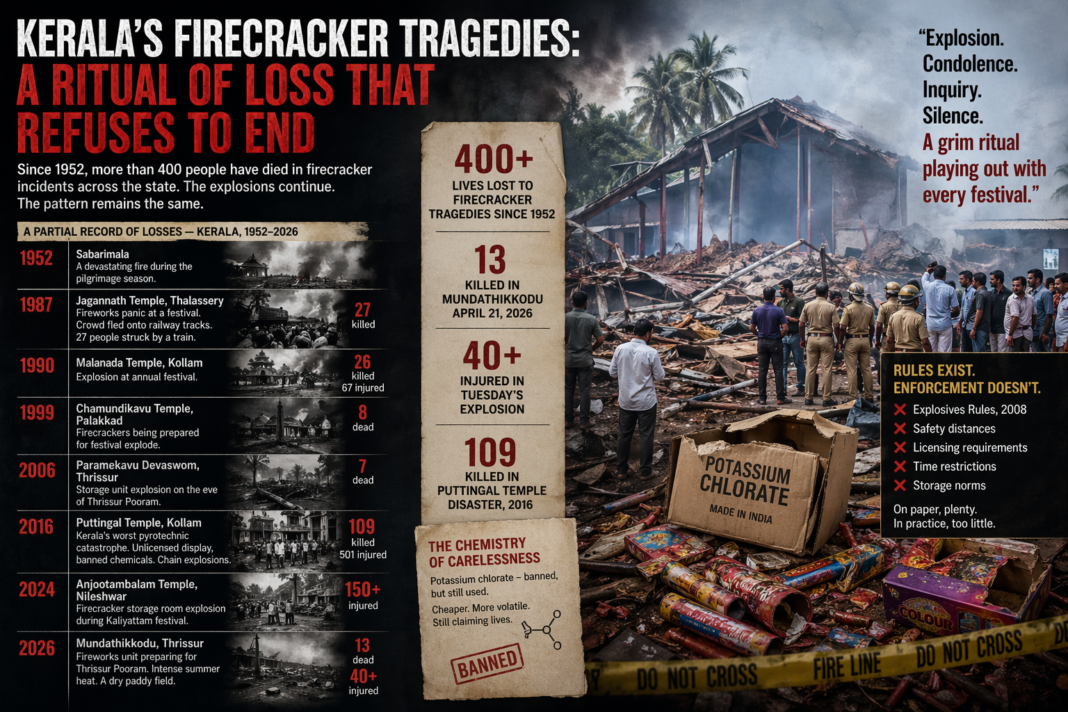
Let us be honest about what the record shows. Since 1952, Kerala has buried its dead from firecracker accidents at a pace that should have long since demanded a reckoning. A conservative accounting of major incidents reveals more than 400 lives lost to pyrotechnic tragedies across the state in under eight decades — and that number does not include the quiet deaths: the factory workers injured beyond recovery, the burns that took weeks to kill.
The Chemistry of Carelessness
Investigators are already asking about potassium chlorate — a chemical banned from fireworks manufacturing in India for precisely the reason one forensic official described with chilling simplicity: once mixed, it stops being a firecracker and becomes a bomb. The presence of this substance keeps turning up, decade after decade, in post-explosion inquiries. It is cheaper than legal alternatives. It is more volatile. And somebody keeps using it.
This is not simply human error. It is systemic negligence wearing the costume of tradition. The 2006 explosion happened at the same festival, in the same district, involving the same Pooram preparations. Journalists had visited the Mundathikkodu site hours before Tuesday’s blast — just as they had visited the 2006 site days before that explosion. We are not unlucky. We are not learning.
Rules exist in abundance. The Explosives Rules 2008, court bans on competitive fireworks displays after sunset, mandatory safety distances, licensing requirements — the paperwork of accountability is plentiful. What is missing is the will to enforce it against institutions that wield social and religious authority. Temple committees, festival organizers, devaswoms — these are powerful entities in Kerala’s cultural life. Nobody wants to be the official who cancelled the Pooram fireworks. And so the fireworks go on. And so do the funerals.
“The paperwork of accountability is plentiful. What is missing is the will to enforce it against institutions that wield social and religious authority.”
Who Were They?
We must not let the scale of the tragedy crowd out the individuals inside it. These were workers — men and women who handle firecrackers for a living because there is money in it, because the festival economy of Kerala is enormous and the demand for skilled firecracker makers is real. They are not reckless people. They are people in a reckless system, working with volatile materials in summer heat, in open paddy fields, without the protections that any responsible industrial country would consider the bare minimum.
Their families are now waiting at Thrissur Medical College Hospital. Some are waiting for news of those still in critical condition. Some are waiting to identify remains. I find myself thinking about that — the quiet, unbearable bureaucracy of grief. And I wonder what we owe them beyond condolences and compensation cheques.
The World Has Already Found a Better Way
✦ The Sky Can Still Be Beautiful
At the opening ceremony of the Tokyo Olympics in 2021, more than 1,800 drones formed a luminous spinning globe above the stadium — no explosives, no smoke, no risk of fire. Dubai lights up its New Year’s Eve sky with thousands of synchronized drones that paint stories in light over the desert skyline. American cities from Salt Lake City to Napa, California have replaced Fourth of July fireworks with drone displays. India itself, at the Beating Retreat Ceremony in 2022, deployed a thousand drones to form the national flag and the face of Mahatma Gandhi in the night sky.
Drone light shows are not a futuristic dream. They are a present reality, deployed at the world’s biggest events, in countries that span every culture and tradition. They produce no smoke, no toxic chemicals, no banned substances that turn storage rooms into bombs. They cannot accidentally ignite from summer heat. They do not scatter body parts across paddy fields.
Yes, the initial cost is higher. A meaningful drone display can cost from twenty thousand dollars upward. But Kerala spends enormous sums on its festival culture — and the cost of a single disaster, measured in lives, in medical bills, in compensation, in the long grief of surviving families, is incalculable. The economics, when honestly accounted for, are not even close.
What would Thrissur Pooram look like with a thousand drones choreographed to the rhythm of the chenda melam? I suspect it would be extraordinary. I suspect the crowd, the same crowd that gathers in the hundreds of thousands for those elephant processions and drum performances, would be moved in ways that gunpowder cannot achieve. The Pooram is, at its heart, a celebration of devotion and artistry. Neither of those things require explosives.
A Suggestion, Offered with Respect
I am not asking Kerala to abandon its traditions. I am asking it to save them. Because every catastrophe like Tuesday’s is another argument for those who would ban fireworks outright, and another wound in the reputation of a festival culture that is genuinely, breathtakingly beautiful. The Thrissur Pooram is one of the great spectacles on earth. It deserves to survive. Its workers deserve to go home.
The state government, the Devaswom boards, the temple committees, the festival organizers, they all have the power to initiate this transition. A phased move toward drone-assisted displays at major festivals, beginning with the highest-risk events, funded in part by the festival budgets that already run into crores of rupees. It would require courage, because traditions resist change, and because those who profit from the existing firecracker economy are organized and vocal. But leadership is precisely the courage to do necessary things before the next disaster makes them unavoidable.
And to the Kerala High Court, which in 2016 banned fireworks after sunset at places of worship, that was a start. Ten years later, the gaps in enforcement are obvious enough to drive a lorry full of potassium chlorate through. The question of who is accountable, and who faces consequences, must be answered with something more than another inquiry report gathering dust in a government office.
What I Feel at This Moment
I will be direct, because this is an opinion and because the dead deserve directness. I am angry. Not in the way that fades by the weekend, but in the slow-burning way of someone who has watched a preventable thing happen again and again and been told, each time, that it is being looked into.
I am also sad for Kerala in a specific way — the sadness of watching a place you love make itself smaller than it is. This is a state that produced some of the finest writers, scientists, teachers, and administrators in modern India. It has the highest literacy rate in the country. It prides itself, rightly, on social progress. And yet it keeps sending its festival workers into unmapped danger zones with banned chemicals and summer heat and the implicit message that the show must go on.
The show must not go on at this price. Thirteen people went to work on Tuesday morning for a festival they loved, in a state they called home. They are gone. Their names deserve more than a line in the next inquiry report. They deserve a decision — a real one — that means the workers preparing the 2027 Pooram fireworks get to come home.
Kerala is better than this. I believe that completely. I have seen it be better than this, in a hundred ways, in a hundred places. The question now is whether it will choose to prove it.
K.T. Abdurabb is a writer and commentator based in the UAE, with roots in Kerala. He has witnessed both the grandeur of Kerala’s temple festivals and the cost of their recurring tragedies. The views expressed are his own.