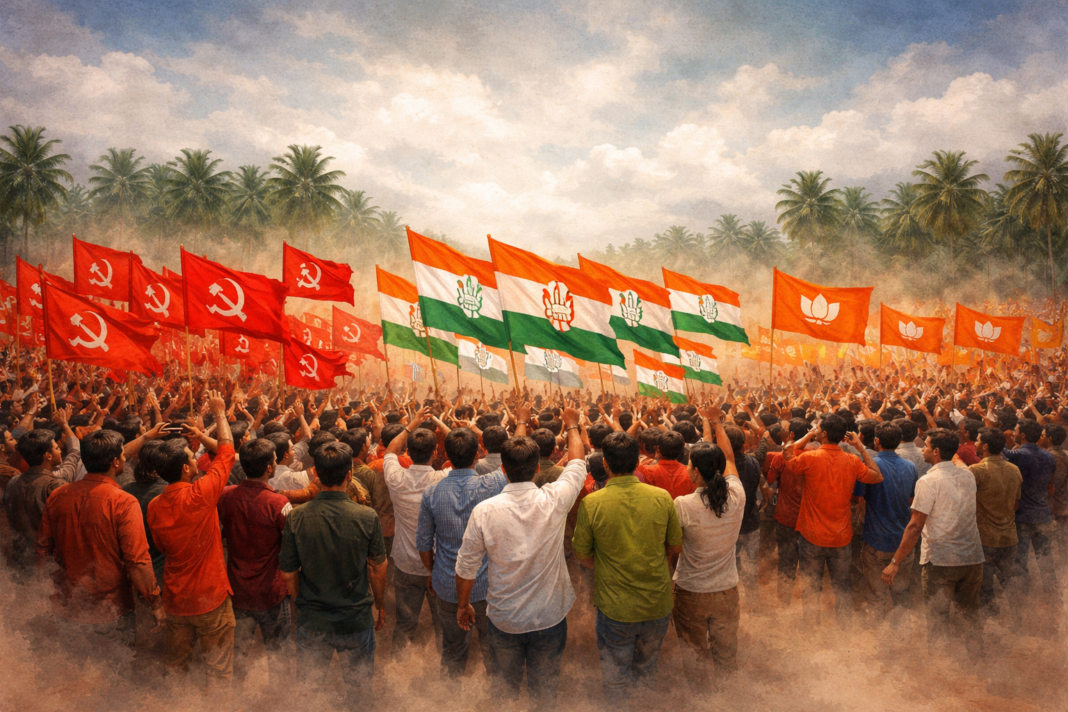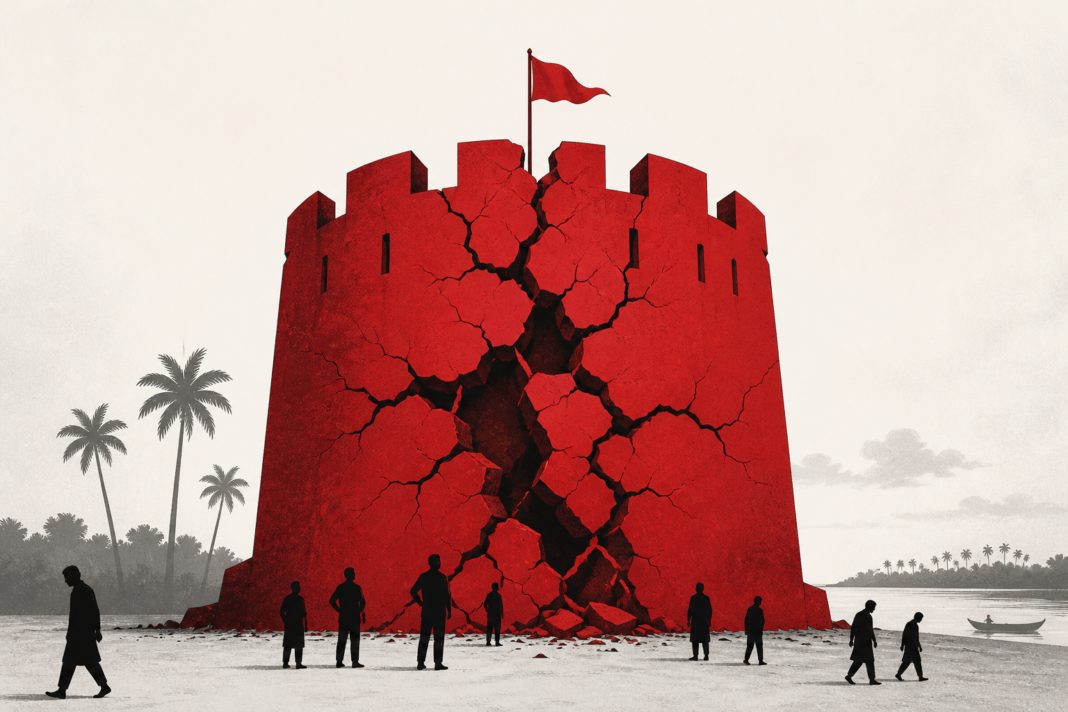
How the Left Democratic Front became a machine — and was consumed by it
On the evening of May 4, a veteran CPI(M) ward worker — call him Rajan — sat before his television and watched his party lose, decisively. He was not surprised. That is the most damning fact of the Left Democratic Front’s defeat.
When those who sustain a party no longer expect it to win, defeat is no longer an event. It is the endpoint of a long, visible process. Kerala’s verdict demands an honest accounting of that process — one that avoids easy villains and convenient excuses.
The LDF did not lose primarily because of what it failed to deliver. It lost because of what it became: insulated, centralized and increasingly indifferent to its own founding principles.
A workers’ party that sidelined its workers
The CPI(M) was built on a simple premise — that power must remain accountable to those who labor for it. For decades, cadre workers served as the party’s eyes, ears and conscience.
Over time, that structure shifted. Decision-making grew centralized. Local voices were diluted. Choices affecting districts were increasingly shaped in Thiruvananthapuram, not in consultation with the grassroots.
More damaging was the ideological drift. A party founded in opposition to concentrated capital came to be seen — fairly or not — as accommodating it. Allegations of proximity to business interests and questionable financial dealings eroded credibility. For many workers, the party no longer resembled the movement they had built.
In Kerala’s politically literate electorate, such shifts do not go unnoticed. When a party distances itself from its base, it does not just lose votes — it loses purpose.
The echo chamber at the top
The LDF’s leadership appeared increasingly insulated from ground realities. Reports of voter anger were filtered or softened. Dissent rarely traveled upward intact.
The result was a classic information failure. A leadership that does not receive accurate feedback cannot respond effectively. Policies were announced with confidence, even as public skepticism deepened.
The issue is not simply who misinformed the leadership. It is structural: organizations that reward affirmation over correction inevitably lose touch with reality. By the time that gap becomes visible, it is often too late.
Eroding trust in institutions
Nothing damaged public confidence more than the perception that policing had become politicized.
Across constituencies, complaints involving party workers were seen as handled differently — delayed cases, reluctance to file FIRs, selective enforcement. Whether formally directed or informally understood, the pattern was widely recognized.
In a state like Kerala, where civic awareness is high, institutional neutrality is not optional. When citizens believe that justice depends on political affiliation, trust collapses quickly — and with it, the legitimacy of governance itself.
No welfare program or infrastructure project can offset the experience of unequal justice.
Incidents that shaped the narrative
Elections are decided not just by policies but by perceptions shaped through specific events.
By mid-2025, a narrative had taken hold: a government that protected insiders and blurred accountability. Incidents like the Naveen Babu case and the Anthoor Sajan controversy reinforced that perception.
More consequential than the controversies themselves were the political responses. Candidate selections and public messaging signaled that voter concerns were secondary to internal calculations.
For core supporters, this was a breaking point. Disillusionment does not always translate into opposition votes — often, it results in silence, abstention or diminished enthusiasm. In a competitive state, that is enough to tilt the outcome.
The cost of unkept promises
Repeatedly, the LDF announced ambitious projects with firm timelines — and repeatedly failed to meet them.
The most striking example was the promised expatriate welfare framework. Positioned as a major policy initiative, it was to be delivered within 100 days. It never materialized.
For Kerala’s large diaspora and their families, this was not abstract policy failure. It was personal. Remittances form a critical part of the state’s economy, and expectations were clear. When the deadline passed without delivery, it reinforced a broader perception: announcements had replaced governance.
Over time, the gap between promise and performance became a defining political liability.
Structural headwinds
Kerala’s electoral history favors alternation. No government has secured a third consecutive term. After a decade in power, the LDF faced inevitable anti-incumbency.
But structural disadvantage does not guarantee defeat — it can be overcome with exceptional governance and sustained public trust. The LDF offered neither at the level required. Instead, governance failures amplified the natural fatigue of long incumbency.
A victory without transformation
The United Democratic Front has won. But this is more a rejection of the LDF than an endorsement of a new model.
Early signals raise familiar concerns. Allegations of favoritism in a state sports award echo long-standing criticisms of institutional politicization. If such patterns persist in opposition, they are unlikely to disappear in power.
Kerala has seen this cycle before: alternating governments, consistent systems. The risk is not change, but continuity under a different banner.
What comes next
For the LDF, the challenge is existential. Cosmetic adjustments will not suffice. Rebuilding requires structural reform — restoring authority to the grassroots, ensuring transparent feedback mechanisms and reasserting institutional neutrality.
For the UDF, the mandate is conditional. Electoral victory does not grant immunity from the same temptations that undermined its predecessor. Early governance choices will determine whether this transition represents change or repetition.
Both fronts face a shared responsibility: to engage seriously with the state’s expatriate community and to replace symbolic commitments with measurable outcomes.
The question that remains
If governance does not fundamentally change with governments, what is the voter choosing?
Kerala’s democratic culture has long absorbed dissatisfaction through electoral rotation. But repetition without reform risks something deeper — disengagement.
The LDF’s fall is significant. What follows will matter more. Whether Kerala sees a genuine shift in governance — or simply a change in colors — remains an open question.