
Editor’s Pick | Analysis
Nine years ago, the UAE appointed the world’s first Minister of State for Artificial Intelligence. At the time, it seemed more symbolic than structural. Today, with 400 senior government officials gathered at Qasr Al Watan in Abu Dhabi, the symbolism has given way to engineering.
Mohammad bin Abdullah Al Gergawi, Minister of Cabinet Affairs and Chairman of the Agentic AI Project Executive Committee, used the occasion to lay out the most detailed government AI transformation blueprint any country has publicly committed to — with named leaders, measurable targets, and a two-year deadline.
The centrepiece: transitioning 50 per cent of all federal government services and operations to Agentic AI models, positioning the UAE as the first government in the world to achieve it.
“The Industrial Revolution redefined the economy. The internet redefined knowledge. Agentic AI today is redefining everything at once,” Al Gergawi told the retreat.
The distinction he drew matters. Unlike generative AI tools that retrieve and produce information, Agentic AI executes chains of tasks independently — making decisions, managing operations, and delivering outcomes without waiting for human instruction at every step. “It is like having an additional team member who executes the tasks you assign, exactly the way you want them done,” he said.
The implementation runs across five tracks, each owned by a senior federal minister — covering training, technology infrastructure, institutional operations, governance, and citizen services. The training target alone is striking: 80,000 federal employees to be qualified as Agentic AI experts, with their combined output projected to equal the productive capacity of 800,000 employees. Performance in AI will be directly tied to promotions and appointments.
The economic logic is equally ambitious. Global studies cited at the retreat suggest AI can raise workforce productivity by more than 40 per cent in some sectors. Al Gergawi linked the programme directly to the UAE’s national economic target of AED 3 trillion by 2031 — and said he expects it to be met ahead of schedule.
The UAE’s AI adoption rate currently stands at over 70 per cent, the highest globally, according to Microsoft’s latest report.
For a government that launched its e-services in 2001 and went fully smart by 2013, the trajectory is consistent. What has changed is the velocity.
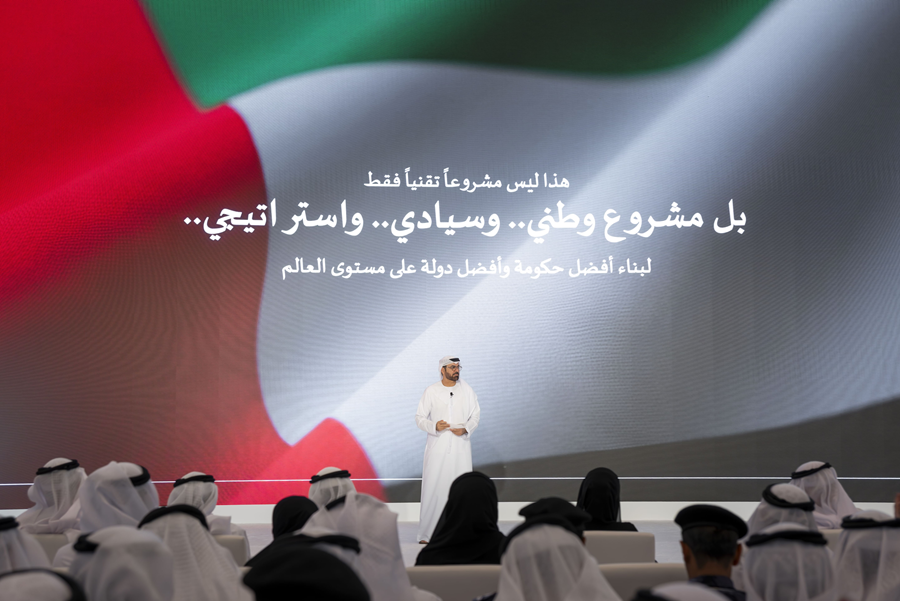
“This is not merely a technology project,” Al Gergawi said in closing. “It is a national, sovereign, and strategic undertaking to build the world’s best government and the world’s best country.”
The UAE just did.