
The United Democratic Front’s victory in the 2026 Kerala Assembly elections — winning 102 seats and handing the Left its worst defeat in decades — should have marked a straightforward political triumph for the Congress.
Instead, the party is now facing a difficult leadership decision that has reopened internal divisions it spent years trying to contain.
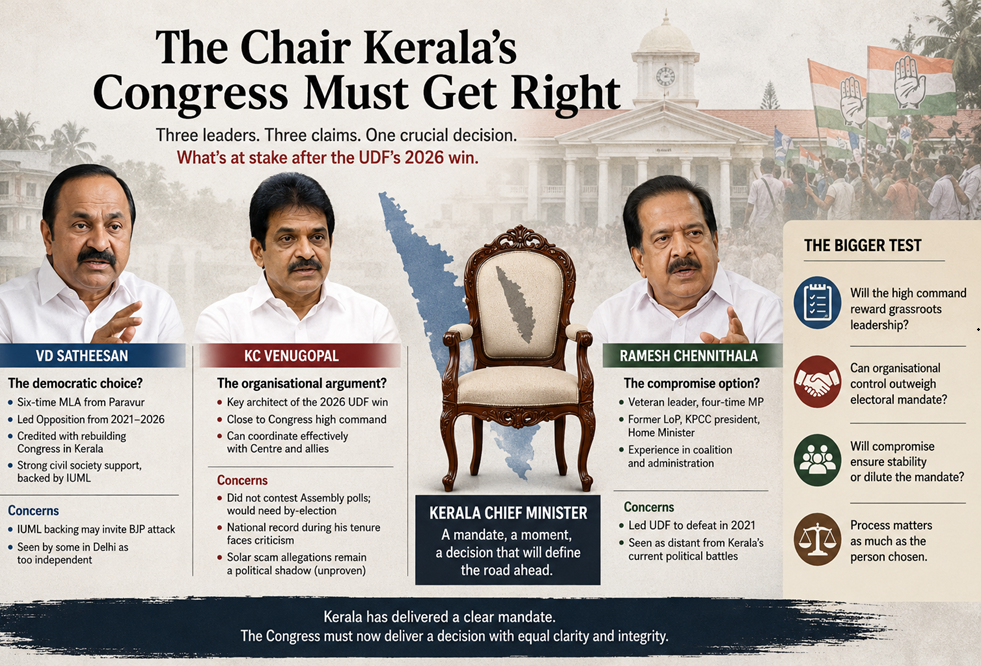
Three leaders are at the center of the discussion over the chief minister’s post: VD Satheesan, KC Venugopal and Ramesh Chennithala. All three bring political experience, organisational influence and support within the party. All three also carry limitations that complicate the decision.
The Congress high command now faces a test that goes beyond Kerala. The choice it makes will shape not only the next state government, but also perceptions about how the party balances electoral legitimacy, organisational control and internal democracy.
This debate deserves a more balanced assessment than the factional narratives currently dominating public discussion.
The Structural Question Around KC Venugopal
Before assessing individual merit, one issue stands out clearly: KC Venugopal did not contest the Assembly election.
Venugopal is currently a Lok Sabha MP from Alappuzha and serves as AICC General Secretary (Organisation). Constitutionally, he can become chief minister if elected to the Assembly within six months. But politically, the arrangement raises obvious questions.
A new government’s first months are usually focused on administrative consolidation and policy direction. A mandatory by-election during that period would create avoidable political uncertainty and distract the government at a sensitive stage.
There is also a broader democratic question. In a legislature with 140 newly elected MLAs, should the government be led by someone who did not seek a mandate in the state election itself?
Venugopal’s supporters argue that leadership cannot be reduced to holding an MLA seat. They point out that Indian politics has seen leaders assume office before entering the legislature formally. That argument has constitutional validity. But it remains a non-conventional route, and therefore requires stronger political justification.
KC Venugopal: Strengths and Concerns
Venugopal’s role in the UDF campaign was significant.
As the Congress leadership’s principal organisational coordinator, he was deeply involved in candidate selection, alliance management and internal negotiations. His camp argues that strategic decisions — including fielding dissident CPI(M) figures in selected constituencies — weakened the Left in key regions and contributed materially to the scale of the UDF victory.
Supporters also make a broader governance argument in his favour. Kerala’s next government will need constant coordination with the central leadership and national institutions. In a federal system where states depend heavily on negotiations with New Delhi over funding, approvals and policy support, Venugopal’s access to the national leadership is viewed by allies as an administrative advantage.
Coalition management is another factor. The UDF includes multiple parties with competing interests. Venugopal’s proximity to the Congress high command gives coalition partners confidence that commitments made in Kerala will carry weight at the national level as well.
At the same time, concerns about his candidacy are substantial.
His tenure as AICC General Secretary coincided with a period of repeated electoral setbacks for the Congress nationally. While no single leader can be blamed for the party’s broader decline, critics argue that organisational success in Kerala cannot be separated entirely from organisational failures elsewhere.
The stronger criticism is political rather than procedural: Venugopal did not directly seek a mandate in the Kerala election. For many within the party, that weakens the democratic legitimacy of his claim compared with leaders who fought and won Assembly contests.
The solar scam allegations also remain part of the political conversation around him. Saritha Nair named several Congress leaders, including Venugopal, during the controversy. No court has found him guilty of wrongdoing, and the Congress has consistently maintained that the allegations were politically motivated. Any assessment of his candidacy must acknowledge that the accusations remain unproven.
VD Satheesan: The Strongest Electoral Claim
Among the three contenders, Satheesan has the clearest claim based on electoral and legislative politics.
A six-time MLA from Paravur, Satheesan led the Congress in the Assembly during one of the party’s weakest phases in Kerala. After successive defeats in 2016 and 2021, he took over as Leader of the Opposition and rebuilt the party’s political credibility through sustained attacks on the Left government inside and outside the Assembly.
His supporters argue that the 2026 result is directly tied to that five-year political effort.
Satheesan’s strength lies not only in electoral success, but in the perception that he represents continuity between opposition leadership and governance. In parliamentary systems, that transition carries political weight.
The endorsement he has received from sections of civil society and from the IUML has strengthened his position further. But the IUML factor also creates complications.
Within sections of the Congress, there is discomfort over perceptions that the Muslim League is exercising excessive influence in the leadership question. Political opponents, particularly the BJP, are likely to use that narrative aggressively if Satheesan becomes chief minister.
There is also another concern that is discussed privately within Congress circles: Satheesan built his authority largely from within Kerala politics rather than through dependence on the central leadership. That independence strengthens his legitimacy within the state unit, but it may also create unease among leaders in Delhi who traditionally prefer tighter organisational control over state leadership structures.
That tension reflects a larger issue within the Congress party itself — the balance between grassroots authority and centralised leadership management.
Ramesh Chennithala: Experience and the Compromise Option
Ramesh Chennithala remains one of the Congress party’s most experienced leaders in Kerala.
He has served as KPCC president, Home Minister, Leader of the Opposition and a four-time MP. His victory margin in Haripad demonstrates that he continues to retain electoral strength and organisational relevance.
His strongest argument is stability.
If the contest between Satheesan and Venugopal escalates into a damaging factional struggle, Chennithala could emerge as a compromise candidate acceptable to multiple camps. He maintains working relationships across factions and has long experience in coalition politics.
But the political limitations of his candidacy are equally clear.
The UDF’s defeat in 2021 took place under his leadership as the coalition’s principal face. The party’s response was to replace him with Satheesan as Opposition Leader. Reversing that transition now would require a convincing political explanation that the Congress has not yet articulated.
There is also the question of distance from Kerala’s recent political battles. Much of Chennithala’s recent work has involved national-level party responsibilities. Kerala’s political environment is unusually intense and fast-moving, and critics argue that the next chief minister must be deeply connected to the state’s current political realities.
The Gandhi Family and the Question of Process
The role of the Congress high command will ultimately determine the outcome.
Rahul Gandhi has repeatedly argued that the Congress must reward grassroots leadership and strengthen internal democracy. That message has become central to the party’s political positioning in recent years.
Any perception that the leadership is imposing a preferred candidate without broad support from elected MLAs could therefore damage the party’s credibility at a moment when it has regained political momentum in Kerala.
That concern applies particularly to Venugopal because of his close working relationship with the central leadership.
At the same time, it would be simplistic to reduce the decision entirely to favoritism or factional politics. The high command is likely weighing coalition dynamics, administrative coordination and long-term organisational considerations that are not fully visible publicly.
The challenge is not simply choosing a leader. It is ensuring that the process itself appears legitimate, consultative and politically defensible.
A Decision With Larger Implications
Each contender represents a different political argument about what the next Kerala government should prioritise.
Satheesan represents electoral legitimacy and continuity from opposition leadership to governance.
Venugopal represents organisational coordination and strong integration with the national leadership.
Chennithala represents administrative experience and internal stability.
There is no risk-free option. But the larger danger for the Congress would be a leadership selection process that appears opaque, heavily factional or disconnected from the public mandate the UDF has just received.
Kerala delivered the Congress one of its biggest political victories in decades. The leadership decision that follows will determine whether that mandate becomes the foundation of long-term stability — or the beginning of another internal conflict.
*Jessica Roberts is a senior political analyst with Delhi background.