
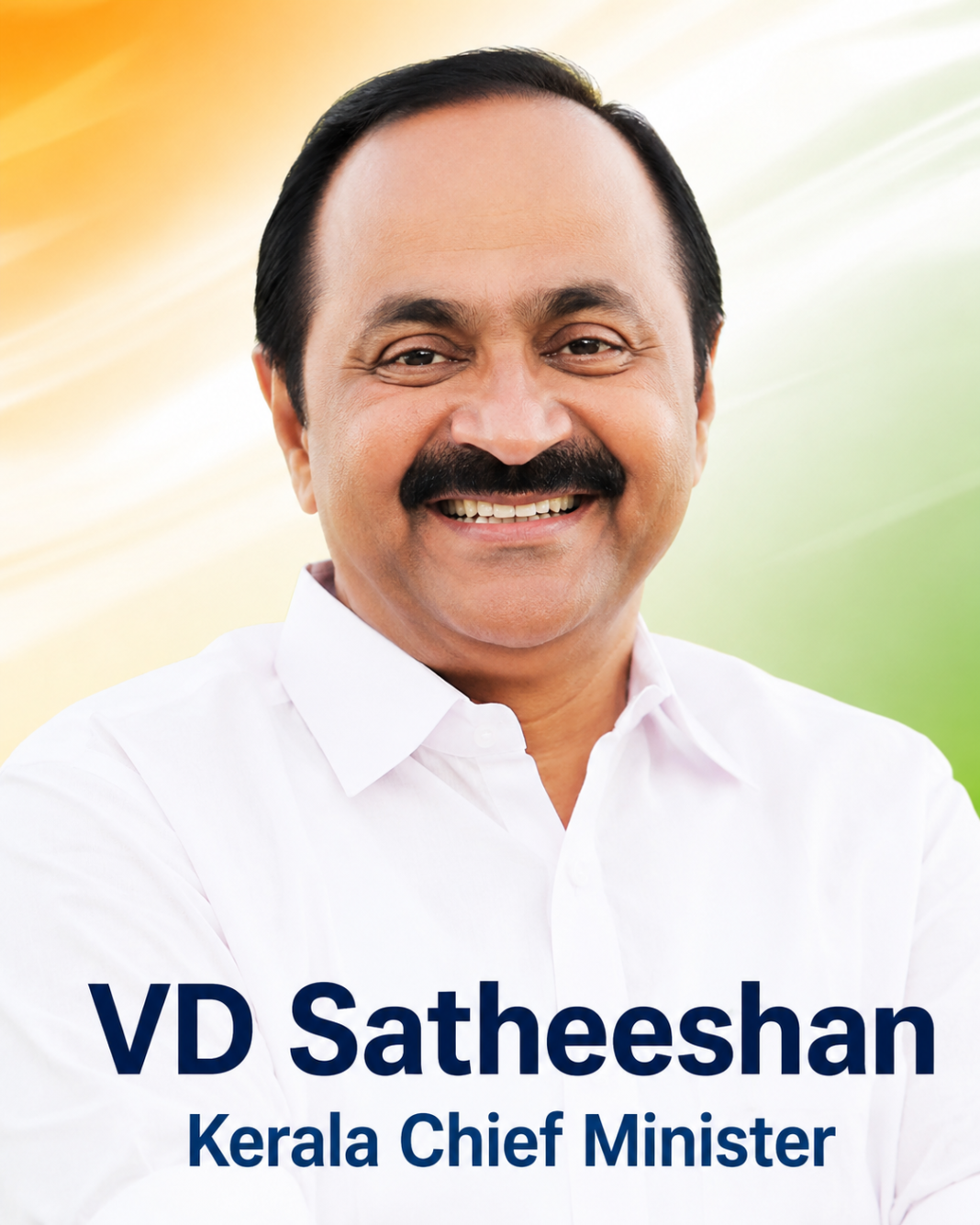
VD Satheesan’s elevation as Chief Minister is the correct decision — perhaps the only defensible one. But the manner in which Congress arrived at it, the wounds it has opened, and the dangerous equations it has disturbed must be studied carefully. For in Kerala, it is never just about who becomes Chief Minister. It is always about what the journey there reveals.

Ten days. That is how long it took the Indian National Congress — a party with 63 MLAs, 102-seat alliance partners, a generation’s worth of organisational memory, and the full apparatus of its Delhi high command — to tell Kerala who its Chief Minister would be. Ten days after the most decisive mandate the United Democratic Front has received since 1977. Ten days during which the streets of Thiruvananthapuram, Kochi, Thrissur and Palakkad erupted with rival processions, social media wars, factional counter-briefings, and the spectacle of a great victory nearly consuming itself from within.
Let it be recorded clearly: V.D. Satheesan was the right choice. He was the only choice that public sentiment, ground reality, and the logic of Kerala’s complex community arithmetic unanimously endorsed. The Congress high command, after an inexcusable delay, finally listened. That the decision was correct does not, however, absolve the party of the damage done in the interval. And it does not excuse the wounds that still lie open — wounds that, if left unattended, will bleed quietly into the five years ahead.
“It looks like they found it more difficult to handle a massive victory than they ever did a crushing defeat.”
A senior journalist said it best in the days of stalemate: “It looks like they found it more difficult to handle a massive victory than they ever did a crushing defeat.” That sentence should be framed and hung in every Congress office in Kerala. Because it captures, with surgical precision, the central paradox of this party in this state — capable of extraordinary electoral mobilisation, and yet chronically unable to manage its own aftermath.
Why Satheesan Was Always the Answer
Those who have watched VD Satheesan for the past two decades know something about the man that his critics in Delhi never fully grasped: he does not perform politics. He practices it. Where most leaders seek proximity to power, Satheesan spent years in Paravur — attending weddings, funerals, local disputes, ordinary lives — building the kind of constituency relationship that no high command posting, no Rajya Sabha seat, and no organisational secretaryship can replicate.
When he was handed the leadership of the Opposition in 2021 — after the UDF’s demoralising back-to-back defeats — many wrote him off as a safe appointment, a compromise candidate who would not upset the factional balance. They were spectacularly wrong. Satheesan turned the Opposition into a functioning institution. He challenged Pinarayi Vijayan’s cabinet on policy, on corruption, on governance failure, week after week, with the preparation of a man who had read every file and memorised every number. His predictions of UDF seat tallies in every subsequent election — by-elections, local body polls, Lok Sabha — proved eerily accurate, because they were not predictions. They were the outputs of genuine ground intelligence.
In the 2026 Assembly elections, when every other Congress leader hedged their language, Satheesan alone stood publicly and declared: UDF will cross 100. He forecast the fall of nearly a dozen Pinarayi cabinet ministers. Both came true. Vismayam — the word he used repeatedly during the campaign to describe the coming verdict — became the defining word of the election season, and ultimately of his own political journey.
The man who coined the slogan became the Chief Minister. That is, as things go in Kerala politics, entirely fitting.
The Wound That Will Not Close Easily: K.C. Venugopal
But the road to that fitting outcome was anything but graceful. And the deepest bruise belongs to K.C. Venugopal — who had the support of a majority of the newly elected MLAs, a large section of the MP community, and the quiet backing of sections of the high command — and who was, in the end, asked by Rahul Gandhi himself to stand down.
This is not a wound that will heal with a phone call or a Cabinet berth. Venugopal is not merely a faction leader; he is a national-level Congress figure with his own political weight. The manner in which the MLAs who backed him were publicly outmanoeuvred, and the manner in which his own retreat was orchestrated — the summons to Gandhi’s residence, the two-hour conversation, the quiet withdrawal — will leave its mark on the relationship between the high command loyalist camp and the new Chief Minister’s office.
History is instructive here. In Punjab in 2021, when Charanjit Singh Channi was installed as Chief Minister over the candidate who had majority MLA backing, the Congress government that followed lasted barely a few months before imploding spectacularly. Kerala’s circumstances are different — Satheesan’s public mandate is far stronger, his political roots far deeper. But the lesson remains: majority MLA backing that is overruled does not disappear. It waits.
The first test of Satheesan’s Chief Ministership will not be his first budget or his first legislative session. It will be the Cabinet formation. How he distributes ministerial berths among the Venugopal camp, the Chennithala camp, the Muslim League, and his own loyalists will define whether this government functions as a coalition or as a coalition in name only. Any perceived slighting of the Venugopal camp in Cabinet allocation will ignite the first internal crisis within weeks of taking oath.
The Older Wound: Ramesh Chennithala’s Silence
And then there is Chennithala. The former Home Minister, former KPCC president, a man who has served the Congress faithfully across decades of factional warfare and electoral defeat, was the third candidate in a three-way race — and the one who lost most quietly. Chennithala’s seniority, his administrative experience, and his institutional knowledge of the Kerala government are not in dispute. What is in dispute is whether his exit from the race was managed with the dignity he deserved.
Those of us who have covered Kerala Congress politics since the Karunakara era know what a Chennithala who feels sidelined looks like. It looks like a government that functions with one hand tied behind its back. Satheesan must — urgently, personally, and not through intermediaries — bring Chennithala into the tent. Not with a token portfolio, but with genuine respect and a meaningful role in the UDF’s governance architecture.
The Community Equations: A Minefield Dressed as a Mandate
Now we come to the part that no one in the Congress will say openly, but that every serious student of Kerala politics understands: the religious and community equations that surrounded this selection were not merely background noise. They were, in several ways, the decisive factor.
The Muslim League, with 22 MLAs — the second largest bloc in the UDF — threw its weight firmly behind Satheesan. The League cancelled a meeting it had scheduled, widely believed to have been a prelude to expressing displeasure if Venugopal was chosen. The signal was unmistakable. The high command read it, and incorporated it into the decision.
On the other side of this equation stood the NSS. The Nair Service Society’s General Secretary Sukumaran Nair held a pointed press conference — timed with some precision to the moment Satheesan’s selection appeared certain — lashing out at the Muslim League for “interfering” in Congress’s internal affairs. The NSS has, on more than one occasion, expressed reservations about Satheesan’s politics, particularly on questions of religious neutrality. That the NSS chose this moment to speak is not incidental.
“In Kerala, no government can survive five years without managing — not just winning — the trust of all three major community pillars.”
In Kerala, the political triangle of the Muslim League, the NSS, and the Catholic Church — each representing communities with genuine demographic and social weight — is not merely an electoral calculation. It is a governing reality. No government in this state can survive five years without managing — not just winning — the trust of all three major community pillars. The LDF learned this repeatedly. The UDF, which drew 63 seats largely on the strength of minority consolidation and Hindu community disillusionment with the LDF, now enters government carrying the arithmetic of that consolidation into the governance phase.
Satheesan is aware of this minefield. He has, in the past, publicly insisted that community leaders will be kept at arm’s length from governance decisions. That is the right instinct. But instinct must become institutional practice. The pressure from community organisations — all of them, across all communities — will begin the moment the Cabinet is sworn in. Satheesan must hold the line, not as a concession to critics, but as a matter of democratic principle and long-term political survival.
The BJP Is Watching — And Smiling
Do not make the mistake of thinking that the BJP sat this drama out as a passive observer. Every day of Congress’s ten-day theatre was a gift. Every rival procession, every factional social media war, every leaked account of high command confusion was documented, archived, and will be deployed in the coming months to sustain a counter-narrative: that the UDF’s historic mandate was squandered before a single day in office began.
More critically, the BJP is already positioning for the community polarisation game. The NSS’s open resentment of the Muslim League’s perceived influence in the CM selection, and the League’s equally open role in advocating for Satheesan, have handed BJP Kerala a ready-made communal narrative. Expect this to be the scaffolding of every by-election campaign, every state-wide agitation, every prime-time debate the BJP wages against the Satheesan government.
The BJP’s Kerala strategy has never been about winning a majority. It is about incrementally normalising its presence — one constituency at a time, one vote-share percentage point at a time. Thrissur in 2024 was not an accident. It was a template. The Congress’s internal implosion over the CM selection has given BJP fresh material to take that template to the next level.
The Community Balance Sheet That Satheesan Must Manage
| Community / Group | Stance / Expectation | Risk Level |
|---|---|---|
| Muslim League (IUML) 22 MLAs, key Cabinet partner | Backed Satheesan openly. Expects ministerial weight and policy responsiveness. Will resist any perception of being sidelined post-election. | Manage |
| NSS Nair community apex body | Publicly hostile to Satheesan during selection. Will scrutinise every Cabinet decision for perceived “minority appeasement.” Relations need urgent repair. | High Risk |
| Catholic Church / Kerala Catholics Significant UDF base | Broadly aligned with UDF. Key in coastal and central Kerala constituencies. Watched the CM drama with concern about internal stability. | Stable |
| KC (Joseph) Kerala Congress UDF ally, Hill district base | Christian community partner with strong plantation belt presence. Expects Cabinet representation and visibility in governance. Quietly watching. | Monitor |
| BJP / NDA Growing footprint | Will exploit any community tension, governance failure, or UDF internal split. Nemom, Kazhakootam, Chathannoor wins show real territorial expansion. | High Risk |
| Venugopal Camp within Congress Majority of MLAs | Backed down under high command pressure. Will observe Cabinet formation closely. Any perceived neglect will trigger quiet destabilisation. | High Risk |
What Satheesan Must Do — Without Delay
The first hundred days of a government set its character for five years. Satheesan knows this. The question is whether he can translate the discipline that defined his five years as Opposition Leader into the more complex discipline required of governing. Opposition is the art of attacking coherently. Government is the art of building coherently — despite allies pulling in different directions, community organisations demanding access, an internal opposition within your own party, and a BJP that is praying nightly for your first misstep.
Three things must happen quickly. First, Cabinet formation must be done with clinical fairness — not with mathematical vote-counting, but with the wisdom to give each significant stakeholder a stake in success. The Venugopal camp, the Chennithala camp, the League, the Kerala Congress — all must feel that the table is large enough for everyone. Second, Satheesan must immediately signal — through early governance decisions, not words — that community pressure will not determine policy. A government that is seen as League-controlled in Thiruvananthapuram, and NSS-ignored in Pathanamthitta, will not survive five years. Third, the UDF must establish a functioning coordination mechanism across alliance partners so that the visible cracks of the CM-selection period are plastered over before they are widened by the opposition.
Satheesan once said that in his political style, “victory is never accidental; it is engineered through preparation, unity, narrative control and an unwavering focus on structure and story.” The election proved that. Now the government must prove it.
A Decision Right in Substance, Costly in Process
Let this column end where it began: with a verdict. VD Satheesan was the right choice. The public knew it before the results were declared. The allies knew it when the results came in. The rank and file of the Congress knew it on May 5th, the morning after the count. The high command arrived at the same conclusion on May 14th — ten days, and a great deal of institutional damage, later.
In Kerala, where the difference between a five-year government and a three-year government has often been the first few months of decision-making, those ten days were not merely symbolic. They were a period during which alliances were strained, community equations were openly argued over in public, factional wounds were cut deep, and the BJP’s narrative machine was handed premium raw material. That cannot be undone.
What can be done is this: govern with the same focused intelligence that won the election. Satheesan earned this mandate on the streets of Kerala, one constituency at a time, over five difficult years. He did not arrive here by accident, or by Delhi’s grace, or by any community’s patronage. He arrived here because he understood Kerala — its people, its contradictions, its aspirations, and its anger — better than anyone else on the political stage.
The people of Kerala gave a verdict. The Congress, after much unnecessary delay, has — just barely — honoured it. Now the real work begins. And this state, patient as it has been, will not wait another ten days for anything.
Kerala does not forgive governments that waste their mandates. It forgives even less those that waste them while quarrelling over who should lead. The door to office is finally open. Whether what walks in is a government or merely a coalition of grievances — that is the question of the next five years.