When a billionaire takes the helm on the world’s most strategic waterway, it is rarely just for the view.
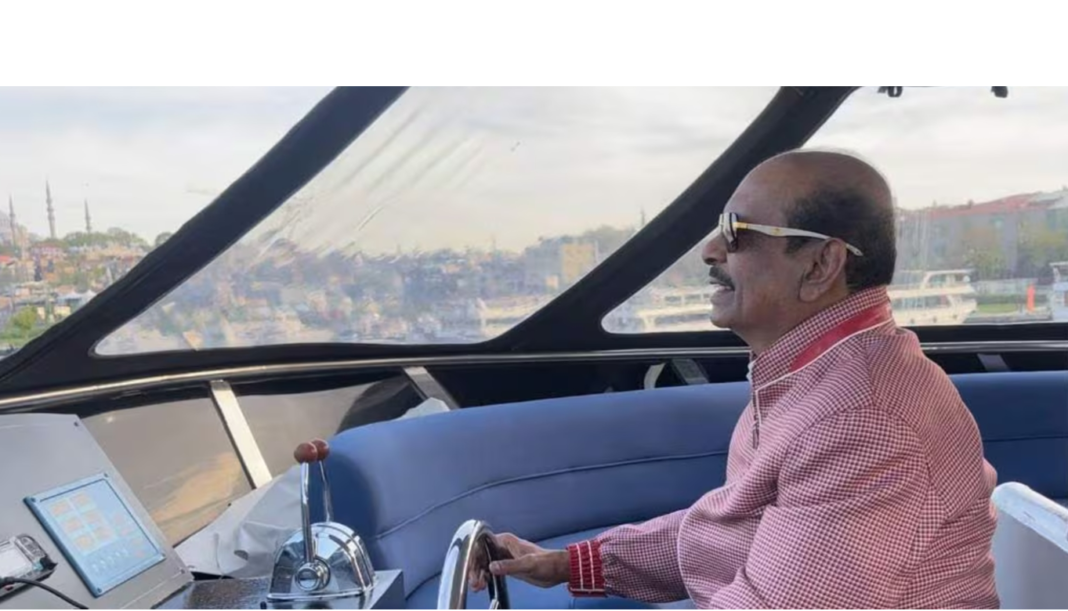
On a clear spring morning in Istanbul, a video began circulating across WhatsApp groups and social media feeds that stopped the Malayalam-speaking world mid-scroll. There, at the wheel of a boat cutting through the sapphire waters of the Bosphorus Strait, was M.A. Yusuffali — billionaire, empire-builder, Kerala’s most celebrated son in the Gulf and beyond — not being chauffeured, not waving from a deck, but personally steering the vessel with the focused calm of a man entirely at home between two continents.
The image was striking precisely because of what it was not. It was not a boardroom handshake, not a ribbon-cutting, not the familiar photograph of Yusuffali flanked by royalty or heads of state. It was something rarer: a glimpse of the man himself, adventurous and unhurried, navigating the very waterway that has divided and connected civilisations for three thousand years.
But those who know Yusuffali well will tell you something important: when this man travels, the pleasure and the purpose are never entirely separate.
“The Bosphorus is not just a strait between two continents. For a businessman of Yusuffali’s ambition, it is a passage between two markets — and he has already planted his flag on both shores.”
A Boy from Nattika, A World to Conquer
To understand why Yusuffali’s presence in Istanbul matters, you first need to understand where he came from. Born on November 15, 1955, in the coastal village of Nattika in Thrissur district, Kerala, Yusuff Ali Musaliam Veettil Abdul Kader grew up in a modest household, the kind of upbringing that forges either comfort with limitation or a furious hunger to transcend it. He chose the latter.
KEY MILESTONES
| 1955 | Born in Nattika, Thrissur, Kerala, into a modest Muslim family. |
| 1973 | At 18, boards the ship Dumra and sails to Abu Dhabi to join his uncle M.K. Abdullah’s EMKE trading company, arriving with little more than ambition. |
| 1990s | Seizes a transforming UAE retail market — launches LuLu Hypermarket and redefines how millions in the Gulf shop, eat and live. |
| 2000s | Lulu Group expands aggressively across Saudi Arabia, Oman, Kuwait, Bahrain and Qatar in rapid succession. |
| 2013 | Lulu arrives in India with its flagship mall in Kochi, Kerala — the most personal expansion of all: bringing prosperity home. |
| 2024–2026 | Net worth exceeds $7 billion. Operations span 22 countries. Turkey is on the map — and he returns to deepen the story. |
Turkey is Not New Territory — It is Next Frontier
What many who shared the viral boat video may not have known is that Turkey is not an exotic detour for Lulu Group. It is already listed among the group’s operational bases — alongside Spain, Italy, the UK, the United States and India — as part of a sourcing, manufacturing and distribution network that spans three continents. Turkey’s strategic location, straddling Europe and Asia, makes it invaluable for a retail empire that prides itself on getting the right product to the right place at the right time.
Istanbul, in particular, sits at the intersection of supply chains, trade corridors and consumer markets that Yusuffali has spent decades learning to read. A visit here is never purely ceremonial. The Bosphorus that he steered across is the same waterway through which goods have flowed between East and West for millennia — and Lulu Group, with its $8.4 billion annual turnover and over 76,000 employees from 46 nations, is very much a part of that flow.
Turkey’s retail sector has been growing rapidly, buoyed by a young, urban population and strong consumer demand. For a group that has mastered the art of reading emerging markets — from Egypt to Indonesia, from Malaysia to Uganda — Istanbul represents exactly the kind of high-potential, strategically located city that fits the Lulu growth playbook.
LULU GROUP — BY THE NUMBERS
| $8.4B Annual global turnover | 76,000+ Employees from 46 nations |
| 250+ Hypermarkets & supermarkets worldwide | $7.4B Yusuffali’s net worth (Forbes 2024) |
| 22 Countries of operation | 1973 Year he sailed to Abu Dhabi with a dream |
The Surprise at the Wheel
And yet, for all the weighty business context, there is something that must not be overlooked in the video that went viral: the sheer joy of it. With Istanbul’s breathtaking skyline — its minarets, its Ottoman palaces, the great suspension bridges that stitch Asia to Europe — rolling past on both shores, Yusuffali took the helm and steered. Not for the cameras, but because he is, at his core, a man who loves to be at the front of things.
His fans recognised it immediately. Here was the same man who has steered a small trading outfit in Abu Dhabi into one of the largest retail empires on earth, who navigated economic crises and global pandemics without losing his course, now quite literally holding the wheel in one of the world’s most iconic and strategically loaded straits. The metaphor almost wrote itself.
“Yusuffali took the helm and steered — not for the cameras, but because he is, at his core, a man who loves to be at the front of things.”
Observers noted his expression in the video: focused, content, entirely present. This is a man who has received the Pravasi Bharatiya Samman Award, the Padma Shri, and has been received in royal courts across the world. And yet, on the Bosphorus, he looks most like himself.
From One Strait to Another
In 1973, a young Yusuffali crossed the Arabian Sea on a ship called Dumra, leaving behind the coconut groves of Nattika for the sun-bleached boulevards of Abu Dhabi. That crossing changed everything. More than five decades later, he crossed the Bosphorus — this time at the wheel — with a business empire spanning three continents behind him and, one suspects, a great deal still ahead.
The Bosphorus has always been more than a body of water. It is the place where empires have paused, calculated, and decided which way to move. For M.A. Yusuffali, steering through it in May 2026, the message to those watching was both personal and professional: he is still moving, still at the helm, and still very much in control of the direction of travel.
That, for the millions who admire him — from the souks of Abu Dhabi to the streets of Thrissur — is the real story behind the viral video.
*Dr. KT Abdurabb is a Gulf-based author and senior journalist