

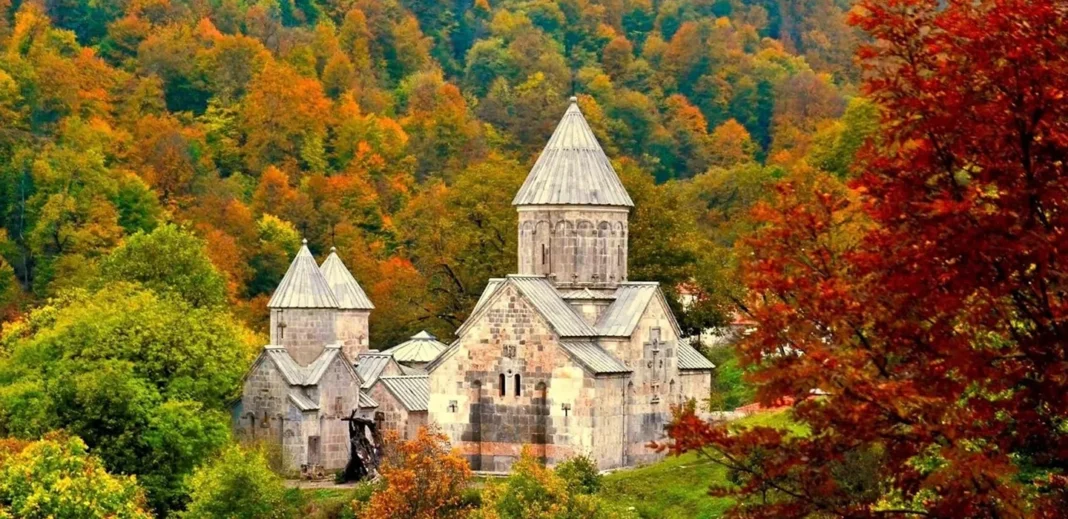
DILIJAN, Armenia — Haghartsin Monastery in northern Armenia is one of those places that rewards slow travel. Hidden in the forests of Dilijan National Park, the centuries-old complex offers quiet stone courtyards, mountain air and a history that reaches far beyond the Caucasus.
What makes the site especially notable for Gulf readers is its UAE connection. The monastery was restored with support from Sharjah’s ruler, Sheikh Dr. Sultan bin Mohammed Al Qasimi, after he visited the site in 2005 and moved to help preserve it.
That link has given Haghartsin a second life as both a religious landmark and a symbol of cultural patronage that crosses faith and borders. For UAE travelers, it is also a reminder that the region’s influence often extends into preservation, education and heritage work far from home.
The monastery dates to between the 10th and 13th centuries and was once an important center of worship, learning and manuscript copying. Its complex includes three churches, with St. Gregory believed to be the oldest.
A visit begins with the drive from Yerevan, which takes about two hours and winds through rolling hills, wooded slopes and small villages selling honey, cheese and fresh lavash. By the time the road reaches Dilijan, the landscape has already done much of the storytelling.
At the monastery, the honey-colored stone walls blend into the trees so naturally that the complex seems to have grown out of the forest itself. Around the grounds, carved Armenian khachkars, or stone crosses, stand as reminders of the country’s distinctive religious art.
One of the most memorable details is the low church entrance, designed so that anyone entering must bow their head. The gesture is architectural, but the effect is spiritual: every visitor steps in with a sense of humility.
The monastery remains an active place of worship. On Sundays, families still gather for prayer, lighting candles and moving quietly through the ancient stone interiors. The atmosphere is calm and deeply rooted in ritual rather than tourism.
The restoration supported by Sheikh Dr. Sultan focused on structural repairs, stronger foundations, improved drainage, repaired floors and walls, and better access to the complex. The work was designed to protect the original character of the medieval buildings rather than transform them.
That approach matters. Haghartsin’s value lies not just in its beauty, but in the fact that it is still alive as a place of prayer, memory and community.
For UAE and GCC travelers, Armenia has become easier to visit, with visa-free access available to eligible residents under current rules until July 2027. The flight time from Dubai to Yerevan is about three to three and a half hours, making the trip a practical long weekend escape.
Visitors should plan for modest dress, cooler mountain weather and comfortable walking shoes. It also helps to set aside extra time for the bakery-cafe below the monastery, where fresh gata, lavash, cheese and Armenian coffee offer a fitting end to the visit.
Haghartsin stands out because it is more than a scenic stop. It is a place where heritage, faith and quiet diplomacy meet, and where a Sharjah-backed restoration helped preserve a landmark that still speaks to visitors today.