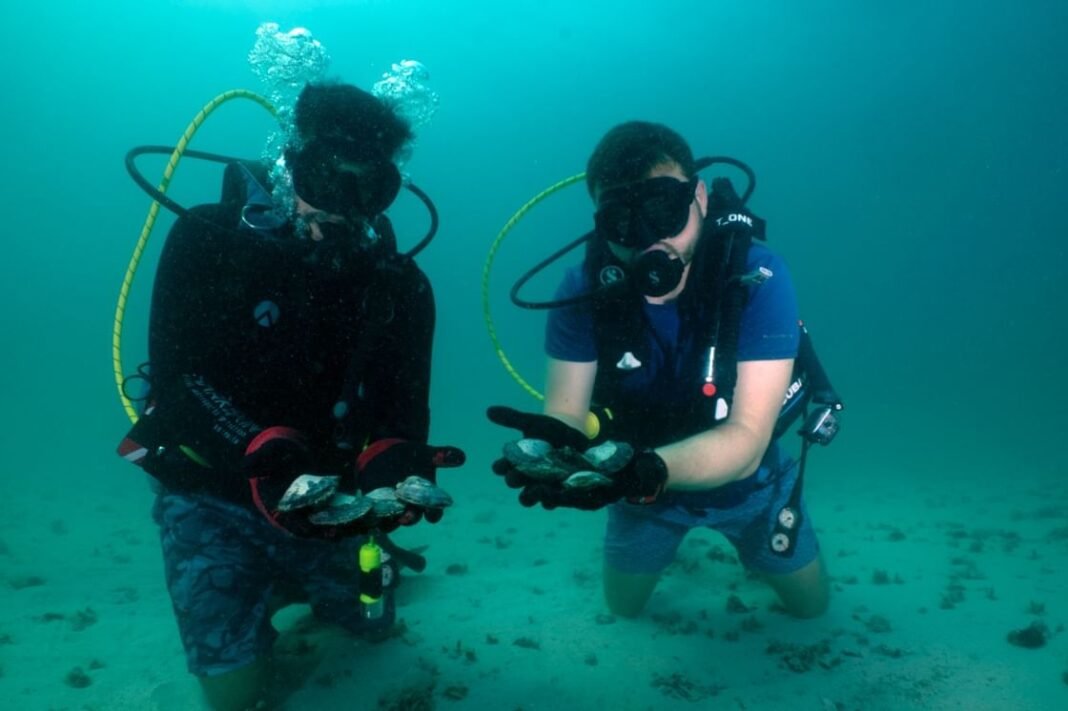
ABU DHABI — The Environment Agency – Abu Dhabi (EAD) has completed the emirate’s most comprehensive survey of oyster beds, mapping more than 3,300 square kilometers of marine habitat in a project that officials say will strengthen conservation efforts and support long-term marine management.
The multi-year initiative, designed in 2022 and carried out between 2023 and the end of 2025, combined historical records, local knowledge and modern scientific techniques to create the first rigorously validated map of oyster bed distribution across Abu Dhabi’s waters.
The survey identified 334 oyster bed sites from 1,088 locations examined during fieldwork covering about 12,000 kilometers. Together, the oyster beds span about 3,314 square kilometers, or roughly 7% of Abu Dhabi’s marine environment, making them far more extensive than previously documented.
The project builds on EAD’s 2021 deep-water survey, which unexpectedly revealed significant oyster habitats. That discovery prompted a dedicated mapping initiative using historical pearl-diving maps from the 1960s and 1970s, hawksbill turtle tracking data, oyster rehabilitation sites and knowledge shared by local fishing and coastal communities.
Survey teams used underwater drop cameras and a real-time mobile data collection system linked directly to EAD’s database. Starting from 335 target locations, researchers expanded their search until oyster beds could no longer be detected, allowing scientists to define habitat boundaries with greater accuracy.
The agency said the project successfully combined generations of maritime knowledge with modern environmental science, validating traditional understanding of Abu Dhabi’s coastal waters through systematic field research.
Dr. Shaikha Salem Al Dhaheri, EAD’s secretary-general, said the findings reflect Abu Dhabi’s long connection to the sea and its historic pearling industry.
“This milestone reflects Abu Dhabi’s deep-rooted connection to its marine environment,” she said, adding that the research strengthens understanding of the emirate’s natural assets and supports its commitment to achieving Net Zero by 2050.
Scientists say oyster beds are among the most important marine ecosystems because they provide habitat and feeding grounds for numerous fish and other marine species. During the survey, EAD researchers also observed large concentrations of fish and whale sightings near oyster habitats, reinforcing their ecological importance.
Oysters also contribute to carbon storage by absorbing dissolved carbon from seawater to form calcium carbonate shells, helping lock carbon into marine ecosystems over long periods.
EAD said the survey establishes a scientific baseline for future conservation planning. The agency plans to expand monitoring programs and use the findings to identify new marine protected areas aimed at preserving Abu Dhabi’s marine biodiversity for future generations.