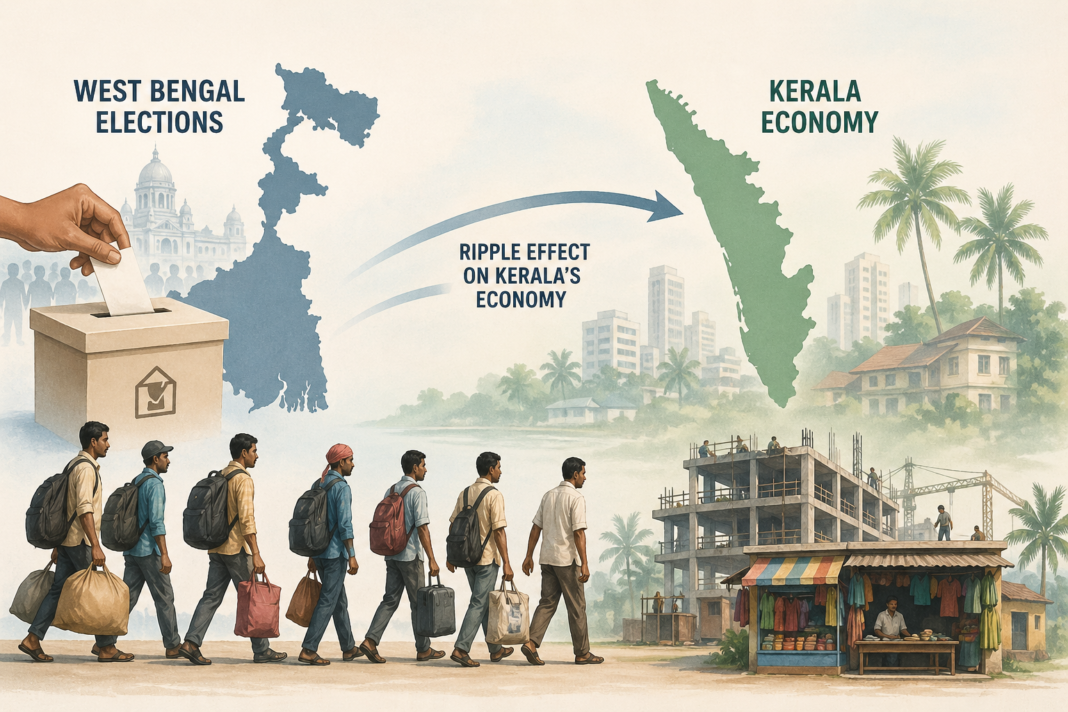
It may seem surprising that an election in eastern India can influence the economy of a southern state. Yet in today’s interconnected labor market, political developments in one region can quickly create economic consequences in another.
Kerala, known for its high literacy and social development indicators, relies heavily on migrant labor from states such as West Bengal, Bihar and Uttar Pradesh. These workers are employed across sectors ranging from construction and manufacturing to retail and services. Their contribution has become essential to sustaining the state’s economic activity.
This dependence became evident during the COVID-19 pandemic, when the return of migrant workers to their home states triggered a severe labor shortage in Kerala. Projects stalled, businesses slowed, and the state faced an unexpected economic strain.
Now, with voting under way in West Bengal, a new wave of uncertainty is emerging. The issue is not limited to voting alone. Reports surrounding the revision of voter lists and concerns over documentation have created anxiety among some migrant communities. Fears — whether fully substantiated or not — about voting rights and citizenship status have prompted many workers to return home temporarily.
Such movement, even if short-term, has immediate economic implications. A reduction in the available workforce can disrupt industries that depend on daily labor, increase wage pressures, and delay ongoing projects. For a state like Kerala, where migrant workers form a significant share of the labor pool, these disruptions are difficult to absorb quickly.
At the same time, the migration pattern itself is driven largely by economics. Wage differentials remain a key factor. An unskilled worker in Kerala can earn significantly more than in many northern states, making migration an attractive option. This wage advantage has, over time, reshaped Kerala’s labor market, with migrant workers filling roles that local workers are often unwilling to take at prevailing rates.
The growing presence of migrant communities has also influenced Kerala’s social and cultural landscape. From small eateries serving regional cuisines to multilingual signboards in public spaces, their integration is increasingly visible.
However, the relationship has not been without challenges. Isolated incidents involving migrant workers have at times led to public concern and social tension. Experts caution, however, against broad generalizations, emphasizing that the vast majority of migrant workers contribute positively to the economy and society.
The current situation raises larger questions for policymakers. How can Kerala reduce its vulnerability to sudden labor shortages? What measures can ensure better integration and security for migrant workers? And how can both sending and receiving states coordinate more effectively during periods of political or economic uncertainty?
For Gulf readers, the situation may sound familiar. Much like Kerala, countries across the Gulf region depend heavily on migrant labor to sustain growth. The Kerala experience highlights how mobility, policy decisions and worker sentiment can quickly intersect — creating ripple effects that go far beyond borders.
As elections unfold in West Bengal, their impact may not remain confined to politics alone. In an interconnected labor economy, even regional developments can carry far-reaching economic consequences.