The UAE has always matched vision with action. But the announcement of a Dh1 billion national fund, approved by Sheikh Mohammed bin Rashid Al Maktoum, Vice President and Prime Minister of the UAE and Ruler of Dubai, stands out — not for its size alone, but for what it reveals about where this country is heading. Sovereign wealth, record-breaking infrastructure, zero-to-city developments in the desert — the UAE has done all of that. What it is now doing is something subtler and arguably more consequential: building the industrial muscle to sustain it all from within. This is not simply another policy initiative. It is a statement of intent
The UAE is not waiting for global conditions to dictate its future. It is actively shaping it.
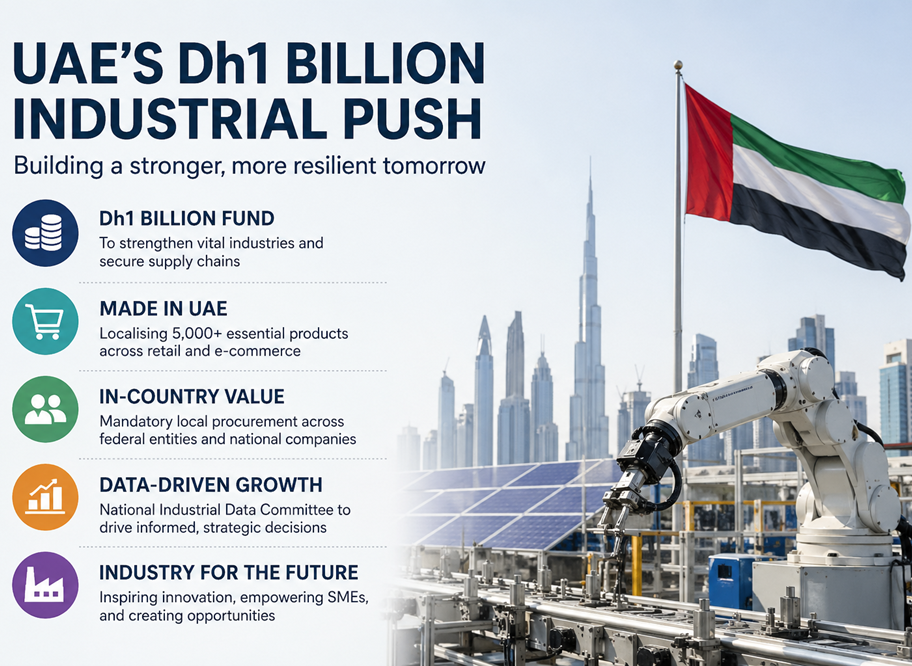
At its core, the newly approved fund is built around a clear set of priorities: strengthening vital industries, securing supply chains, and deepening the country’s ability to produce what it needs. Together, these goals reflect a broader shift in thinking—one that places resilience and self-reliance at the heart of economic planning.
The lessons of recent years have been hard to ignore. Disruptions to global supply chains, whether caused by pandemics or geopolitical tensions, exposed vulnerabilities even in the most advanced economies. For a country like the UAE, which has long thrived as a global trading hub, the message was clear: openness must be balanced with preparedness.
This fund is part of that recalibration.
Its focus on essential sectors—food production, manufacturing, and strategic goods—underscores a simple but powerful idea: the ability to produce critical items locally is no longer optional. It is a necessity. From everyday staples to industrial inputs, ensuring steady and reliable access is now a matter of national importance.
Alongside this, the initiative aims to strengthen supply chains and build reserves that can cushion the country against external shocks. In an increasingly unpredictable world, such buffers are not just prudent—they are indispensable.
Equally significant is the push to expand the presence of UAE-made products across retail shelves and digital platforms. The ambition to localise more than 5,000 essential products speaks to a long-term vision that goes beyond policy documents and enters daily life.
The initial list may appear modest—bottled water, dairy products, eggs, poultry, bread, flour, vegetable oils, and seasonal produce—but these are the building blocks of everyday consumption. Ensuring their availability through domestic production is a cornerstone of food security and economic stability.
The approach is straightforward: create space for local products, support producers, and encourage a cycle where demand and supply reinforce each other. When consumers consistently find locally made goods on shelves, producers gain the confidence to expand, invest, and improve. Over time, this strengthens the entire ecosystem.
Another important step is the expansion of the National In-Country Value Programme, now made mandatory across federal entities and national companies. The message is unambiguous: prioritise local procurement.
Every dirham spent on locally produced goods contributes directly to building the country’s industrial capacity. It supports factories, sustains businesses, and keeps economic value circulating within the national economy. What was once encouraged is now expected.
Behind these efforts lies a growing emphasis on coordination and information. The establishment of a National Industrial Data Committee reflects the recognition that effective planning depends on timely and reliable insights. By bringing together federal and local entities, the committee is tasked with ensuring that decision-making is informed, responsive, and aligned with national priorities.
The timing of these announcements is also notable. They come ahead of the fifth edition of “Make it in the Emirates 2026,” expected to draw more than 120,000 participants to Abu Dhabi. With over 1,000 exhibitors across multiple sectors, the event has evolved into a major platform for industry, investment, and collaboration.
What stands out is the strong presence of small and medium-sized enterprises, which make up a significant share of participants. This signals that industrial growth in the UAE is not confined to large corporations. It is increasingly being shaped by entrepreneurs, innovators, and smaller businesses willing to take calculated risks.
New initiatives set to be unveiled at the event—from expanded procurement opportunities to dedicated platforms for start-ups—point to an ecosystem that is becoming more inclusive and interconnected. The vision is not just to build industries, but to create an environment where they can thrive.
Step back, and a larger picture begins to emerge. The Dh1 billion fund is more than a financial commitment; it is a strategic pivot. It reflects a recognition that economic strength in the years ahead will depend not only on trade and services, but also on the ability to produce, adapt, and sustain.
For decades, the UAE has built its reputation as a global hub—open, dynamic, and deeply connected to international markets. That identity remains intact. But it is now being complemented by a renewed focus on domestic capability.
This is not a retreat from globalisation. It is a refinement of it.
For the millions of workers who form the backbone of the country’s industrial and logistics sectors, this shift carries tangible meaning. A stronger push toward local production translates into more opportunities, greater stability, and a clearer sense of continuity. Factories expanding their operations, supply chains deepening their reach, and new ventures taking shape all point to one outcome: work that endures.
For businesses, the signal is equally clear. A policy environment that actively supports local production, creates demand, and opens procurement channels offers a level of certainty that is often hard to find. It encourages investment, rewards initiative, and lowers the barriers for those willing to build.
In essence, the fund brings together two forces that have always driven the UAE forward: the determination to create opportunity and the confidence to invest in the future.
The coming years will determine how this vision unfolds. But one thing is already evident—the UAE is placing a deliberate bet on its own capabilities. It is choosing to build, to produce, and to strengthen from within.
In doing so, it is not just preparing for tomorrow. It is helping define it.