Dubai’s ruler has unveiled the emirate’s single biggest-ever transport investment — a Dh34 billion ($9 billion), 42-kilometre, fully underground Gold Line that will serve 1.5 million residents across 18 new stations and 15 strategic city zones, with an opening date of September 9, 2032.
KEY FACTS AT A GLANCE
- Total Investment: Dh34 billion ($9 billion USD)
- Route Length: 42 kilometres — expanding the metro network by 25%
- New Stations: 18 stations across 15 key city areas
- Engineering: First fully integrated underground route in Dubai
- Target Opening: September 9, 2032 (23rd anniversary of Dubai Metro)
- Residents Served: Approximately 1.5 million
- Real Estate Links: Connects to 55 major developments under construction
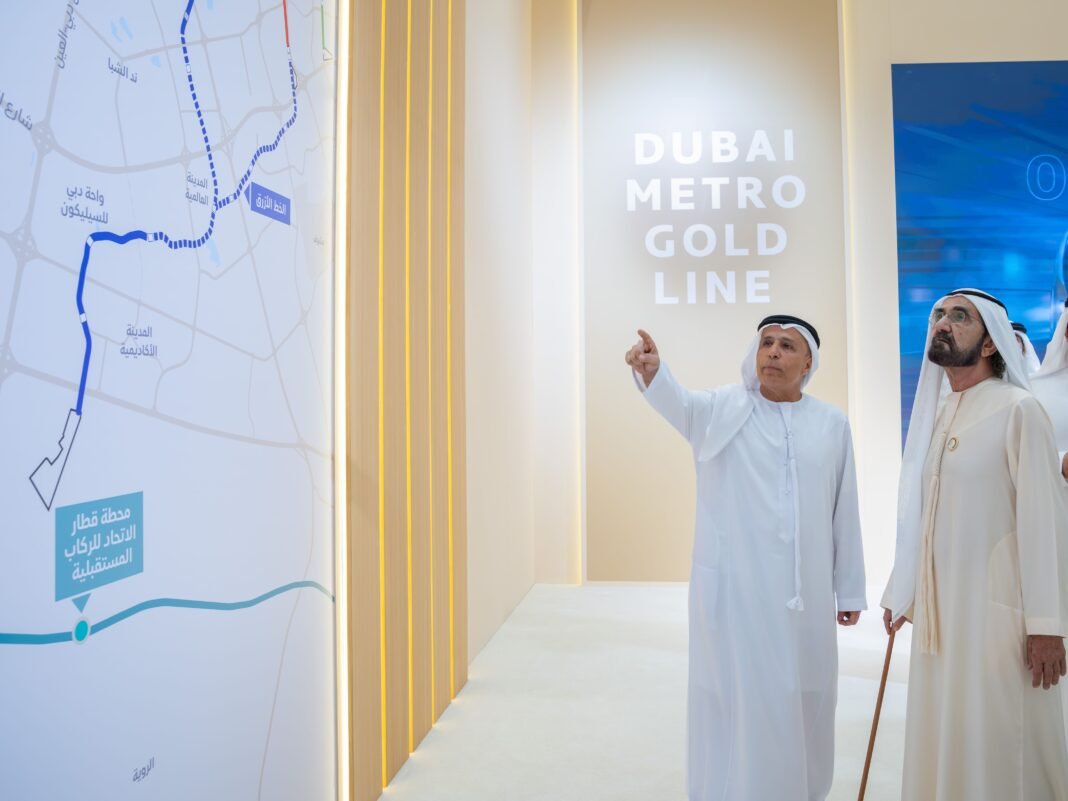
In what officials are describing as the largest transportation project in the history of Dubai, Sheikh Mohammed bin Rashid Al Maktoum, Vice President and Prime Minister of the UAE and Ruler of Dubai, on Wednesday officially unveiled plans for a new Dh34 billion Gold Line — a fully underground metro route set to dramatically reshape how more than 1.5 million people move across the emirate.
The announcement, made by Sheikh Mohammed via a post on X, comes at a pivotal moment for Dubai’s infrastructure ambitions and signals that the emirate’s most expansive phase of public transport investment is still only just beginning.
“Our landmark projects to position Dubai as the world’s best city to live in are on track. Our future endeavours will not stop; rather, they will accelerate.”
— HH Sheikh Mohammed bin Rashid Al Maktoum, April 22, 2026
Route, Stations & Key Areas
The Gold Line will stretch 42 kilometres — expanding the total Dubai Metro network by approximately 25 percent — and pass through 15 strategically chosen areas of the city. A total of 18 new stations will be built along the route. While the Roads and Transport Authority (RTA) has not yet officially confirmed the full station list, maps released by the Dubai Media Office suggest the line will serve a broad sweep of the city’s growing residential and commercial hubs.
Likely areas & interchange stations (based on released maps):
- Al Ghubaiba — interchange with existing metro network
- Business Bay — interchange station
- Jumeirah Golf Estates — interchange station
- Future Etihad Rail Station connection
- Jumeirah Village Circle (JVC)
- Dubai Hills
- Wasl Road corridor
- Nad Al Sheba
- Mohammed Bin Zayed Road corridor
- Global Village and Dubai Miracle Garden area
A defining engineering characteristic of the Gold Line is that it will be the first fully integrated underground route in Dubai — a distinction that separates it from both the Red and Green lines, which transition between tunnel and elevated viaduct sections. The Gold Line’s advanced underground tunnel network will be double the size of the metro’s current tunnel infrastructure.
The line will also link to 55 major real estate developments currently under construction across the emirate, underlining the Gold Line’s role not just as a passenger carrier but as a backbone for Dubai’s next wave of urban development.
Why the Gold Line Matters: Population & Congestion
Dubai’s population has grown at a pace that has consistently outrun transport planning. The Gold Line is a direct response to that pressure. The areas it serves — from the densely populated JVC to the fast-developing Dubai Hills corridor — are home to significant numbers of residents who currently lack a direct rail connection to the city’s core.
By linking these communities to the wider metro network at multiple interchange points, the Gold Line is expected to meaningfully shift commuter behaviour away from private vehicles. That modal shift is a central goal of Dubai’s broader Urban Master Plan, which envisions 25 percent of daily trips being made via public transport by 2030.
CONTEXT: DUBAI METRO NETWORK AT A GLANCE
Dubai Metro launched on September 9, 2009, becoming the Arabian Peninsula’s first rapid transit system. The Red and Green lines now cover 89.6 km across 55 stations. The Blue Line (Dh20.5 billion, 30 km, 14 stations) is under construction and opens September 2029. When the Gold Line opens in 2032, the total network will exceed 160 kilometres with more than 87 stations.
Dubai Metro Expansion Timeline
2009 Red Line opens on 9/9/09 — the Arabian Peninsula’s first metro.
2011 Green Line opens, completing the original two-line network.
2020 Route 2020 Red Line extension opens, linking the city to Expo 2020 site.
2024 Construction begins on the Dh20.5bn Blue Line (30 km, 14 stations).
2029 Blue Line opens September 9 — the metro’s 20th anniversary.
2032 Gold Line opens September 9 — Dh34bn, 42 km, 18 stations, fully underground. Network exceeds 160 km.
Frequently Asked Questions
What is the Dubai Metro Gold Line?
The Dubai Metro Gold Line is a new, fully underground, 42-kilometre metro line announced by Sheikh Mohammed bin Rashid on April 22, 2026. It will cost Dh34 billion ($9 billion), include 18 new stations, and serve approximately 1.5 million residents across 15 key areas of Dubai.
When will the Dubai Metro Gold Line open?
The Gold Line is scheduled to open on September 9, 2032 — the 23rd anniversary of the Dubai Metro’s original launch.
Which areas will the Gold Line serve?
Based on maps from the Dubai Media Office, the Gold Line is expected to serve Jumeirah Village Circle, Dubai Hills, Wasl Road, Nad Al Sheba, the Mohammed Bin Zayed Road corridor, and areas near Global Village and Dubai Miracle Garden. Full official station details are pending from the RTA.
How does the Gold Line differ from the Blue Line?
The Blue Line (Dh20.5bn, 30 km, 14 stations) opens in 2029 and serves areas like Mirdif and Dubai Silicon Oasis. The Gold Line (Dh34bn, 42 km, 18 stations) is larger in scope and is the first fully underground route in Dubai’s metro history, with no elevated viaduct sections.
How much does the Gold Line cost?
The Dubai Metro Gold Line carries a total investment of Dh34 billion (approximately $9 billion USD), making it the single largest transport project in Dubai’s history.