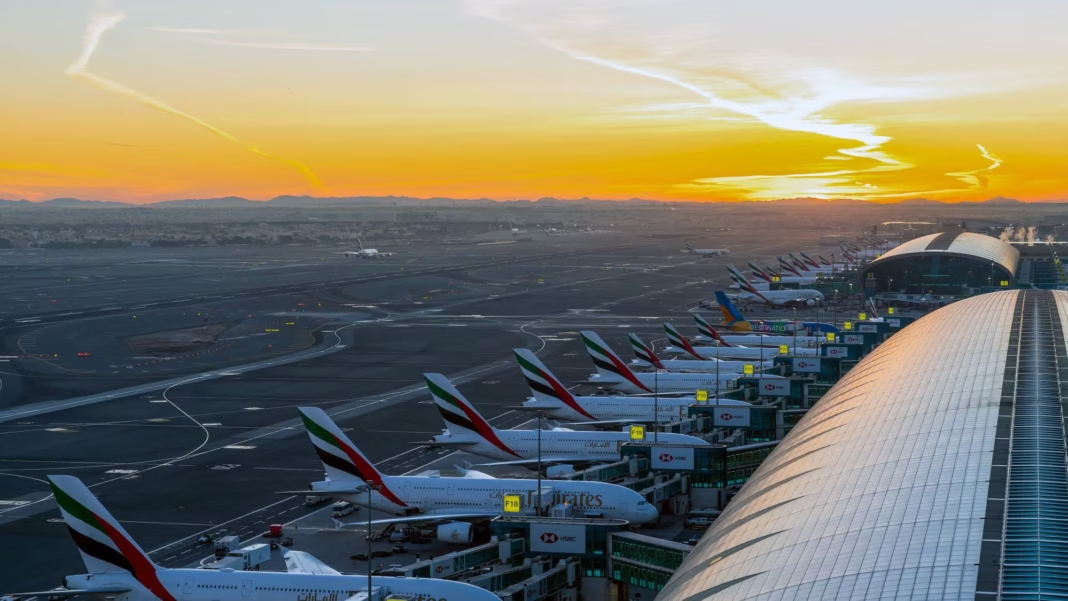
DUBAI, United Arab Emirates — Whether travelers are heading to Europe, Asia, Africa or the Americas, Dubai International Airport (DXB) continues to reinforce its role as one of the world’s most important connecting hubs, combining extensive global connectivity with increasingly seamless passenger experiences.
Fresh aviation data for July 2026 places DXB at the top of the world for scheduled international airline seat capacity, underscoring Dubai’s continued strength as a gateway for both business and leisure travelers.
According to aviation analytics firm OAG, Dubai International offered approximately 4.35 million international seats during July, placing it ahead of major global airports including London Heathrow, Amsterdam Schiphol, Seoul Incheon and Paris Charles de Gaulle.
Rather than being driven by a single tourism season, Dubai’s aviation success reflects the emirate’s year-round appeal as a destination and one of the world’s busiest transit hubs linking East and West.
More routes, more choice for travelers
For visitors planning holidays or business trips, Dubai’s extensive airline network continues to offer one of the widest selections of international destinations from a single airport.
The latest figures show international seat capacity at DXB increased by 18% compared with July 2025, highlighting growing airline demand and expanding global connectivity.
The airport has consistently ranked among the world’s busiest throughout 2026 after also leading global capacity rankings during the opening months of the year.
On an annual basis, Dubai International retained its position as the world’s busiest airport for international passenger traffic in 2025, recording 95.2 million passengers, the highest annual total in its history.
That momentum has continued into 2026, with 18.6 million travelers passing through DXB during the first quarter as airlines expanded services and regional airspace conditions stabilized.
Faster journeys through the airport
Beyond adding flights, Dubai has continued investing heavily in making the airport experience quicker and more convenient.
Recent improvements include the launch of a Smart Gates Eligibility Pre-Check, allowing eligible passengers to confirm before reaching immigration whether they can use the airport’s biometric smart gates.
Travelers can access the service through Pocket Flights, helping reduce uncertainty and shorten waiting times during busy travel periods.
Passengers who qualify can pass through immigration using facial recognition and biometric verification, completing the process within seconds instead of joining traditional passport queues.
The airport has also expanded its AI-powered “Travel Without Borders – Red Carpet” service, enabling eligible travelers to clear immigration using advanced biometric technology without presenting travel documents during processing.
Additional digital services—including real-time baggage tracking, digital wayfinding, family priority lanes and off-site baggage check-in—have also helped improve passenger flow across the airport.
A gateway beyond Dubai
While millions arrive to explore attractions such as the Burj Khalifa, Palm Jumeirah and Dubai Mall, DXB also serves as a strategic hub for travelers connecting across six continents.
Its extensive flight network makes Dubai an increasingly popular stopover destination, allowing visitors to combine international journeys with short city breaks before continuing to their final destinations.
As airlines continue expanding capacity and airport technology evolves, Dubai International is expected to remain at the forefront of global aviation, offering travelers faster processing, broader connectivity and one of the world’s most efficient international travel experiences.
For travelers departing or arriving in the UAE, DXB’s latest milestone reflects not only growing passenger demand but also Dubai’s continued investment in creating a smoother journey from check-in to takeoff.