

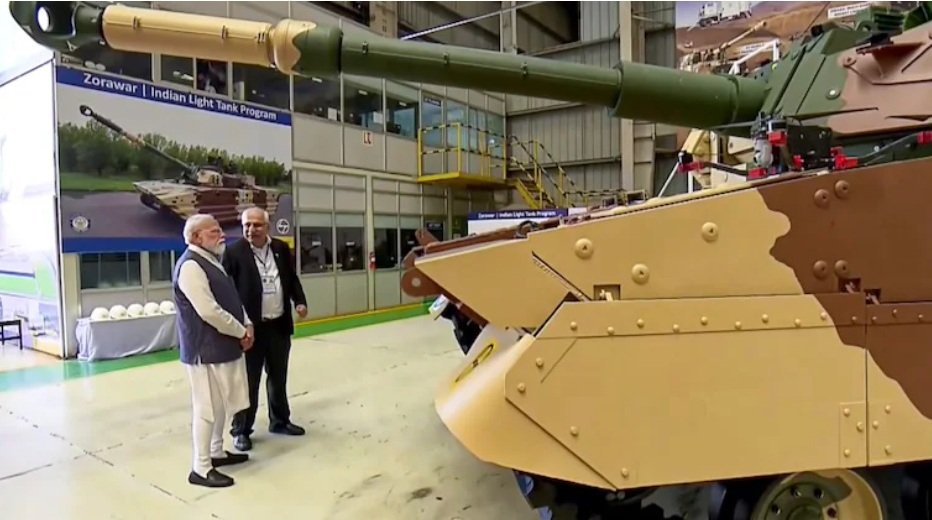
NEW DELHI – Prime Minister Narendra Modi turned the national spotlight on Larsen & Toubro on Friday, 5 June 2026, when he toured the company’s sprawling Hazira complex near Surat as part of a day-long Gujarat and Daman itinerary that carried a development outlay of more than ₹22,600 crore. The visit focused on industrial growth, transportation infrastructure, power transmission, healthcare, aviation and regional development, with the Hazira inspection positioned as one of its defining moments.
At the A.M. Naik Heavy Engineering Complex — India’s first armoured system complex built by a private firm, which Modi himself inaugurated in 2019 — company officials walked the Prime Minister through the facility’s defence and heavy-engineering portfolio. He reviewed the indigenous ‘Zorawar’ light tank and other defence systems being manufactured at the site. The Zorawar, developed jointly by the Defence Research and Development Organisation (DRDO) and L&T Defence, is designed to meet the Indian Army’s requirement for a highly mobile armoured platform capable of operating in high-altitude regions, particularly along the frontier with China. The air-transportable 25-tonne tank is built for rapid deployment, and the plant is also home to the K9 Vajra-T tracked howitzer and future infantry combat vehicles.
The complex showcased capabilities that extend well beyond armour. From building the massive pressure hulls for India’s nuclear-powered submarines to rolling out the K9 Vajra-T, the coastal facility handles mega-scale fabrications that few facilities globally can match, and a domestically manufactured 700 MW nuclear steam generator stood among the exhibits — a class of equipment only a handful of countries can produce at scale.
Modi captured the visit’s tone in a post on X afterward, writing that he had witnessed some of L&T’s pioneering innovations across different sectors and that the company’s role in furthering self-reliance in the defence sector was commendable. The Hazira plant is India’s largest private manufacturer of tracked armoured vehicles, and the visit reinforced New Delhi’s wider pivot toward a private-sector “Make in India” defence ecosystem under the Atmanirbhar Bharat banner.
The timing was notable on a second count: 5 June was also the day L&T held its 81st Annual General Meeting, capping a year the company described as among its strongest.
A conglomerate built over eight decades
L&T traces its origins to 1938, when Danish engineers Henning Holck-Larsen and Søren Kristian Toubro founded the firm in India, formally incorporating it in 1946. From those beginnings it has grown into one of India’s most diversified industrial houses, headquartered in Mumbai and operating across more than 50 countries with a workforce numbering in the hundreds of thousands. S.N. Subrahmanyan serves as Chairman and Managing Director, having become CEO and MD in 2017 and Chairman and MD in October 2023, succeeding A.M. Naik.
The group’s reach spans engineering, procurement and construction (EPC) across buildings, transport and urban infrastructure; hydrocarbon onshore and offshore; heavy engineering; power transmission and distribution; defence and shipbuilding; green energy; IT services through LTIMindtree and L&T Technology Services; financial services; and real estate. As of 2024, L&T is India’s largest private-sector defence manufacturer by revenue and is expanding into space launch vehicles and satellites.
The numbers behind the year underline the scale. For FY 2025-26, L&T reported revenue of ₹2.86 lakh crore, up 12 per cent, with recurring profit after tax of ₹17,238 crore. Its consolidated order book stood at an all-time high of ₹7.40 lakh crore as of 31 March 2026, a 28 per cent jump over the previous year, with international orders making up 52 per cent of the book. The company has now completed its Lakshya 2026 strategic plan and launched its next five-year trajectory, Lakshya 2031.
The Gulf at the centre of the international story
Much of L&T’s international momentum runs through the Gulf, a region where the company has been a fixture for decades — having helped build Abu Dhabi’s airport and, more recently, anchored itself across the GCC’s energy and infrastructure boom. More than 30 per cent of the group’s turnover comes from international markets, especially the Gulf region, and international orders contributed 67 per cent of the total order inflow in the fourth quarter of the last financial year.
The single largest contract in the company’s history came from the region. In March 2025, L&T won a roughly US$4 billion order from QatarEnergy LNG for two offshore compression complexes under the North Field Production Sustainability Offshore Compression Project. Across the energy transition, the company has positioned itself as a leading EPC partner: it secured the EPC contract for the 1,800 MW Phase 6 of Dubai’s Mohammed bin Rashid Al Maktoum Solar Park, and in Saudi Arabia it has worked on the world’s largest green hydrogen plant with NEOM Green Hydrogen Company at Oxagon, later signing an MOU with ACWA Power for the Yanbu Green Ammonia Project.
The power transmission and distribution business has been particularly active, winning substation and high-voltage line contracts across the UAE, Saudi Arabia, Qatar and Kuwait, and serving utilities including DEWA, Transco, SEC, Saudi Aramco, Kahramaa and OETC across more than 50 regional projects. At WETEX 2025 in Dubai, where it was platinum sponsor, L&T highlighted its role in driving the GCC’s energy transition with 11 major renewable projects and a global track record of more than 35 GWp of solar and 16 GWh of battery storage.
Taken together, the Hazira visit and the company’s order-book milestones tell a single story: a 1938 engineering partnership that has become both a pillar of India’s industrial self-reliance ambitions and one of the most prolific builders shaping the Gulf’s energy and infrastructure future.