

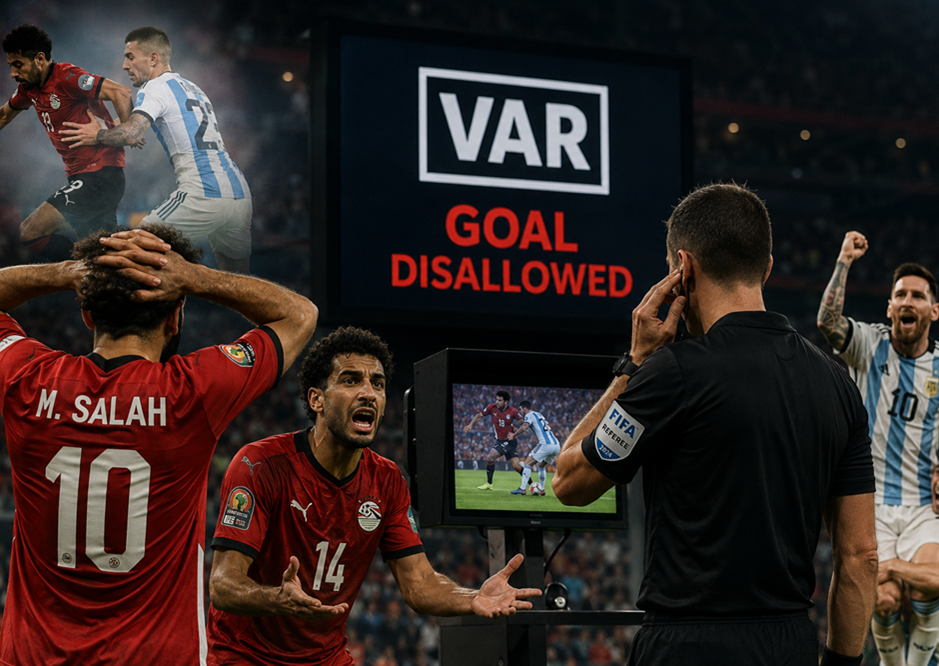
There is a particular kind of silence inside a football stadium when a goal is celebrated and then taken away after a video review. That silence fell over Atlanta Stadium on July 7 when Mostafa Zico’s second goal for Egypt against Argentina was ruled out following a VAR intervention.
Egypt still led 2-0 shortly afterwards. Then Argentina, inspired by Lionel Messi, scored three goals in 13 minutes to complete a dramatic 3-2 victory. Egypt were eliminated, and what could have been remembered as one of the tournament’s biggest upsets instead became another major controversy surrounding VAR.
Argentina’s technical quality, tactical discipline and Lionel Messi’s extraordinary ability to influence a game are beyond question. The debate after this match is not about Argentina’s football. It is about the consistency of officiating and the application of VAR.
The turning point
Egypt were leading 1-0 when Zico appeared to double the advantage just after the hour mark. Referee François Letexier initially allowed the goal before being advised to review the incident. After watching the monitor, he ruled that Egyptian midfielder Marwan Attia had fouled Lisandro Martínez earlier in the attacking move.
The goal was disallowed.
The decision immediately divided former players, referees and television analysts.
Former Mark Clattenburg said he did not believe a foul had occurred and questioned why VAR became involved after the referee had allowed play to continue. FOX Sports analyst Rob Green described the incident as being “a full pitch away” from the goal and argued that VAR had gone well beyond its intended role.
Egyptian football analyst Ahmad Yousef raised another question during BBC Radio 5 Live coverage. Would the same level of scrutiny have been applied if the player involved had been Lionel Messi rather than an Egyptian defender?
The debate intensified because videos circulated online highlighting three earlier Argentina goals in the tournament that appeared to involve possible fouls during the build-up but were never reviewed in the same manner.
Egypt’s frustration increased further when coach Hossam Hassan claimed his team should have received a penalty after Mohamed Salah was challenged before Argentina’s stoppage-time winner. Speaking after the match, Hassan openly questioned the referee’s decisions.
The law and the controversy
According to International Football Association Board protocol, VAR is permitted to review the entire attacking phase leading to a goal rather than only the final action. From a technical standpoint, the intervention fell within the Laws of the Game.
The controversy lies elsewhere.
Many observers questioned why this particular attacking phase received such extensive examination while similar incidents in other matches appeared to receive far less attention. Whether the decision was technically correct is only part of the discussion. Consistency remains the larger issue.
This is not a problem limited to Argentina. VAR has produced contentious decisions throughout the tournament involving several teams. That broader inconsistency has only strengthened criticism of the system and increased doubts about its application.
Other key decisions
The referee’s decisions did not favour Argentina throughout the match. Argentina were awarded a first-half penalty, but Messi failed to convert it, allowing Egypt to retain their lead.
However, Egypt also appealed for fouls inside Argentina’s penalty area, including incidents involving shirt-pulling and blocking. Those appeals received no review. Combined with the disallowed goal and the rejected penalty claim before Argentina’s winning goal, many Egyptian supporters were left feeling that similar incidents were not being judged by the same standard.
Football supporters usually accept difficult decisions when they believe both teams are being treated equally. It becomes far harder to accept when comparable incidents appear to produce different outcomes.
A question of confidence
There is no evidence that officials deliberately favoured Argentina. No investigation, report or official finding supports such a conclusion.
Even so, football depends heavily on confidence in its officiating. When supporters repeatedly see similar incidents producing different outcomes, doubts inevitably grow.
The controversy has shifted attention away from what was, by any measure, a remarkable comeback. Instead of discussing Argentina’s recovery from two goals down, much of the conversation after the final whistle centred on VAR and whether similar incidents are being judged consistently.
Ultimately, this match will be remembered not only for Argentina’s recovery from two goals down, but also for another debate about whether football’s most powerful officiating tool is being applied consistently. Until that question is answered convincingly, VAR will continue to dominate discussions long after the final whistle.
Dr. K.T. Abdurabb is a Gulf-based journalist, writer, and media professional who writes on social, cultural, and general affairs. With decades of experience in journalism and communication, he has contributed extensively to discussions on diaspora issues and contemporary society.