
ABU DHABI – The UAE’s readers are spending more time with audio and digital content and slightly less time with printed books — but they want to read more, they’re reading in Arabic more than before, and they feel better than ever about Emirati literature. Those are among the more telling findings from the UAE National Reading Index 2025, released Monday by the Ministry of Culture.
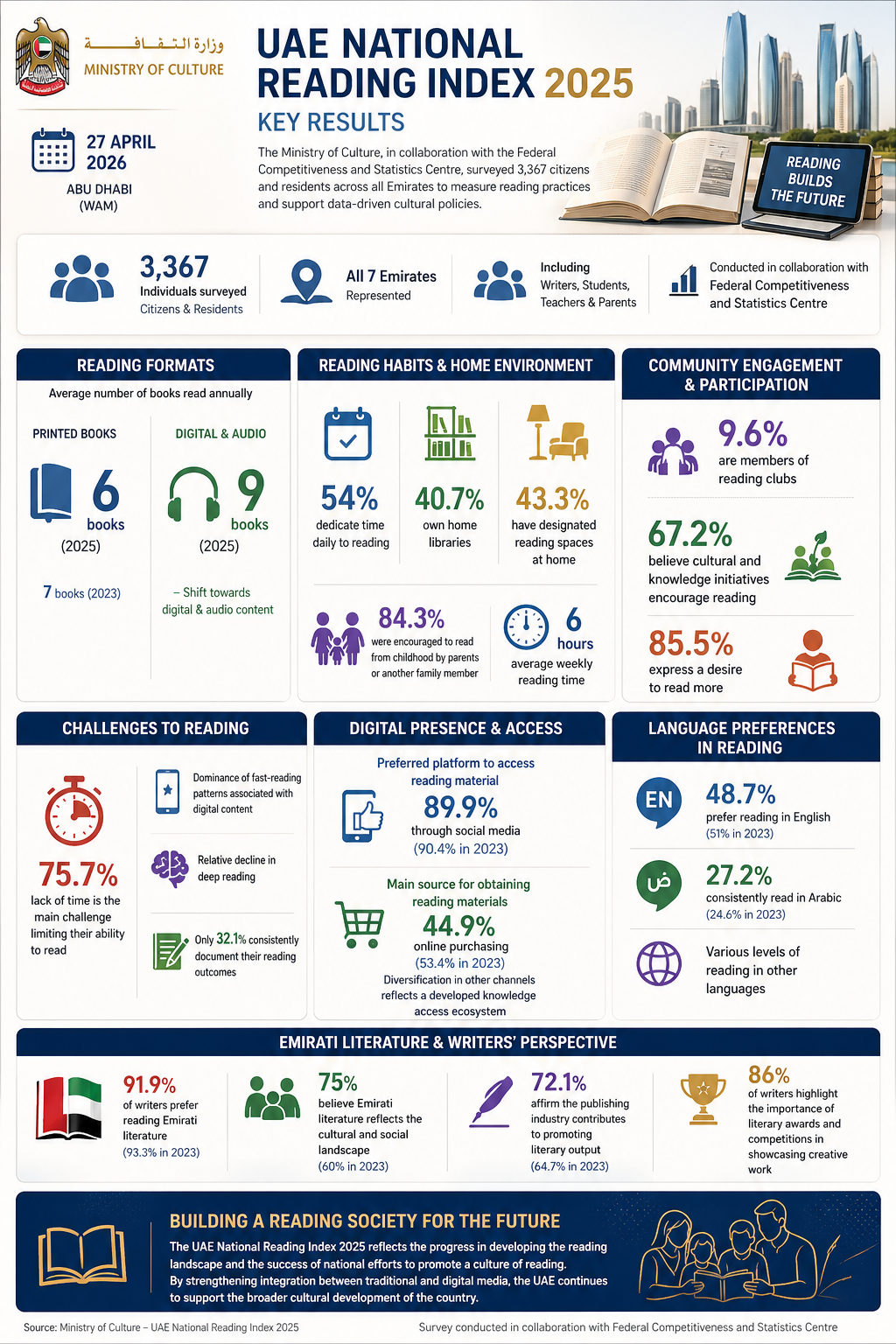
The biennial survey — which tracks how the country reads, what it reads and in which languages — covered 3,367 citizens and residents across all seven emirates, along with a dedicated cohort of writers, students, teachers and parents. It was conducted in collaboration with the Federal Competitiveness and Statistics Centre.
The headline number is a small retreat on paper: the average number of books read annually per individual, which had risen from six in 2021 to seven in 2023, slipped back to approximately six printed books in 2025. But that dip looks less like declining interest and more like a migration. Digital and audio formats recorded an average of nine books annually — a figure the index interprets as a shift in format rather than a step back from reading itself.
That reading is still very much part of daily life comes through clearly in the numbers. Fifty-four per cent of those surveyed said they dedicate time to reading every day. The average weekly reading time stands at six hours. More than 40 per cent own home libraries, and 43.3 per cent have set aside a dedicated reading space at home — small but meaningful signs that books, in some form, remain part of the domestic fabric.
The digital wall is everywhere
Social media’s grip on how people in the UAE access reading material remains almost total. Some 89.9 per cent of respondents said they access reading content through social media platforms — a figure that was 90.4 per cent in 2023 and 88.1 per cent in 2021, suggesting the ceiling has largely been reached. What the 2025 data adds to this picture is a note of concern: the index flags a growing dominance of fast-reading patterns associated with digital consumption, alongside what it describes as a relative decline in deep reading. Only 32.1 per cent of respondents said they consistently document or organise what they have learned from reading — a figure that raises questions about how much of all that scrolling is actually sticking.
Time, as ever, is the main obstacle. Three in four respondents — 75.7 per cent — cited lack of time as the primary reason they don’t read more. Yet 85.5 per cent said they want to read more. The gap between aspiration and habit is wide, and the index identifies it as one of the more pressing policy challenges going forward.
Arabic making a quiet comeback
One of the more quietly significant trends in the 2025 data concerns language. In 2023, 51 per cent of readers said they preferred to read in English, while 24.6 per cent read exclusively in Arabic. In 2025, that ratio shifted: English preference fell to 48.7 per cent, while consistent reading in Arabic climbed to 27.2 per cent. It is a modest swing, but given the direction of travel over previous years, it is notable — and likely reflects both the UAE’s Arabic cultural programming and a growing body of Arabic-language digital content.
The perception of Emirati literature took an even more striking turn. In 2023, only 60 per cent of writers believed Emirati literature reflected the cultural and social landscape — a drop from 80.1 per cent in 2021, that had raised eyebrows at the time. The 2025 index shows that figure rebounding strongly, to 75 per cent. The percentage of writers who believe the publishing industry contributes to promoting literary output also rose, from 64.7 per cent in 2023 to 72.1 per cent — closer to the 72.8 per cent recorded in 2021. Literary awards and competitions were singled out by 86 per cent of writers as important to showcasing creative work.
The family connection
Perhaps the most enduring finding in the index is about where reading habits begin. An overwhelming 84.3 per cent of respondents said they were encouraged to read in childhood by a parent or family member. The index reads this as confirmation that the home remains the most powerful environment in which reading culture is formed — and that any policy aimed at building a reading society needs to reach families first.
Membership in reading clubs remains the outlier: just 9.6 per cent of community members belong to one, pointing to an area where growth is both possible and, in the index’s framing, desirable.
Mubarak Al Nakhi, Undersecretary of the Ministry of Culture, said the results confirm the impact of cultural and digital initiatives on reading behaviour. “This index serves as a strategic tool to support decision-makers and guide cultural policies towards more impactful and sustainable initiatives,” he said, adding that programmes targeting all segments of society would continue to be developed.
The 2025 index is the fourth in the series, following editions in 2021, 2023 and the inaugural cycle before that. Together, they trace a society navigating a global shift in how content is consumed — one that the UAE is trying to shape rather than simply absorb.
The full results are available through the Ministry of Culture.