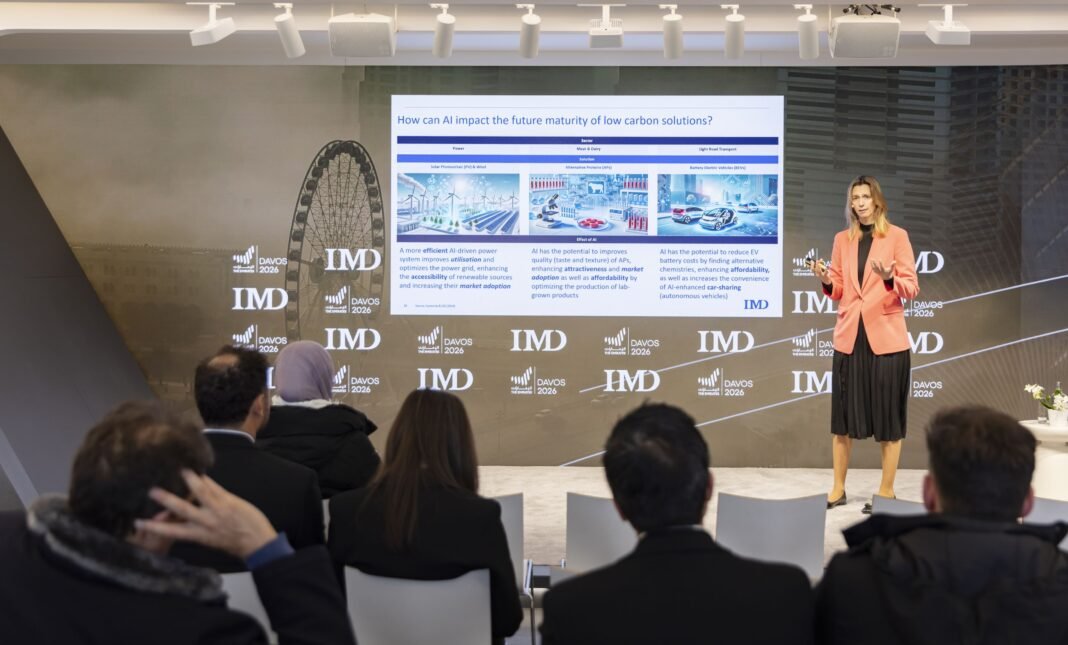
DAVOS, Jan 19, 2026 (WAM) — The UAE Pavilion at the 56th Annual Meeting of the World Economic Forum, being held in Davos, Switzerland from Jan. 19 to 23, hosted a high-level dialogue titled “Artificial Intelligence, Sustainability, and the Question of What We Optimise For.”
The session examined the evolving relationship between artificial intelligence and sustainability, focusing on whether current economic and technological models prioritise easily measurable outcomes such as short-term efficiency and immediate returns, or adequately account for long-term value creation for the economy, society and the environment within clear strategic frameworks.
Delivered by Professor Julia Binder, Professor of Business Transformation at IMD Business School, the session brought together young global leaders participating in the Forum. It addressed the fundamental shift artificial intelligence is driving in how institutions approach growth, value creation and competitiveness.
The discussion highlighted the need to redefine the concept of value in the age of artificial intelligence. Professor Binder said economies best positioned to lead the next phase will be those that align algorithms with societal and environmental priorities, rather than relying solely on short-term efficiency and profitability metrics.
She noted that artificial intelligence can act as a powerful accelerator of sustainability when models are designed to optimise resource use, reduce waste and enable responsible innovation across value chains.
Drawing on her academic and practical experience in organisational transformation, Professor Binder said the central challenge has shifted from what can be optimised technically to what should be optimised strategically to support long-term economic sustainability and build future-ready organisations.
The session underscored the role of leadership in guiding this transformation, emphasising that decisions on adopting artificial intelligence are fundamentally leadership and ethical choices before they are technical ones. Participants highlighted the importance of leaders’ ability to interpret global signals of change and translate them into clear strategies, adaptive business models and responsive organisational cultures.
The dialogue also explored the circular economy as a key driver of competitiveness in the coming decade, noting that artificial intelligence can support the transition to more efficient and sustainable production and consumption models by optimising value chains, enhancing design-led innovation and linking sustainability with economic growth.
Participants discussed the need to view global challenges, including climate change, environmental pressures and resource constraints, as catalysts for rethinking business models rather than barriers to growth. They said organisations that embed sustainability at the core of their strategies are more likely to achieve long-term competitive advantage and gain the confidence of markets, investors and societies.
The discussion also highlighted the importance of education and capacity building, stressing that investment in leadership skills, strategic thinking and cross-disciplinary collaboration is critical to fully realising the potential of artificial intelligence. It underscored the need to strengthen links between research and practical application to ensure lasting impact.
The session concluded by reaffirming that artificial intelligence and sustainability are not separate tracks but an integrated pathway shaping the future of the global economy, with participants noting that the key question for leaders is not what can be optimised today, but what must be optimised to ensure sustainable prosperity for future generations.