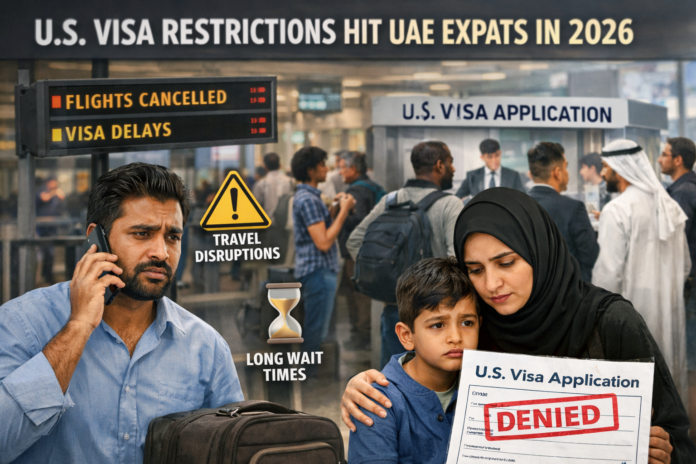

FUJAIRAH, United Arab Emirates – A sweeping U.S. visa policy expansion, effective January 1, 2026, under Presidential Proclamation 10998 titled “Restricting and Limiting the Entry of Foreign Nationals to Protect the Security of the United States,” is creating indirect challenges for expatriates in the United Arab Emirates, particularly within the diverse Indian community.
The proclamation imposes full or partial suspensions on visa issuance for nationals of 39 countries, plus individuals using travel documents issued or endorsed by the Palestinian Authority. Full restrictions apply to 19 countries—including Afghanistan, Burkina Faso, Burma (Myanmar), Chad, Republic of the Congo, Equatorial Guinea, Eritrea, Haiti, Iran, Laos, Libya, Mali, Niger, Sierra Leone, Somalia, South Sudan, Sudan, Syria, and Yemen—barring both immigrant and most nonimmigrant visas (with limited exceptions, such as for lawful permanent residents or certain major events). Partial restrictions affect another 19–20 countries, including Angola, Antigua and Barbuda, Benin, Burundi, Côte d’Ivoire, Cuba, Dominica, Gabon, The Gambia, Malawi, Mauritania, Nigeria, Senegal, Tanzania, Togo, Tonga, Venezuela, Zambia, Zimbabwe, and in some cases Turkmenistan, limiting categories like B-1/B-2 visitor visas, F/M/J student and exchange visas, and all immigrant visas.
While the UAE itself is not on the restricted list, the policy’s impact is felt keenly in the Emirates’ multicultural workforce and resident population. The UAE hosts millions of expatriates from around the world, including significant numbers from affected nations such as Nigeria, Pakistan (though not always explicitly listed in the core 39 but overlapping in related pauses), Iran, Afghanistan, Sudan, and Syria. Many of these individuals hold UAE residency visas and passports from their home countries, making them subject to the new U.S. curbs when applying for American visas for business, tourism, family visits, education, or professional opportunities.
For the large Indian expatriate community in the UAE—estimated at over 3.5 million—the effects are often indirect but notable. Indians in the Emirates frequently hold diverse passports due to dual citizenship options, family ties, or birth circumstances in neighboring or restricted countries. Mixed-nationality families, where one spouse or child carries a passport from a listed nation, now face heightened scrutiny, longer processing times, or outright denials for U.S. travel. Business professionals in Dubai and Abu Dhabi’s global hubs, who travel frequently to the U.S. for meetings, conferences, or investments, report increased uncertainty when family members or colleagues from restricted backgrounds are involved in group travel or sponsorships.
Community leaders in the UAE’s Indian associations have voiced concerns about disrupted family reunions, postponed educational pursuits for children studying in the U.S., and strained cross-border business networks. “It’s not just about one nationality—it’s the interconnected fabric of expat life here,” said one Dubai-based Indian entrepreneur, speaking anonymously. “A colleague’s Nigerian passport or a relative’s Iranian ties can suddenly complicate what used to be routine U.S. visa applications.”
The U.S. Department of State emphasizes that these measures stem from national security, public safety, and immigration enforcement priorities, including concerns over vetting cooperation from the listed countries. Applicants from affected nations may still submit applications and attend interviews, but issuance remains suspended or limited, with existing valid visas (issued before January 1, 2026) generally unaffected.
Expatriates in the UAE are advised to check the latest guidance on travel.state.gov, consult U.S. consular services in Dubai or Abu Dhabi, and consider alternative travel plans if U.S. entry is essential. As global mobility evolves under these new rules, the Emirates’ role as a cosmopolitan hub continues to test the resilience of its international residents.