
By. KT Abdurabb
As the crescent moon is sighted or awaited across skies from the Gulf to South Asia, Ramadan begins—likely on February 19 in many places like the UAE, India (including Kerala and Mumbai), and parts of Asia, or possibly February 18 in some regions, pending final local confirmations.
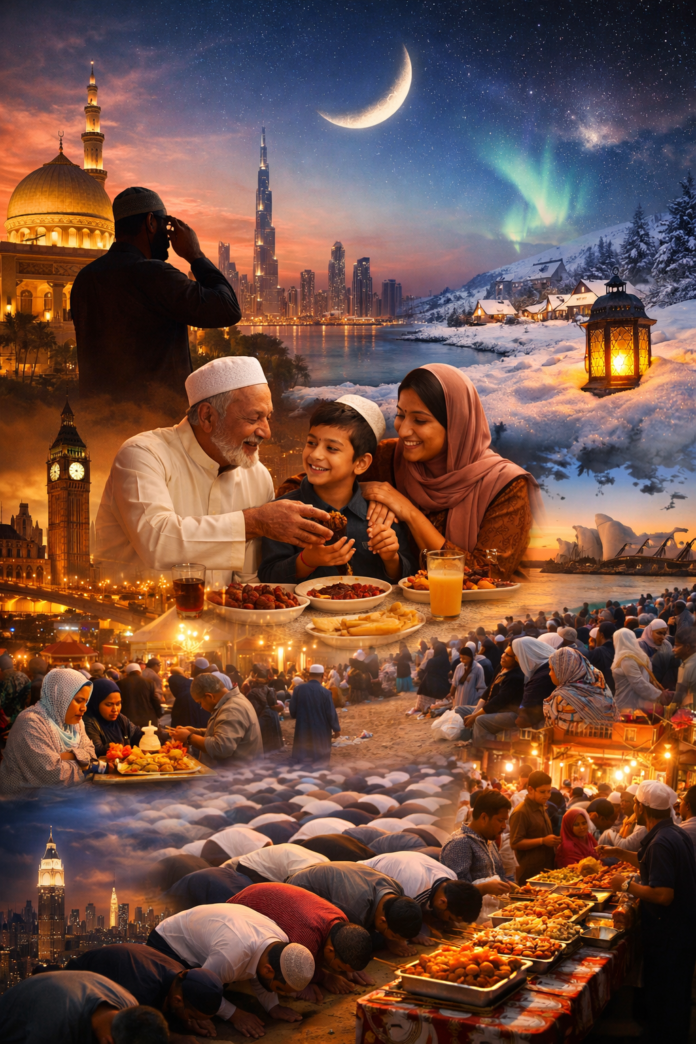
For Muslims worldwide, this holy month brings deep joy and renewal: the quiet intimacy of pre-dawn suhoor with family, the burst of gratitude at iftar as the adhan rings and dates are shared, and the communal warmth of taraweeh prayers and charity that binds hearts closer to faith and each other. “Ramadan isn’t just about going without food—it’s about nourishing the soul, building patience, and feeling that unbreakable connection,” says a resident in Sharjah, echoing the happiness that transforms everyday moments into something sacred from bustling Mumbai streets to quiet Toronto neighborhoods.
What adds a fascinating layer this year is how the fast’s length—from fajr to maghrib—shifts by geography, influenced by latitude and the season (late winter in the north, late summer in the south). In 2026, as Ramadan falls near the spring equinox, hours are more uniform globally than in some years, typically ranging 12–15 hours, but variations still create unique experiences and traditions.
In the Gulf—UAE (Dubai/Sharjah ~12 hours 45 minutes on early days), Saudi Arabia (Riyadh ~12 hours 45 minutes), Qatar (~12 hours 40 minutes)—the manageable length allows ample time for night prayers, family gatherings, and vibrant iftar buffets or street food markets. Shorter fasts in northern Europe (UK London ~12 hours, Germany Berlin ~12 hours, Netherlands Amsterdam ~12 hours, even Finland Helsinki dipping to around 11–12 hours in some calculations) often mean more energy for extended community events, like larger mosque iftars or cultural programs, turning the evenings into lively hubs of reflection and connection.
Equatorial and mid-latitude spots offer steady balance: India (Mumbai ~13 hours, Kerala similar), Malaysia (Kuala Lumpur ~13 hours 20 minutes), Singapore (~13 hours), Thailand (Bangkok ~13 hours), Philippines (Manila ~13 hours)—where tropical warmth encourages outdoor bazaars, shared meals with local flavors like nasi lemak or adobo-inspired dishes, and a rhythm that blends fasting with daily life seamlessly.
In the US, New York (~12 hours) sees diverse iftars at mosques or halal spots amid city energy, while San Diego (~12.5 hours) adds a relaxed coastal vibe. Canada (Toronto ~12 hours 15 minutes, Vancouver similar) brings cozy indoor gatherings with hot soups against the chill. Italy (Rome ~12.5 hours) and Switzerland (Zurich ~12 hours) highlight growing communities blending heritage with local customs.
Farther south, longer fasts test resilience and inspire adaptation: Australia (Sydney ~14–15 hours) sees beach prayers and barbecues shifted to evenings, with extra hydration prep and community support. Globally, extremes push further—southern spots like New Zealand (Christchurch ~14–15 hours) or Chile emphasize endurance with fortified suhoor meals and family solidarity, while far northern areas (e.g., parts of Scandinavia, Iceland, or Greenland) can reach 16+ hours (even nearing 20 in extremes), leading to special rulings for very long days, like combining prayers or estimating times, and stories of remarkable perseverance shared in online forums or mosques.
These differences—shorter fasts enabling more worship focus in the north, longer ones building deeper discipline in the south—underscore Ramadan’s beauty: the same devotion, tailored by the sun’s path, yet uniting billions in spirit. From the call echoing over Dubai’s towers to reflections in Vancouver’s streets, it’s a shared journey—one sunrise and sunset at a time—where the true reward lies in the heart, not the hours.
- Dr. KT Abdurabb is a UAE based writer and journalist.