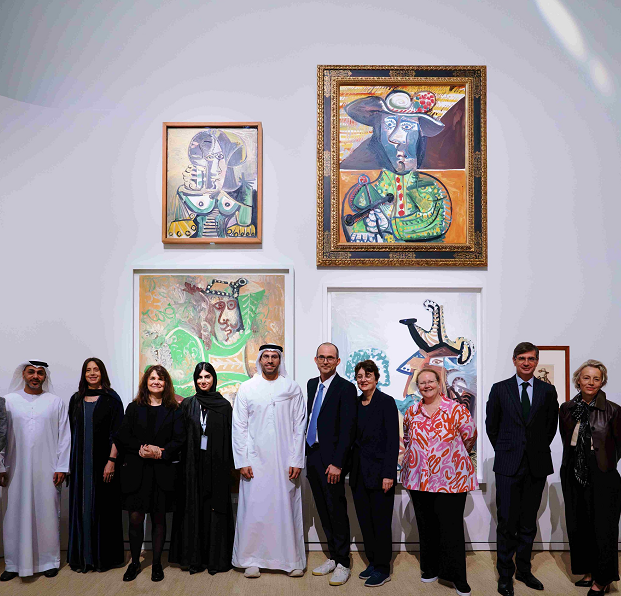
Abu Dhabi, Jan 21, 2026 — From fractured Cubist bodies to myth-laden hybrids and bold late figures, a major exhibition opening at Louvre Abu Dhabi charts Pablo Picasso’s lifelong obsession with the human form, while tracing the artist’s dialogue with cultures far beyond Europe.
Titled Picasso, the Figure, the exhibition runs until May 31 and brings together more than 130 works spanning the Spanish master’s career, positioning figuration as the central thread in the artistic revolutions that defined the 20th century.
Presented in collaboration with the Musée national Picasso–Paris and France Muséums, the show follows Picasso’s transformations from early Cubist experiments through classical portraiture, Surrealism and his expressive late paintings. It unfolds as a chronological journey, linking radical shifts in style to recurring mythological and symbolic archetypes.
Curated by Cécile Debray, President of the Musée national Picasso–Paris, Virginie Perdrisot-Cassan, Chief Curator and Head of Sculpture and Ceramics at the same institution, and Aisha AlAhmadi, Associate Curator at Louvre Abu Dhabi, the exhibition interweaves painting, sculpture, drawing and ceramics. Greek mythology, particularly the figure of the Minotaur, emerges as a key reference through which Picasso explored metamorphosis, power and psychological tension.
Seven works from Louvre Abu Dhabi’s own collection and six from the Department of Culture and Tourism – Abu Dhabi are shown alongside major loans from institutions and collections in France, Qatar, Lebanon, the United Arab Emirates and across West Asia. Contributors include the Musée du Louvre in Paris, Mobilier National, Mathaf: Arab Museum of Modern Art in Doha, the Dalloul Art Foundation in Beirut, Meem Gallery in Dubai and the Barjeel Art Foundation in Sharjah.
The exhibition also places Picasso in conversation with the modern Arab world. Works by six Arab artists are featured, underscoring the Spanish artist’s influence beyond Europe. Among them are paintings by Iraqi artists Dia al-Azzawi, Jewad Selim and Shakir Hassan Al Said, Egyptian artist Ramses Younan, and a painted ceramic work by Algerian artist Baya Mahieddine. Mahieddine’s Paris exhibition in 1947 attracted the attention of Surrealists and Picasso himself, highlighting a reciprocal artistic exchange.
Visitors enter the exhibition through footage from Le Mystère Picasso, Henri-Georges Clouzot’s film capturing the artist at work, before moving through five thematic sections. Early galleries examine how Catalan sculpture and African and Oceanic art informed Picasso’s simplification of the body and the emergence of Cubism. A later return to classicism reflects his engagement with ancient models and the European masters.
Surrealist works inspired by mythological creatures reveal a fascination with hybridity and inner conflict, while increasingly monumental figures from the 1930s echo prehistoric idols and respond to the emotional weight of war. One pivotal moment juxtaposes Dora Maar’s photographs documenting the creation of Guernica with Dia al-Azzawi’s Elegy to My Trapped City (2011), drawing parallels between their use of art as political expression.
The final section brings together Picasso’s late works, marked by bold colour, liberated line and multiple viewpoints. Musketeers, matadors and other archetypes signal a renewed engagement with his Spanish identity.
Alongside the exhibition, Louvre Abu Dhabi has curated a programme of talks, films and educational activities, including screenings of Mystery of Picasso and Young Picasso, children’s pathways through the galleries, guided tours and hands-on drawing sessions. A podcast and a trilingual catalogue in Arabic, English and French accompany the show.
Picasso, the Figure offers a sweeping view of an artist who continually reinvented representation, while reflecting Louvre Abu Dhabi’s broader mission to connect global artistic narratives through cross-cultural exchange.