
From the Gulf Desk
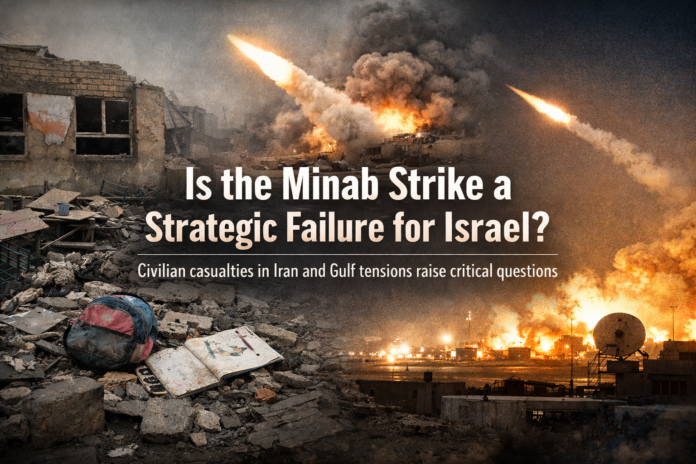
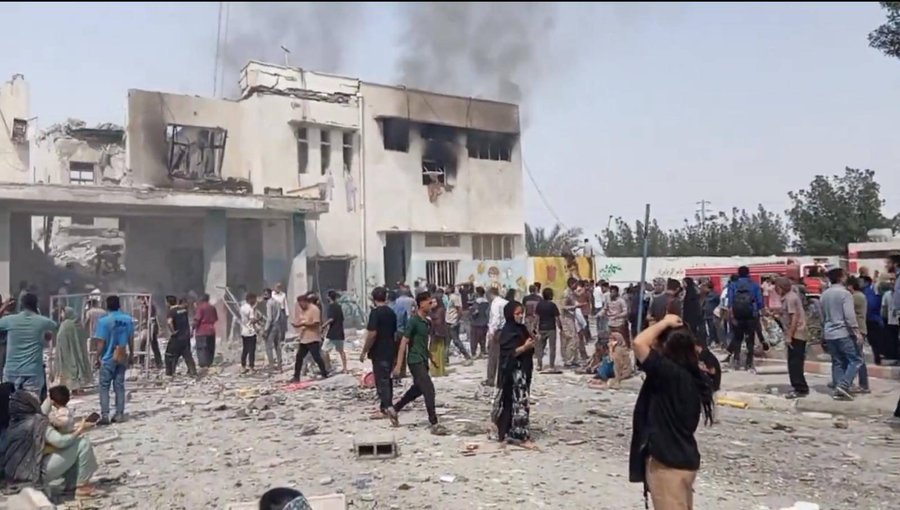
The reported Israeli-US strike on the Shajareh Tayyebeh girls’ primary school in Minab, in Iran’s Hormozgan province, has become one of the most emotionally charged episodes in the current escalation. Iranian state media say at least 40 people — mostly students aged seven to 12 — were killed, with dozens more wounded. Independent verification remains limited due to restricted access for international media.
Iranian officials insist the school was directly targeted. Others suggest its proximity to an Islamic Revolutionary Guard Corps facility may have made it a collateral victim or a misidentified site. In modern warfare, that distinction matters legally — but politically and psychologically, it often does not.
For Gulf audiences, the central question is stark: has the Minab strike, intended to weaken Tehran’s capabilities, instead become a strategic failure for Israel?
A country divided, but fiercely national
Iran has been under severe internal strain. Protests over economic hardship, inflation, currency collapse and political repression have exposed deep dissatisfaction with the Islamic Republic. Thousands have reportedly been killed in crackdowns in recent years. Disillusionment is real.
Yet Iran also has a strong tradition of nationalism rooted in resistance to foreign interference — from the 1953 US-backed coup to the Iran-Iraq War. Even many regime critics draw a sharp line between opposing their government and opposing their country.
External military strikes, especially those perceived as harming civilians, can trigger the classic “rally round the flag” effect. Internal grievances are temporarily sidelined in favour of national unity against an outside threat.
If the Minab strike is widely believed inside Iran to have killed schoolchildren, it risks activating exactly that dynamic, potentially strengthening the very regime Israel aims to weaken.
The narrative battle
Here the war is not only kinetic but narrative.
Iranian state media have framed the incident as deliberate civilian targeting. Social media — both inside Iran and in the diaspora — has amplified outrage, with emotionally charged language dominating online discourse.
In conflicts across the region, perception often travels faster than facts, and once fixed, it is difficult to reverse.
From a strategic standpoint, this hands Tehran a powerful tool. Civilian deaths, particularly of children, are uniquely potent symbols. They can:
• Strengthen hardliners who argue that compromise with the West is impossible.
• Justify harsher domestic crackdowns under the banner of national defence.
• Undermine sympathy abroad for Israeli and US military objectives.
History offers parallels. Civilian casualties in the 2006 Lebanon war bolstered Hezbollah’s standing. US strikes in Iraq and Afghanistan that hit non-combatants often deepened resentment and prolonged conflict. Even when militarily justified, civilian harm has repeatedly reshaped political outcomes.
Strategic logic versus strategic optics
From an Israeli and US perspective, the broader campaign is framed as a pre-emptive effort to degrade missile capabilities and prevent future threats.
If the school was near a military installation, Israeli officials might argue the strike targeted legitimate assets and any civilian harm was unintended collateral damage.
That argument may satisfy legal thresholds in wartime — but it rarely satisfies public emotion.
Wars are fought as much in perception as in precision. Even if collateral, the image of a destroyed school overwhelms technical explanations. For critics, especially in Iran and across parts of the region, the strike reinforces narratives of indiscriminate force and external aggression.
Iran’s subsequent attacks on Gulf states — Al Dhafra in the UAE, the 5th Fleet in Bahrain, and Al Udeid in Qatar — have created widespread negative sentiment in the region. Gulf states are unlikely to show sympathy toward Tehran, complicating Iran’s regional standing and further isolating it politically.
If Israel’s broader objective includes encouraging internal pressure on Tehran’s leadership, civilian casualties may be counterproductive. Calls from Washington urging Iranians to rise up sit uneasily alongside images of bombed neighbourhoods.
 A risky gamble
Strategically, the Minab incident appears — at least in the short term — to be a liability for Israel.
It risks:
• Consolidating public support around a regime that had been facing domestic unrest.
• Providing Tehran with propaganda leverage.
• Complicating regional alliances already strained by retaliation across the Gulf.
For Gulf states already navigating missile alerts, airspace closures, and economic uncertainty, the attack reinforces fears about regional instability and pushes local governments further from Iran.
At the same time, war outcomes are fluid. If Iran’s military capabilities are significantly degraded and the regime weakens structurally, the strike may be judged within a broader calculus of cost and gain. If casualty figures are later revised or disputed, perceptions could shift.
But in the immediate aftermath, the emotional and symbolic weight of reported child casualties is profound.
The broader regional stakes
Some observers argue that if Iran ultimately fails in this conflict, Israel risks emerging as the dominant — and potentially feared — military power in the region. In that scenario, even tactical victories could carry long-term reputational costs.
Others contend that failing to confront perceived strategic threats earlier would only defer a larger and more destructive confrontation.
What is clear is this: strategic success depends not only on destroying targets but on shaping political outcomes. Civilian harm complicates that equation dramatically.
The Minab strike raises a difficult question: has Israel’s action, intended as a show of force, inadvertently handed Tehran a propaganda victory while hardening Gulf states against Iran?
Whether the Minab strike proves to be a decisive miscalculation or a painful episode in a larger campaign will depend less on the explosion itself than on what follows — militarily, politically, and psychologically — inside Iran and across the region.