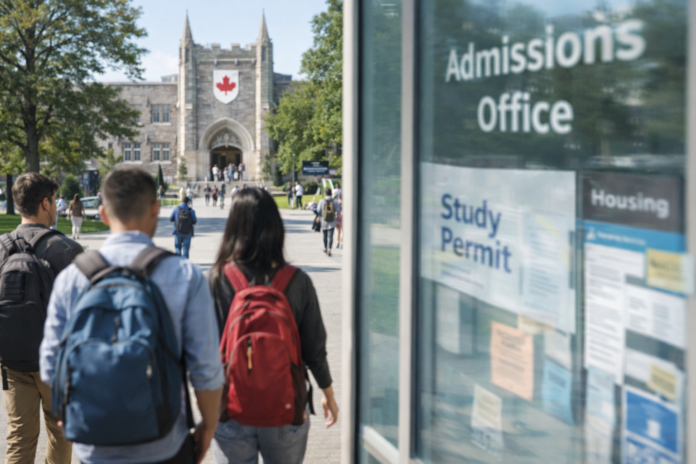

OTTAWA, Canada — Canada’s federal government is maintaining tighter controls on international student intake following a cap introduced in 2024, a move that has significantly reduced new study permit approvals and is being closely felt by Indian applicants, the largest source group of foreign students in the country.
In January 2024, Immigration, Refugees and Citizenship Canada (IRCC) announced a two-year cap on new international study permits to ease pressure on housing, healthcare and other public services. The measure reduced the number of approved study permits by roughly 35 percent compared with 2023 levels.
India has consistently ranked as the top source country for international students in Canada in recent years, accounting for more than 40 percent of study permit holders at peak levels. As a result, any overall reduction in permits has had a pronounced numerical impact on Indian applicants.
Under the revised framework, most applicants are now required to obtain a Provincial Attestation Letter (PAL) confirming that they fall within provincial allocation limits. The federal government also increased the minimum proof-of-funds requirement to reflect higher living costs and introduced a mandatory acceptance letter verification system to combat fraud.
Eligibility rules for Post-Graduation Work Permits (PGWP) were also tightened, including restrictions affecting certain private college programs delivered through public-private partnerships.
The government has said the measures are intended to “stabilize” growth in the international student program while protecting system integrity. Officials have emphasized that the cap applies broadly across countries and is not targeted at any specific nationality.
Canada admitted a record number of temporary residents in recent years, including international students and foreign workers, contributing to rapid population growth. The government has since signaled its intention to moderate that growth to better align with housing supply and infrastructure capacity.
Despite the tighter controls, Canada continues to promote pathways from temporary residence to permanent residency through programs such as Express Entry and Provincial Nominee Programs. Former international students remain a significant component of economic immigration streams.
Education consultants say the new framework has made the application process more competitive and documentation-intensive, prompting some prospective students to consider alternative destinations. However, Canada remains one of the world’s leading study destinations due to its established immigration pathways and English-language institutions.
IRCC advises prospective applicants to consult official guidance at canada.ca and to ensure they apply through designated learning institutions within provincial quotas.