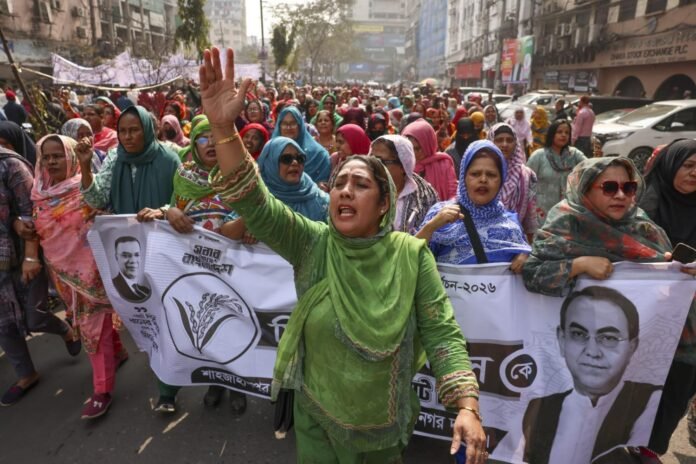

Bangladesh heads to the polls on Wednesday in its most consequential election in decades, with voters choosing a new government in the first nationwide ballot since mass protests forced longtime prime minister Sheikh Hasina from power in August 2024.
Around 127 million voters are eligible to cast ballots on Feb. 12 in an election that will also feature a national referendum on proposed constitutional and electoral reforms, according to election officials.
For the first time since the country’s independence in 1971, the Awami League will not contest the vote. The former ruling party was barred by the Election Commission after being proscribed under the Anti-Terrorism Act over its role in the violent suppression of last year’s uprising.
The race has effectively narrowed to two political blocs: the Bangladesh Nationalist Party (BNP) and its allies, widely seen by analysts as the frontrunners, and a rapidly rising alliance between Jamaat-e-Islami and the National Citizens Party (NCP), a student-led group born out of the 2024 protest movement.
A referendum on upheaval
Analysts describe the election as a de facto verdict on the 2024 revolt that ended Hasina’s 16-year rule. Voters are being asked whether to back the interim administration’s reform agenda or opt for a return to more familiar political forces.
“The election is less about ideology than about accountability for the past and expectations for stability,” said a Dhaka-based political analyst. “Many voters want change, but they also want predictability.”
The BNP has focused its campaign on restoring democratic institutions, reviving the economy and dismantling what it calls one-party authoritarianism. The return of acting chairman Tarique Rahman from exile has energized the party’s core supporters, particularly in cities and among middle-class voters.
“I voted BNP before, and I will again,” said Abdul Karim, a 52-year-old shop owner in Dubai. “We need experienced people to fix the economy. Experiments are risky now.”
Youth-driven challenge
Jamaat-e-Islami, long sidelined under Hasina’s rule and controversial for its opposition to the 1971 independence war, has re-emerged after restrictions were lifted by the interim government. The party is campaigning on promises of clean governance and social welfare.
Its partnership with the NCP — led by prominent figures from last year’s student movement — has broadened its appeal, especially among young and first-time voters who played a central role in toppling the former government.
“This election is our chance to reshape politics,” said Farzana Akter, a 23-year-old university student in Chattogram who plans to vote for the Jamaat–NCP alliance. “The old parties failed us. We want leaders who come from our struggle.”
High stakes, heavy security
Both camps have made similar pledges on jobs, welfare, education and anti-corruption measures, but questions remain over how quickly any new government can deliver amid high inflation, debt pressures and a fragile global economy.
The campaign has been marred by sporadic violence, with at least 12 people killed in election-related clashes, according to official figures and local media. Authorities say around one million security personnel have been deployed nationwide, while international observers have been invited to bolster the credibility of the vote.
The outcome is being closely watched abroad, particularly by neighboring India, as Bangladesh seeks to recalibrate its foreign relations after Hasina’s exit.
As results begin to emerge after Feb. 12, they are expected to signal whether Bangladesh is embarking on a new political era driven by post-uprising forces — or returning, in modified form, to the rivalry that has dominated its politics for decades.
Analysis reflects the political landscape as campaigning ended on Feb. 10, 2026, with contributions from Umarul Farooque, Sandeep Kumar in Dubai, and Jeshan Akhtar in Dhaka.