
Special to Gulf Daily Mail
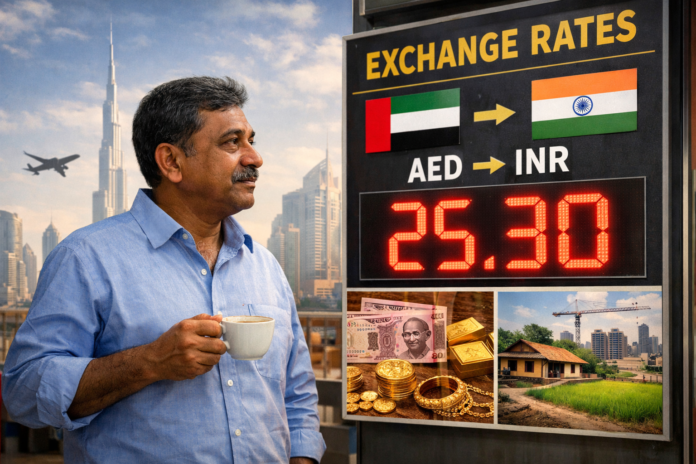
Rajan Menon still remembers the day he landed at Dubai Airport in the summer of 1995. He had AED 200 in his pocket, a single suitcase, and a salary letter promising AED 5,000 a month. Back home in a small town in Kerala, that was a fortune. The exchange rate at the local hawala agent that week was somewhere between AED 1 and Rs 9, which meant his monthly pay converted to around Rs 45,000 — enough to build a house, fund a wedding, and send his siblings to college.
Thirty years later, Menon earns AED 40,000 a month as a Senior Project Manager in Abu Dhabi. His apartment costs three times what his first room-sharing arrangement did. And yet, when he sits down to calculate how many sovereigns of gold his salary can actually buy today, the number makes him quietly uncomfortable.
“Five thousand used to feel like real money back home,” he said, stirring his evening tea. “Forty thousand feels like it should be eight times more. It isn’t.”
A Number That Made Headlines
This week, the Indian rupee slipped to 25.30 against the UAE dirham — a level that currency traders and exchange house managers in Dubai and Abu Dhabi are calling, cautiously, historic. The rate climbed to 25.406 on March 20, 2026, with the AED touching its highest-ever level against the Indian rupee in recent memory.
For the roughly 3.5 million Indian expatriates living and working in the UAE, this number carries a simple, immediate meaning: every dirham they send home is now worth more rupees than it has been in years. Exchange houses across the country reported a sharp uptick in remittance volumes within hours of the rate crossing the 25-mark.
On the surface, this looks like good news. In a narrow, transactional sense, it is. But dig a little deeper and the story gets complicated.
Why the Rupee Is Falling
The rupee’s slide has not happened overnight, nor has it been caused by a single event. The currency lost roughly 5 percent in 2025, making it the worst-performing in Asia, pressured by steep US tariffs and weak investment flows.
Surging global crude oil prices have significantly worsened India’s import bill, since the country imports nearly 80 percent of its oil. Geopolitical tensions in West Asia pushed global investors toward safe-haven assets, applying further pressure on the rupee. And rupee weakness has fed expectations of further depreciation, which in turn has amplified dollar buying, as importers and traders tend to accelerate purchases when they expect the currency to fall further.
India’s FY2025 remittances reached a record $135.46 billion, with 2026 forecasts remaining resilient amid stable Gulf employment. That figure tells its own story: the Indian diaspora is more connected to the homeland’s economy than almost any policy tool the Reserve Bank of India can deploy.
The Immediate Gain Is Real
The arithmetic is straightforward. An Indian professional earning AED 10,000 who sends AED 7,000 home was getting around Rs 1,68,000 when the rate was at 24. At 25.30, that same transfer becomes Rs 1,77,100 — an extra Rs 9,000 without doing anything differently. Over a year, that adds up to more than a lakh of rupees.
For workers on lower wages who send the bulk of their earnings and live on very little in the UAE, the difference is even more meaningful. A man earning AED 1,500 who sends AED 1,200 home was previously sending Rs 28,800. Now he sends Rs 30,360. That Rs 1,560 extra each month could be the difference between his child staying in school or dropping out.
The Long View Tells a Different Story
But here is where Rajan Menon’s quiet discomfort becomes more than a personal feeling.
In 1995, the global price of gold was approximately $380 per troy ounce. Converted at the rate then prevailing, 22-carat gold in Dubai retailed at approximately AED 40 to 45 per gram. An eight-gram sovereign, the standard unit of gold gifting across South Indian communities, cost around AED 340 to 360.
On a salary of AED 5,000, a man could buy roughly 13 to 14 sovereigns of gold every month — or about 112 grams. Today, the 22-carat gold price per gram in the UAE is AED 522. That puts an eight-gram sovereign at well above aed 4,100. On a salary of AED 40,000, that same man can buy fewer than ten sovereigns — roughly 76 grams. The salary is eight times higher. The gold-buying power has dropped by more than 30 percent
“That is what nobody tells you,” Menon said. “They say, look at the exchange rate, it is 25 now. But they don’t tell you that gold was AED 40 a gram when I first came here.”
Land Prices: The Other Side of the Ledger
Back in his village in Thrissur district, Menon’s father bought a cent of land — roughly 435 square feet — for Rs 20,000 in the mid-1990s. That same plot would today cost between Rs 10 and Rs 12 lakh in the same locality, and considerably more near a road or town centre. Some parts of Kerala have seen land prices multiply twenty to thirty times over three decades.
When Menon arrived in 1995, his monthly salary of Rs 45,000 could have bought more than two cents of prime land. Today, his AED 40,000 converts to roughly Rs 10.12 lakh at the new rate. That sounds generous. But a cent of land in the same area now starts at Rs 10 to 12 lakh, meaning his entire month’s salary barely buys one cent, not much more than what his father could have managed with a fraction of that income thirty years ago.
The exchange rate gain has been real. The purchasing power gain, after accounting for Indian inflation, gold prices, and land costs, is far more modest than the headline figure suggests.
The UAE Side of the Equation
For the UAE, a stronger dirham against the rupee is largely neutral, or mildly positive. Indian goods and services become slightly cheaper to import. Indian tourists who convert rupees to dirhams find the UAE marginally more expensive, which could dampen leisure travel from India in the months ahead.
More significantly, construction and service sector employers benefit from a relatively lower effective wage burden when measured in purchasing power terms. An Indian worker willing to accept AED 1,500 a month does so partly because that salary converts to a meaningful sum back home. If the rupee strengthens significantly, the UAE could face pressure from workers demanding higher wages or choosing to return — a dynamic the Gulf has seen before.
For Indian businesses operating in the UAE, a weaker rupee cuts both ways. The cost of goods sourced from India falls in dirham terms, which can improve margins. But domestic obligations back home may consume a larger share of earnings in real terms, squeezing disposable income in other directions.
What Should an Expat Do?
Financial advisors in the UAE have urged expatriates to stagger remittances over time, averaging out exchange rate movements and reducing exposure to sudden reversals. The advice is sound: nobody can predict whether the rupee will slide further toward 26 or recover toward 23 in the months ahead.
Much will hinge on a potential US-India trade deal and foreign portfolio investor activity. A successful agreement could push the rupee back toward the 88-89 level against the dollar, which would translate to roughly 23 to 24 against the dirham.
What the moment does offer is an opportunity. For expats with large, planned expenses back home — a property purchase, a wedding, school fees, a fixed deposit — converting at 25.30 rather than waiting at 23 or 24 represents a genuine advantage. Locking in remittances now, for predictable near-term costs, is a reasonable move.
The Feeling That Numbers Cannot Capture
Rajan Menon does not regret his thirty years in the UAE. He has built a house in Kerala, educated his children, and put enough aside to retire comfortably. But there is a calculation he returns to, quietly, when the exchange rate becomes news.
In 1995, one month’s salary of AED 5,000 could buy something close to 112 grams of gold. Today, one month’s salary of AED 40,000 buys perhaps 76 grams.
“People look at me like I am complaining,” he said. “I am not complaining. I am just saying that the number on the exchange board is only part of the truth. The rest of it is written in the price of gold and the price of land and the price of a bag of rice.”
He paused, looked at the rate board outside an exchange house on the Corniche, and nodded slowly at the number: 25.30.
“Good rate,” he said. “But thirty years ago, a good rate meant something different.”
India’s remittances from the UAE remain the largest single corridor of South Asian financial flows to any one country. Exchange house operators expect March 2026 transfer volumes to be among the highest since the sector began keeping records. Whether that represents the community’s gain or its anxiety is a question each family answers privately, on the other end of a money transfer.
*Dr. K.T. Abdurabb is a Gulf-based journalist who writes about expatriates, geopolitics and diaspora affairs.