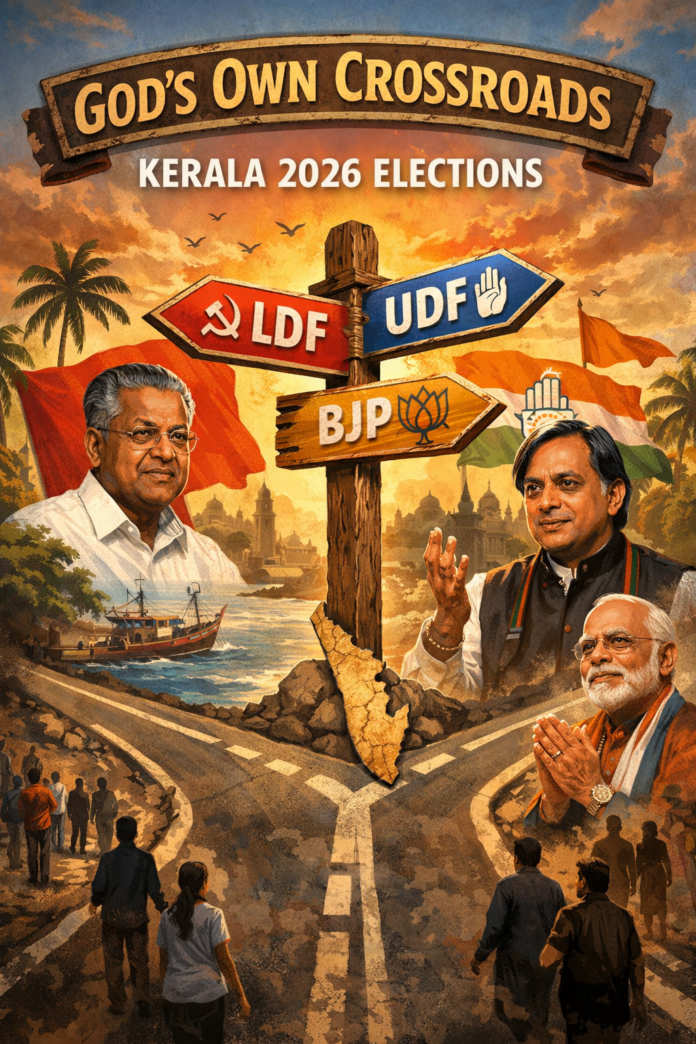

“Kerala’s voters have spent decades perfecting alternation. In 2021, they broke their own rule. In 2026, they must decide whether that was an exception—or a shift.”
Kerala goes to the polls on April 9. This is not a routine election. It is a moment of political clarification.
The Left Democratic Front (LDF), led by Pinarayi Vijayan, is asking for a third consecutive term—something modern Kerala has never granted. The Congress-led United Democratic Front (UDF) believes the state is ready to revert to type. The BJP, as ever, hopes persistence will eventually pay off.
Strip away the campaign noise, and the election reduces to a single, uncomfortable question:
After ten years, has this government earned continuity—or simply exhausted its time?
A Decade in Power: The LDF’s Real Test
Ten years is long enough for any government to build a record. It is also long enough for that record to turn against it.
The LDF can point to tangible achievements. The Vizhinjam port is not a slogan—it is a structural bet on Kerala’s economic future. Public health and education systems remain functional and, in parts, improved. The government’s early pandemic response strengthened its reputation for administrative control.
Its welfare network is equally significant. Pensions, subsidies, and targeted schemes have created a dependable constituency that votes not out of ideology, but out of lived benefit.
But governance is not judged in fragments. It is judged in accumulation.
Kerala’s fiscal position is no longer an abstract debate for economists. Rising debt and tightening finances have begun to shape everyday perception. For voters—especially middle-class households and expatriate families managing remittance flows—the question is no longer about policy design, but about financial strain.
And then there is perception—often more decisive than proof.
A steady stream of controversies, allegations, and administrative questions has, over time, created a narrative the government has struggled to shake off. None of these issues alone may decide an election. Together, they create doubt.
Political violence, particularly in northern districts, remains an unresolved stain. Kerala prides itself on political maturity. Episodes that contradict that image carry disproportionate weight.
At the centre of it all is Pinarayi Vijayan.
He remains the LDF’s strongest asset—disciplined, controlled, and unmistakably in charge. But after a decade, even strength raises a counter-question: has authority become over-centralised?
Continuity, beyond a point, demands justification—not assumption.
The UDF: Opportunity, If It Can Hold It Together
If elections in Kerala followed historical script alone, this would already be the UDF’s to lose.
The pattern is clear. Ten years is typically the limit. Recent electoral signals—from the Lok Sabha results to local body trends—suggest the ground has shifted. There is visible fatigue with the incumbent, particularly in urban and semi-urban constituencies.
Add to this the Gulf factor.
Kerala’s economy still breathes through its diaspora. Remittances sustain households, influence consumption, and shape political attitudes. Over the past few years, many expatriate families have felt a tightening—rising costs back home, uncertain returns on investment, and a sense that economic momentum has slowed.
This sentiment does not always appear in speeches. But it travels quietly—through family conversations, WhatsApp calls, and visits during vacation months. And it often translates into votes.
The UDF benefits from this mood. But it has a habit of complicating its own advantage.
The absence of a clearly projected chief ministerial face remains its most visible gap. Voters are not just choosing a government; they are choosing a leadership style. On that front, the LDF offers clarity. The UDF offers options.
Options do not always inspire confidence.
Internal dynamics within the Congress continue to hover in the background. Leadership ambitions, regional balances, and organisational coordination are manageable issues—until they are not.
Shashi Tharoor’s presence captures this contradiction perfectly. He is one of the few leaders who can expand the party’s appeal beyond its traditional base, particularly among urban voters and the global Malayali community. Yet his positioning within the state unit remains carefully managed, sometimes to the point of hesitation.
The UDF does not lack leaders. It lacks a settled answer to a simple question:
Who is in charge if it wins?
That question matters more in a close election than in a wave.
The BJP: Limited Reach, Strategic Impact
The BJP’s Kerala story has not changed much—but its relevance has.
The party continues to command a measurable vote share, but not one that easily converts into seats. Its support is dispersed, not concentrated.
Yet in an election this tight, even a dispersed vote matters.
In several constituencies, the BJP’s presence could determine whether the anti-incumbency vote consolidates or fragments. That alone gives it influence beyond its likely seat tally.
For now, it remains less a contender for power and more a factor in deciding who gets it.
Where This Election Will Be Decided
This will not be a wave election. It will be decided in pockets.
A few dozen constituencies—no more—will determine the outcome. In these seats, broad narratives give way to local realities: candidate credibility, community equations, last-mile campaigning.
Kerala elections often come down to this granular level. 2026 will be no different.
The Likely Direction
Let’s be clear.
The LDF is unlikely to replicate its 2021 performance.
The UDF is positioned to gain ground.
The only question that matters is whether that gain crosses the majority line.
At this moment, the UDF holds a slight but real advantage—driven by history, momentum, and a discernible shift in public mood.
But advantage is not victory.
If the UDF maintains discipline and presents a coherent alternative, it should form the next government. If it slips—through internal confusion or strategic missteps—the LDF has enough organisational depth to stay competitive until the end.
The Bottom Line
Kerala’s electorate is neither impulsive nor easily swayed. It listens, observes, and then decides—often quietly.
This is a state where elections are not merely fought; they are assessed.
On April 9, voters will weigh ten years of governance against the promise of change. They will factor in not just policy, but experience—what has improved, what has not, and what might come next.
And on May 4, the verdict will likely reflect something deeper than a simple swing:
a decision on whether Kerala wants continuity—or correction.
Either way, the margin will be narrow. The message will not be.