
By Dr. KT Abdurabb
THE interceptor trails fade into the Gulf night almost as quickly as they appear — bright arcs across a dark sky, then silence. But what lingers longer, and cuts just as deep, is what happens next on the ground: the scramble for phones, the urge to film, the reflex to share.
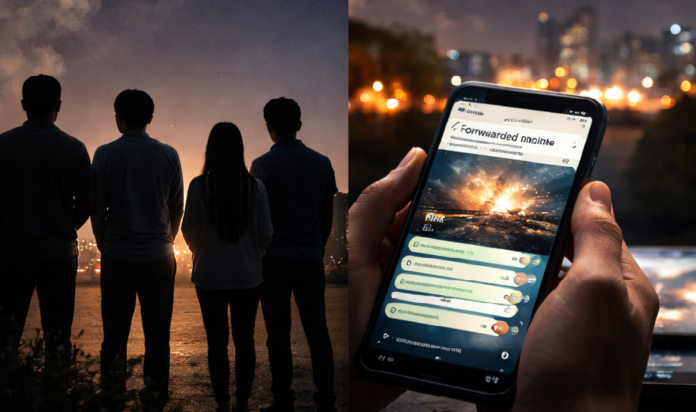
In the weeks since Iran’s sustained missile and drone campaign began testing the resolve of the Arabian Peninsula, a second battle has been fought — not against ballistic trajectories, but against fabricated videos, AI-generated fireballs, doctored interception footage and panic-spreading rumours spreading at the speed of a WhatsApp forward.
The response from Gulf governments has been swift, decisive and rooted in a clear duty of care toward every person living within their borders.
A Region Standing Firm
In the United Arab Emirates, the Attorney-General ordered the arrest of 10 individuals of various nationalities for circulating real air-defence footage alongside AI-crafted images portraying phantom strikes on landmarks — phantom fires, phantom devastation designed to sow fear. They face expedited trials with penalties that include a minimum of one year in prison and fines of no less than Dh100,000. In a separate operation, Abu Dhabi Police detained 45 people for filming at sites where missiles had been neutralised or debris had fallen, then posting the material online with misleading commentary.
Qatar recorded the region’s largest enforcement action: more than 300 individuals detained for filming attacks, circulating unauthorised footage and publishing content capable of inflaming public sentiment. The message from Doha was consistent with that of its neighbours — trust official channels, and only official channels.
In Bahrain, several Asian nationals were held for sharing AI-generated images appearing to fabricate damage or glorify aggression. Kuwait detained individuals for videos that mocked national defences or falsely claimed strikes on civilian areas, invoking state security provisions that carry multi-year sentences. Saudi Arabia and Oman have reinforced monitoring of sensitive sites and digital platforms, ensuring unverified material is contained before it can spread and cause alarm.
Across six nations, the approach has been unified: protect the public, protect the truth, and protect the stability that millions depend on.
The Faces Behind the Footage
What gives this moment its particular human texture is who is being caught up in it.
Many are expatriate workers — men and women from South Asia, Southeast Asia and beyond who came to the Gulf for the most straightforward of reasons: stable work, physical safety, the chance to build something better for their families back home. They did not arrive here to cause harm. Yet some, in a moment of misplaced excitement or simply wanting to send “proof” of what they witnessed to a relative via WhatsApp, filmed the very systems that were protecting everyone within these borders from harm — citizens and long-term residents alike.
The footage, innocent in intent at the moment of capture, can become something else entirely by the time it circulates. Reposted with false captions. Paired with AI-generated images of destruction that never occurred. Amplified across platforms in a cascading loop of panic that the original filmmaker never intended and cannot reverse.
A recent hoax illustrated the stakes with particular clarity. An AI-generated image falsely claimed that an Indian telecom engineer named Nitin Mohan had been arrested in Bahrain for leaking intelligence to Israel’s Mossad. Bahraini authorities and India’s Ministry of External Affairs moved swiftly to debunk it — demonstrating both how precisely a modern fabrication can be targeted, and how alert the systems for countering disinformation have become across the region.
What This Land Has Given
To understand why this moment matters so deeply, you need to understand what the Gulf has actually done for the people who live here.
In 35 years of living in the UAE, I have watched something extraordinary unfold — not in government statistics or economic reports, but in the lives of real people standing in front of me. I have known men who arrived here with nothing but a suitcase and a trade who built businesses worth tens of millions of dirhams. I have watched families from Kerala, from Karachi, from Manila, from Cairo, accumulate the kind of wealth and security that three generations before them could not have imagined. I have seen expatriates rise to trusted senior positions in government-linked institutions, carrying responsibilities that reflected the genuine confidence their host nation placed in them.
The Gulf did not merely give these people jobs. It gave them futures. And the scale of that generosity radiates outward — entire states in India, entire provinces across South and Southeast Asia, are today substantially sustained by the remittances that flow from this region. When a family in a village in Uttar Pradesh puts a child through school, or a household in Mindanao builds a home, or a family in Colombo weathers a crisis — that Gulf connection is often the invisible thread holding it together.
This is not a transaction. It is a relationship built on decades of mutual respect, and it carries obligations on both sides.
What Is at Stake
The expatriate community — the nurses, engineers, teachers, traders, drivers, domestic workers and executives who make the Gulf function day to day — has kept its compact with these nations with dignity and loyalty, overwhelmingly and consistently. What is being asked in this moment is not extraordinary. It is the same logic that governs any decent society under pressure: do not add noise to a signal that people are depending on to stay calm and safe.
These countries are tracking genuine aerial threats in real time. Their ground systems — legal, digital and administrative — are doing the same. Both are working, night after night, to protect the same people: the families in the apartment buildings beneath the interceptor trails, the children asleep in the suburbs, the workers who sacrificed to be here and who have every reason to want this region to remain the stable, welcoming place it has always been.
A moment of reckless sharing — thirty seconds of engagement, a viral forward, a misguided attempt to document history — is not neutral. It has consequences for public calm, for operational security, and now, clearly, for the individual who pressed record. Those who risk it risk not only a court-room, but the goodwill of a nation that has, in many cases, given them everything.
The Compact Holds
After more than three decades here, one truth stands beyond argument: the Gulf has earned its stability, and it defends it with the same deliberate care with which it was built.
The air defences intercepting threats overhead are protecting you, your family, your colleagues and every person in every building around you. The information systems working to keep the public calm are doing the same. To film those defences and feed panic is not neutrality — it is a betrayal of the place that made your life possible.
The vast majority will never need to be told this. They already know it. They feel it in the loyalty they carry quietly every day. It is to them — and to the countries that welcomed them — that this moment ultimately belongs.
The Gulf endures, not because it is shielded from the world’s disorder, but because it has built, over decades, the trust and cohesion that allow it to face pressure without fracturing. Every resident — citizen and expatriate alike — has a share in keeping that intact.
Truth and loyalty, in these days, are not abstractions. They are the infrastructure of survival.