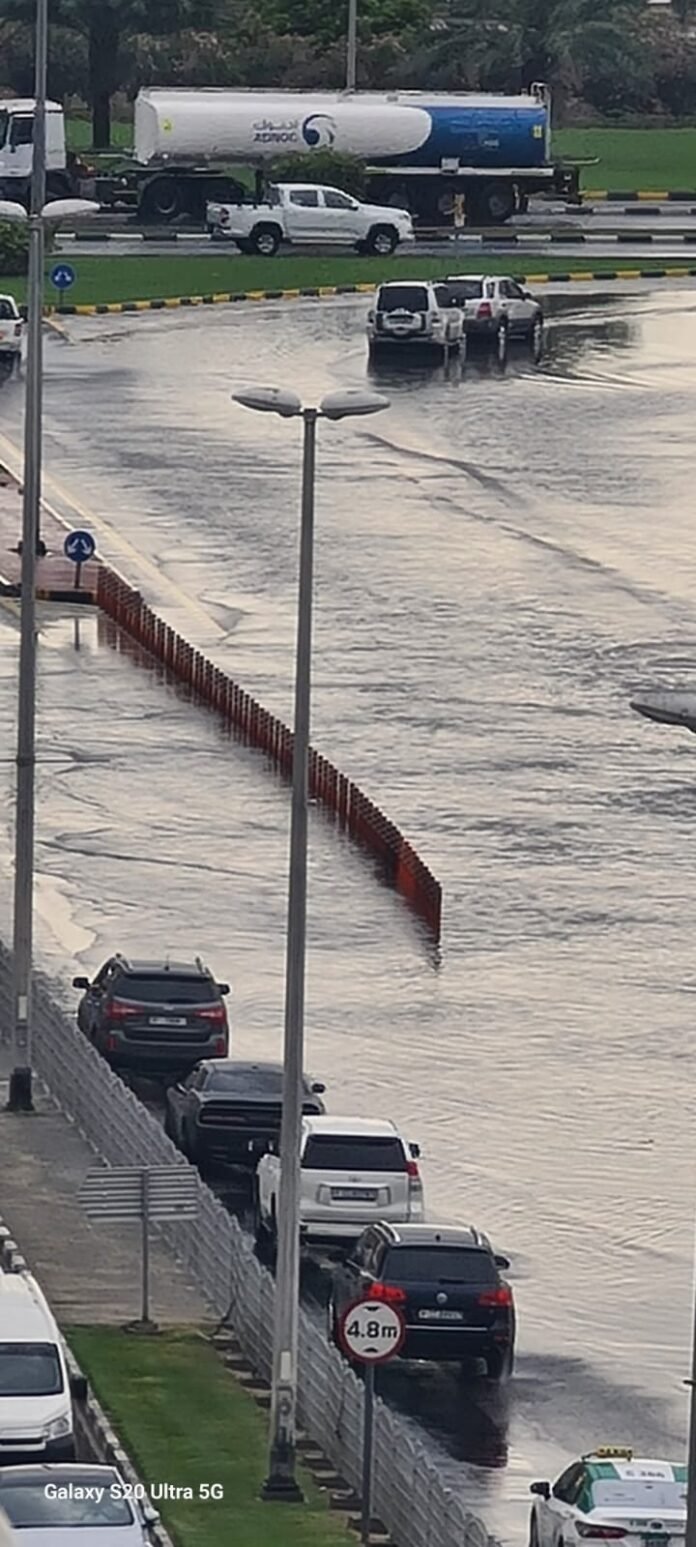

From the mountains of Ras Al Khaimah to the salt flats of Abu Dhabi, rain transforms the Emirates into something ancient and alive
A Nation Washed Clean | March 2026
It begins before dawn. A smell — salt and wet stone and something green that has no name in a desert vocabulary — drifts in from the Arabian Gulf. The skies above the UAE, so reliably blue and merciless for months on end, bruise themselves purple and slate. Then comes the first drop. One. Then ten. Then the heavens break open, and the land the world knows only as sand and steel and ambition reveals a face far older than any of its towers.
Rain in the UAE is not weather. It is an event. A national exhale. A reminder that beneath the highways, the dunes and the date palms, this is still a land shaped by water — by its promise, its rarity, its sudden, startling abundance.
“The camels stand still and tilt their faces upward. Even they remember.” — A Bedouin elder, Liwa Oasis
Average annual rainfall nationwide: ~78mm Hajar Mountains receive in a single season: 200mm+
Ras Al Khaimah
The rain comes to RAK first. It always does. The Hajar Mountains — those ancient, fractured ridges of ophiolite and limestone — catch the clouds rolling in from the northeast and wring them like wet cloth. By the time the rest of the country is squinting at a darkening sky, Ras Al Khaimah is already singing. The Wadi Bih rushes. The terraced farms at Wadi Shimal turn the colour of moss within hours. Children in the old town of Al Nakheel run barefoot on stone alleys that have been rained on for four thousand years, their laughter indistinguishable from the sound of water finding its way downhill.
The pearl fishermen’s sons — now hotel managers and property developers — still step outside when it rains. Old habit. Old gratitude.
Fujairah
On the east coast, where the Indian Ocean pounds the Hajar’s feet, Fujairah receives rain differently. Here it arrives sideways, salt-laced and warm, smelling of deep water and seaweed. The wadis — Wadi Ham, Wadi Wurayah — transform in minutes from dry, sun-bleached corridors into muscular brown rivers, carrying centuries of accumulated silt and the occasional startled goat. The falaj channels, some of them pre-Islamic in origin, brim and overflow. Mango farmers in Masafi — a village caught between two mountains and two seas — watch their orchards drink. Their trees, accustomed to patience, do not waste a drop.
The Language of Wadis
A wadi in flood is called a “sail” in Arabic — a word that also means sailing, as if the water itself is a vessel crossing the land. In Fujairah and RAK, villagers can read a wadi the way sailors read the sea: the colour of the water tells you where it has been, the sound tells you how fast, the smell tells you how much more is coming from the mountains above.
Al Ain
The Garden City earns that name twice over when it rains. Al Ain, sitting at the foot of Jebel Hafeet — the great limestone whale that rises nearly 1,240 metres from the desert floor — becomes briefly Alpine. Clouds descend below the mountain’s summit. The falaj network, a UNESCO-recognised marvel of ancient engineering, runs full and cold. The date palms in the Al Ain Oasis shiver. The air, almost always dry as paper here, thickens. Tourists who came for the dunes end up, improbably, huddled under café awnings on the mountain road, watching curtains of rain descend into the Buraimi valley.
The children of Emirati families who have farmed the oasis for generations say the rain sounds different here — lower, slower, as if the mountain is absorbing it thoughtfully, storing it for the long dry months ahead.
Dubai
In Dubai, rain is theatre. The city was not built for it. Water pours off the angled faces of skyscrapers in theatrical curtains. Sheikh Zayed Road — normally a river of red and white light moving at ninety kilometres an hour — slows to something approaching humility. Drivers who have crossed deserts and conquered sand dunes in their four-wheel drives suddenly find themselves confounded by an inch of standing water on an underpass.
But Dubai in rain has a beauty it rarely permits itself in sunshine. The Burj Khalifa vanishes into low cloud — and the city, briefly, becomes human-scaled. The Creek, swollen and silver, looks the way it must have looked in photographs from the 1950s. Families crowd the windows of JBR apartments, watching the rain hit the Gulf. Children too young for nostalgia nevertheless press their palms flat against the glass with an instinct older than themselves.
“In Dubai, rain stops time. Briefly, beautifully, the city forgets what it was rushing toward.”
Sharjah
The Cultural Capital receives rain with something close to dignity. The old souks — Al Arsah, the Heritage Area — are washed clean. The smell of frankincense drifts from doorways into the wet street and hangs there, sweeter for the moisture. Along the Khalid Lagoon, the water goes pewter and then charcoal as the sky darkens, and the dhows at anchor rock gently, their painted hulls streaked with rain. Families who might otherwise have crowded the Corniche for an evening walk end up in the covered galleries of the Sharjah Art Museum instead, discovering exhibitions they never planned to visit. The rain, it turns out, is a curator.
Umm Al Quwain
The smallest emirate holds its rain like a secret. Umm Al Quwain’s lagoon — a shallow inland sea teeming with flamingos and herons — turns dark green when the clouds come. The mangroves along its edges drip. The old fort on the headland, made of gypsum and coral stone, absorbs the water slowly, giving it back to the air as a fine cool mist by morning. In the fish market, the men who have been up since three — who have been reading the sea for signs of mackerel and hammour — barely look up when it rains. To them, all water is familiar. All water is home.
Abu Dhabi
The capital receives rain as a statement. When the sky opens over Abu Dhabi, you feel the scale of the place differently. The Sheikh Zayed Grand Mosque — white marble under grey sky — seems to glow from within, as if lit by something more patient than electricity. The Corniche stretches five kilometres along a Gulf turned from turquoise to slate, and the date palms that line it — planted, like everything in this city, with deliberate ambition — shudder and lean and drink. In the inland desert south of the city, near Liwa, the rain touches the dunes and vanishes. No trace. As if the sand is ashamed of its own thirst, taking water too quickly to be seen.
But the desert remembers. Within two weeks of significant rainfall, the sabkha — the salt flats — throw up a thin crust of crystalline white where water pooled and evaporated. The ghaf trees put out new leaves, that impossible, defiant grey-green. The oryx, somewhere beyond the last road, turn and face the wind that carried the rain in, and move toward whatever it left behind.
The Skies Are Not Done Yet
The UAE’s National Centre of Meteorology says tomorrow brings more rain — brace for a second act
Do not put away the umbrella just yet. The UAE is expected to experience unstable weather with scattered thunderstorms and a decrease in temperatures on Tuesday, March 24, as the current spell of atmospheric instability shows no sign of relenting.
Tuesday’s forecast calls for partly cloudy to cloudy skies interspersed with convective clouds, and a chance of rainfall over scattered areas. Light to moderate southeasterly to northeasterly winds are expected, turning fresh to strong at times, with speeds reaching up to 45 km/h and the possibility of blowing dust and reduced visibility.
Sea conditions in the Arabian Gulf and the Oman Sea are expected to be slight to moderate, becoming rough at times with cloud activity. Residents in coastal areas are advised to exercise caution.
For temperatures, coastal areas can expect highs between 24°C and 27°C, inland areas between 23°C and 28°C, and mountainous regions between 17°C and 21°C.
The period of unstable conditions is forecast to continue through Friday, March 27, with spells of rain of varying intensity across the country.Authorities have reminded residents that entering valleys or wadis during active water flow carries a fine of Dh2,000, 23 black points, and vehicle impoundment.
For live updates, follow the National Centre of Meteorology at ncm.ae or on social media @ncmuae.
Source: National Centre of Meteorology (NCM) | National Emergency Crisis and Disaster Management Authority (NCEMA)