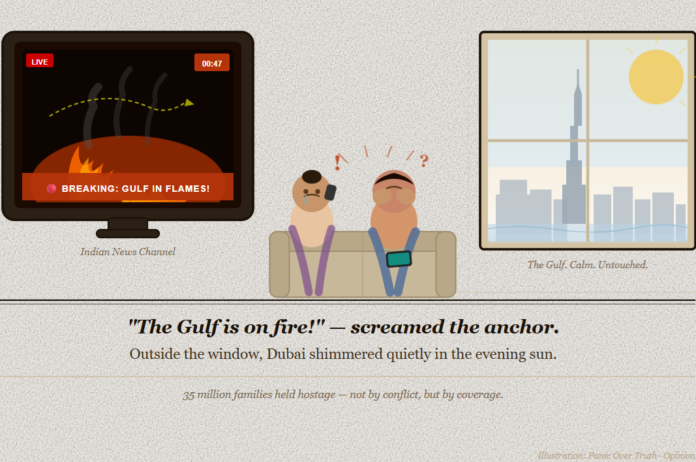

A section of Indian Television Is Not Reporting the Gulf Crisis. It Is Performing It — and 35 Million Families Are Paying the Price.
By KT Abdurabb
Susan, a retired schoolteacher in Kerala, spent an entire night trying to reach her son in Dubai. A Malayalam news anchor had declared that Palm Jumeirah was nearly “destroyed.” Her son, his wife, and their three-year-old were fine. They had no idea what the fuss was about. Palm Jumeirah was untouched. Dubai was calm. But for Susan, and for thousands of families like hers across Kerala, Tamil Nadu, and the Hindi heartland, the damage had already been done — not by a missile, but by a television screen.
This is the reality of Indian war reporting in the Gulf today. It is loud, theatrical, and frequently untrue. And it needs to stop.
More than 8.9 million Indians live and work across the Gulf — in the UAE, Saudi Arabia, Kuwait, Qatar, Bahrain, and Oman. Kerala alone accounts for over 2.1 million of them. Their families back home — an estimated 35 million people — depend on news media to understand what is happening in the region where their children, spouses, and siblings have built their lives. That dependency is a profound responsibility. Indian television is treating it as a revenue opportunity.
When the Middle East crisis escalated in late February 2026, what did viewers in Kerala get? Countdown clocks. Animated maps showing hypothetical missile trajectories over Gulf cities. Archival footage from Syria and Yemen repackaged as live coverage of the UAE. WhatsApp messages read aloud as breaking news. A panel on ABP News featuring astrologers predicting the war’s trajectory using lunar eclipse charts. And through it all, screaming anchors performing urgency rather than delivering information.
Meanwhile, BBC News, Al Jazeera English, Reuters TV, Al Arabiya, and Sky News Arabia reported with verification and context. When confirmation was unavailable, their anchors said so. When they erred, they corrected it. The contrast was the difference between journalism and theatre.
What the International Standards Actually Require
The BBC Editorial Guidelines, the Reuters Handbook of Journalism, the Associated Press Standards, and the Society of Professional Journalists Code of Ethics all stress the same principles: verification, proportionality, correction, and minimising harm.
These are not academic theories. They are protocols forged through decades of covering real wars and real crises. Indian channels covering the Gulf know these standards. They have simply chosen not to follow them.
Why It Happens — and Why It Will Not Stop on Its Own
India has over 900 television news channels. Malayalam alone has several dozen. In such a saturated market, being first often matters more than being right.
In the race for ratings, speed has overtaken accuracy. Social media clips are aired without authentication. Anonymous “sources” replace official confirmation. Speculation is packaged as certainty. A rumor becomes a headline within minutes.
For families in India, the consequences are immediate. Parents panic. Phone networks get jammed. WhatsApp groups fill with forwarded clips of fiery graphics and dramatic commentary. Anxiety spreads faster than any verified update.
Add to this a weak broadcast regulatory framework and a political media culture that rewards outrage. The result is a media environment ranked 151st on the Reporters Without Borders Press Freedom Index, where commercial survival often trumps editorial restraint.
The human cost is real. Workers in the Gulf report spending hours reassuring frightened relatives back home. Elderly parents experience stress-induced health episodes. Emergency funds are transferred for flights that were never necessary.
The Gulf Is Not Just Watching — It Is Taking Notes
Senior Gulf officials have privately expressed alarm at the quality of some Indian coverage. They question how channels without accreditation, without on-ground presence, and without verified sourcing are shaping narratives about their countries.
In a region hosting nearly nine million Indian workers, such monitoring is not symbolic. It carries implications for access, institutional cooperation, and diplomatic relationships.
The Gulf is watching back.
A Message To News Editors
Train your people. Teach them what war reporting means and what war analysis requires. Make them understand the difference between broadcasting a rumour and confirming a fact — between emotional performance and professional journalism. Keep your ethics. Do not inflate your numbers through dishonesty; it is a short-term gain with long-term damage to your credibility, your access, and your standing. Do not make Indian journalism a joke at the international table. The world is watching. The Gulf is watching. And 35 million families deserve far, far better than what you are giving them.
What Responsible Coverage Should Look Like
Responsible crisis reporting does not require silence. It requires discipline. If an explosion is unverified, say it is unverified. If visuals are from another country, label them clearly. If information is developing, update it — do not dramatise it.
Indian television does not lack talent. It lacks editorial restraint.
There is no shame in saying, “We do not yet know.” That sentence is the foundation of credibility. Viewers forgive delay. They do not forgive deception.
In an era of deepfakes, manipulated clips, and algorithm-driven outrage, journalism’s competitive advantage is not speed. It is trust.
Millions of families will continue to be held hostage to panic — not by conflict, but by coverage.
Dr. KT Abdurabb is a senior media professional with deep-rooted expertise in the United Arab Emirates and Gulf media landscape, and a researcher on the role and impact of Indian media in the Gulf.