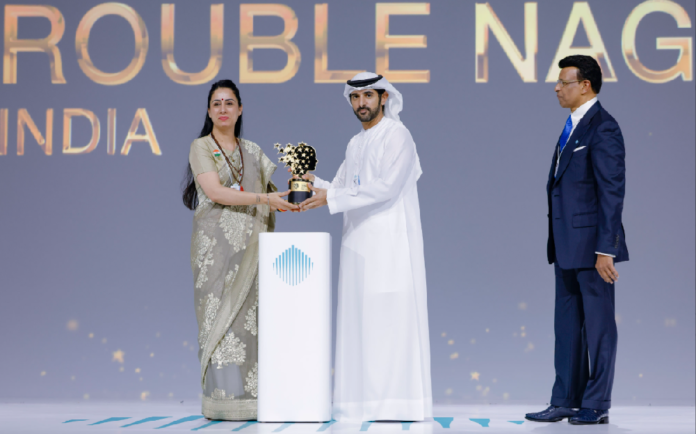


DUBAI, United Arab Emirates, MUMBAI, India – In the gleaming halls of Dubai’s World Governments Summit, where global leaders convene to chart the future, an unassuming Indian artist and educator stepped into the spotlight on February 5, 2026. Rouble Nagi, a 45-year-old force of creativity and compassion, was awarded the prestigious $1 million Global Teacher Prize for her transformative work bringing education to India’s most marginalized children through art and innovative learning centers. Her story is one of resilience, blending fine art with grassroots activism to bridge educational gaps in slums and rural villages, reaching over a million young lives in the process.
From Army Cantonments to London’s Art Halls: Nagi’s Formative Years
Born on July 8, 1980, in a small village in Jammu and Kashmir to Sikh parents, Nagi grew up as the daughter of an Indian Army officer. This nomadic childhood in military cantonments across India instilled in her a deep sense of patriotism and adaptability, shaping her worldview amid the region’s turbulent history. She pursued a bachelor’s degree in political science before heading to London for formal training in fine arts at the renowned Slade School of Fine Art, part of University College London. There, she honed her skills in sculpture, painting, and installations, and further studied European art at Sotheby’s. By 1999, she had held her first solo exhibition in West Bengal, marking the start of a career that would evolve from gallery walls to the streets.
Nagi returned to India in the early 2000s, settling in Mumbai, where she now resides. The bustling megacity, with its stark contrasts of wealth and poverty, became her canvas. Little is publicly known about her immediate family beyond her parents—her father’s military service remains a private pillar of her inspiration—but Nagi has often spoken of her upbringing as fueling her commitment to national service through education and empowerment. She has no publicly documented spouse or children, channeling her energy into her foundation and community work.
Art as a Tool for Change: Building Classrooms Without Walls
Nagi’s journey into education began over two decades ago, evolving from pure artistry to socially engaged projects. In 2016, she launched “Paint Dharavi,” a mural initiative in Mumbai’s largest slum, which expanded into “Misaal Mumbai” and later “Misaal India.” Through her Rouble Nagi Art Foundation (RNAF), established as a non-profit, she has created more than 800 learning centers across India, primarily in underserved urban slums and rural areas. These aren’t traditional schools; they operate in informal spaces like community courtyards or abandoned buildings, focusing on children who have never attended formal education or have dropped out.
Her signature “Living Walls of Learning” turns neglected slum walls into interactive murals teaching literacy, numeracy, science, history, public health, and environmental awareness. These vibrant artworks—often painted with community participation—serve as permanent, accessible textbooks, reducing dropout rates by over 50% in targeted areas and improving long-term retention. Nagi recruits and trains over 600 teachers and volunteers, blending academics with vocational skills, psychosocial support, and creative activities to build confidence and aspiration among students.
Her foundation also runs skill-development programs for women and youth, helping them start micro-businesses in crafts, tailoring, and digital literacy. In 2022, she authored “The Slum Queen,” a book chronicling her experiences in India’s underbelly, emphasizing how art can clean, beautify, and educate environments once deemed hopeless. Starting with just 30 children in a small workshop 24 years ago, Nagi’s efforts have now touched over one million lives, integrating them into mainstream education systems.
The Global Teacher Prize: A Beacon for Unsung Educators
The Global Teacher Prize, now in its 11th year (launched in 2015 by the Varkey Foundation in partnership with UNESCO), celebrates teachers who go beyond the classroom to impact communities profoundly. Valued at $1 million—the largest of its kind—it draws from thousands of nominations worldwide, honoring innovation, inclusivity, and societal change. Presented by Dubai’s Crown Prince Sheikh Hamdan bin Mohammed bin Rashid Al Maktoum at the 2026 summit, the award underscores teachers’ role in fostering values and inspiring generations.
Nagi was selected from over 5,000 entries across 139 countries, edging out nine other finalists:
- Adeola Olufunke (Nigeria)
- Alfonso Filippone (Italy)
- Ana Hernández Revuelta (Spain)
- Colleen O’Rourke (Australia)
- Ewa Drobek (Poland)
- Gloria Cisneros (Argentina)
- Jasmyn Nicole Wright (USA)
- Joshue Castellanos Paternina (Colombia)
- Timothy Stiven (USA)
These educators hail from diverse contexts, from urban schools in the U.S. to rural communities in Colombia, each addressing unique challenges like inclusivity, STEM access, and mental health support.
Previous winners of the prize
In 2015, American educator Nancie Atwell was honoured for founding innovative reading and writing workshops, followed a year later by Hanan Al Hroub of Palestine for promoting non-violent education in conflict zones.
Canada’s Maggie MacDonnell won in 2017 for her work supporting Inuit youth in remote Arctic villages, while the UK’s Andria Zafirakou was recognised in 2018 for integrating the arts into multicultural London classrooms.
Kenyan teacher Peter Tabichi took the 2019 award after donating much of his salary to support poor students in remote areas. In 2020, India’s Ranjitsinh Disale was celebrated for transforming girls’ education through QR-coded textbooks, and in 2021, Keishia Thorpe of the United States was recognised for helping immigrant and low-income students access higher education.
The 2023 prize went to Pakistan’s Sister Zeph, who founded a school for underprivileged girls at the age of 13, while the most recent winner in 2025, Saudi Arabia’s Mansour Al Mansour, was honoured for volunteering more than 3,000 hours to support orphans and prisoner
Sunny Varkey, founder of the Varkey Foundation and GEMS Education, praised Nagi as embodying “courage, creativity, compassion, and an unwavering belief in every child’s potential.” UNESCO’s Stefania Giannini echoed this, noting the prize “reminds us of a simple truth: teachers matter.”
Looking Ahead: Vocational Dreams and Broader Impact
Accepting the award, Nagi reflected humbly: “I began 24 years ago with 30 children… Now, reaching over a million, it’s a humbling experience. This gives me momentum to go further—breaking barriers so every learner can succeed.” She plans to invest the prize money in establishing a vocational institute offering free training in professional skills, digital literacy, and entrepreneurship, targeting underprivileged youth to foster financial independence and reduce poverty cycles. This aligns with RNAF’s existing programs, potentially scaling her model nationwide and inspiring similar initiatives globally.
Nagi’s win places India back in the global education spotlight—following compatriot Ranjitsinh Disale’s 2020 victory—and highlights how unconventional approaches can address systemic inequalities. As slums transform into vibrant learning hubs, her work proves that education isn’t confined to four walls; it can bloom on any surface, one brushstroke at a time. (with inputs from Sona Shaji from Mumbai)