

DUBAI, United Arab Emirates — Closing gaps in data and research on women’s health could unlock up to $1 trillion annually for the global economy by 2040, industry leaders said at the World Health Expo (WHX) in Dubai.
Speakers at the inaugural Women’s Health 360 forum said women live longer than men but spend a greater proportion of their lives in ill health, exposing structural weaknesses in health systems and research frameworks.
Citing analysis by consultancy McKinsey & Company, delegates said narrowing the women’s health gap could reduce an estimated 75 million years of life lost each year due to poor health and early mortality, while generating productivity gains equivalent to 137 million full-time jobs globally.
Despite making up roughly half the world’s population and around 70 percent of the global healthcare workforce, women spend about 25 percent more of their lives in ill health than men, according to the data presented.
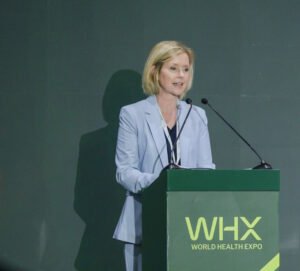 Kate Lancaster, chief executive of the Royal College of Obstetricians and Gynaecologists, said many disparities stem from historical biases in medical research and care design.
“Women are really struggling to access healthcare systems which have not been built around their needs,” she told delegates, adding that such gaps widen further when factors such as race, disability and geography are considered.
Women were not formally required to be included in clinical trials in the United States until 1993, she noted, meaning many medicines currently in use were not adequately tested on women. McKinsey estimates that less than one percent of health research funding is directed towards conditions that primarily affect women, excluding cancer.
Held under the patronage of the UAE Ministry of Health and Prevention, WHX has brought together policymakers, clinicians and investors at the Dubai Exhibition Centre to discuss prevention-led and more equitable healthcare systems.
Organisers said embedding women’s health into national and regional policy frameworks would be critical for Middle East countries seeking to strengthen health system resilience, diversify economies and expand workforce participation in line with long-term development strategies.
The four-day event concludes on February
12.