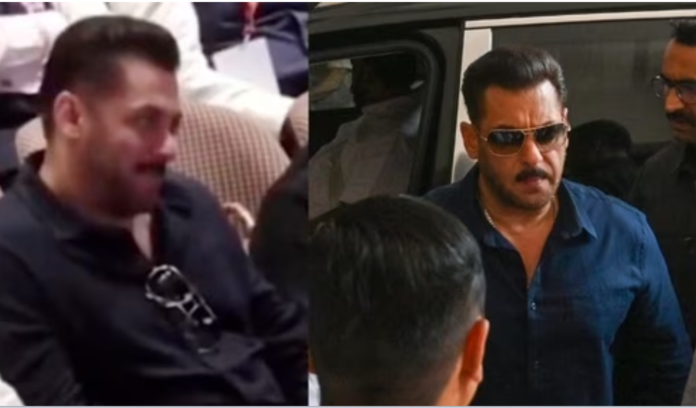

MUMBAI, India: In a city where film sets stand not far from political headquarters, the distance between celebrity and ideology has never been very wide. Yet even by Mumbai’s standards, Salman Khan’s quiet appearance at a Rashtriya Swayamsevak Sangh (RSS) centenary event has triggered an unusually loud national conversation — one that stretches far beyond Maharashtra and resonates deeply with Indians abroad.
The two-day lecture series, titled “100 Years of Sangh Journey: New Horizons,” marked the RSS’s centenary at the Nehru Centre in Worli. Organizers framed it as a platform for dialogue on national unity, cultural heritage and social service. RSS chief Mohan Bhagwat emphasized that the organization works “for the country, for its people, without opposing anyone,” describing its century-long evolution.
But the moment that dominated headlines was not a policy statement. It was Bhagwat’s passing remark that Salman Khan inspires young people, particularly in fashion — that students copy what he wears “even if they don’t know why.” The camera cut to Khan, seated in the front row, smiling politely. He did not speak.
In another era, that might have been the end of it: a celebrity attending a cultural event, listening, leaving. Instead, the episode has become a prism through which India’s uneasy relationship between cinema and politics is being examined once again.
For supporters of the ruling alliance in Maharashtra, including Deputy Chief Minister Eknath Shinde, the outrage is misplaced. Khan, they argue, is an Indian citizen free to attend any public event. Shinde framed the issue as one of cultural respect rather than political endorsement, noting Khan’s participation in festivals like Ganesh Chaturthi at home and questioning why his presence at a lecture should be politicized.
Opposition leaders saw it differently. Shiv Sena (UBT) leader Sanjay Raut asked whether Khan attended out of conviction or coercion. Samajwadi Party MLA Abu Azmi went further, alleging pressure from the BJP-led establishment. Neither offered evidence, but the implication was clear: in today’s climate, even silence can be interpreted as alignment.
For the Indian diaspora — from Dubai to London to Toronto — the debate carries particular resonance. Bollywood has long been more than entertainment for overseas Indians. It is cultural glue, a nostalgic bridge to language, music and identity. Salman Khan is not just an actor; he is a global brand, his films filling theatres from the Gulf to North America. When such a figure appears at an event hosted by an organization often associated, fairly or unfairly, with a specific ideological current, the symbolism travels instantly across borders.
The RSS, for its part, appears to understand this symbolism. Bhagwat himself remarked that such broad participation from the film industry would have been “unthinkable” two decades ago. The presence of actors including Ranbir Kapoor, Akshay Kumar, Vicky Kaushal, Karan Johar and others signaled a deliberate outreach to India’s cultural establishment. For an organization seeking to project inclusivity during its centenary, star power carries undeniable value.
But celebrity participation in public life is a double-edged sword. In India, film stars have often blurred the line between screen charisma and political capital. Some have formally entered politics; others have lent tacit support to causes and campaigns. Even an appearance without a speech can be read as endorsement — or, by critics, as complicity.
Yet there is another question worth asking: must every public appearance be reduced to a partisan litmus test? In a democracy, civil society spaces — lecture halls, cultural forums, literary festivals — ideally allow for dialogue across differences. If attendance alone becomes suspect, the space for such dialogue narrows.
For many Indians abroad, accustomed to pluralistic societies where public figures routinely cross ideological boundaries, the ferocity of the reaction may seem excessive. But India’s political landscape is intensely polarized, and the RSS occupies a central, contested place within it. That reality ensures that any association, however brief, will be scrutinized.
Salman Khan has offered no clarification. His silence has allowed competing narratives to flourish. To admirers, he was simply listening. To critics, he was signaling. In the age of social media, where images outrun context, interpretation often matters more than intent.
Ultimately, the controversy says as much about India’s current moment as it does about one actor’s weekend schedule. Bollywood remains a powerful cultural force, and the RSS remains a powerful ideological one. When the two intersect, even casually, the reverberations are bound to be felt — not just in Mumbai, but wherever Indians gather to watch a Friday release and debate the country’s future.
In that sense, the real story may not be why Salman Khan attended. It may be why so many people believe that his presence, or absence, carries such weight.
With inputs from Mahesh Nair, Mumbai