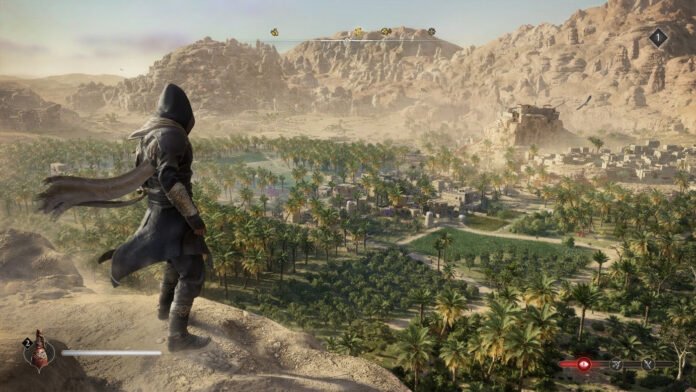

ALULA, Saudi Arabia — Ubisoft has transported players to the timeless desert landscapes of AlUla in a new story expansion for Assassin’s Creed Mirage, blending the kingdom’s rich archaeological heritage with the franchise’s signature historical fiction.
Released under the title Valley of Memory, the downloadable content places series protagonist Basim Ibn Ishaq in 9th-century AlUla, where he journeys with his companion Dervis in search of answers tied to a painting left by his estranged father, Is’haq Ibn Khalid.
The expansion draws heavily on the real topography and monuments of AlUla, including Saudi Arabia’s first UNESCO World Heritage Site, Hegra, as well as Dadan, Jabal Ikmah and the AlUla Oasis.
Ubisoft collaborated closely with the Royal Commission for AlUla (RCU) and leading archaeologists to ensure historical fidelity. Experts including Dr. Abdulrahman Alsuhaibani, vice president of culture at RCU; Dr. Rebecca Foote, director of archaeology and cultural heritage research; and Dr. Ingrid Périssé-Valéro, director of archaeology, heritage and research at AFALULA, advised on architectural details.
Their guidance shaped the recreation of tomb proportions, stone finishes, decorative carvings and religious structures. While some modifications—such as added climbable surfaces and walls—were introduced for gameplay, the team sought to preserve the essential character and visual identity of the sites.
In-game educational content incorporates photographs and artefacts from AlUla’s collections and international museums. The expansion also uses updated, inscription-based readings of landmark names, including the Tomb of Hayyan, Son of Kuza.
Players can explore several faithfully rendered locations:
- The Lion’s Tomb, based on the iconic lion reliefs at Dadan, with seated lion sculptures symbolizing power and protection.
- The lush AlUla Oasis, a vital ancient waypoint on the Incense Road and an emotional anchor in the narrative.
- AlUla Fort, the hilltop citadel overlooking AlUla Old Town, reimagined as a high-stakes prison fortress.
- Elephant Rock (Jabal AlFil), the distinctive natural sandstone formation.
- Jabal Ikmah, the “open-air library” featuring hundreds of ancient inscriptions in multiple languages.
- The commanding Tomb of Hayyan, Son of Kuza, with its refined Nabataean façade.
- Jabal Ithlib in Hegra, known for its narrow rock passage, rock-cut altars and large banquet hall.
The Royal Commission for AlUla described the project as “a careful dance between scholarship and playability,” in which the region’s real heritage actively shapes the player’s journey.
AlUla, located 1,100 kilometers northwest of Riyadh, encompasses 22,561 square kilometers of sandstone mountains, fertile oasis valleys and archaeological sites spanning thousands of years. Hegra served as the southernmost major city of the Nabataean Kingdom and later a Roman outpost, while Dadan was a prominent capital of the Lihyanite and Dadanite civilizations. Jabal Ikmah was recently inscribed on UNESCO’s Memory of the World Register for its multilingual rock inscription