
KERALA ELECTION SPECIAL
Sunny mornings and sultry afternoons mark the southern Indian state of Kerala, where soaring temperatures make March and April the cruelest months for its people. The earth seems to be burning beneath the relentless sun. Alongside the harsh weather, the political temperature is also rising as the legislative elections approach.
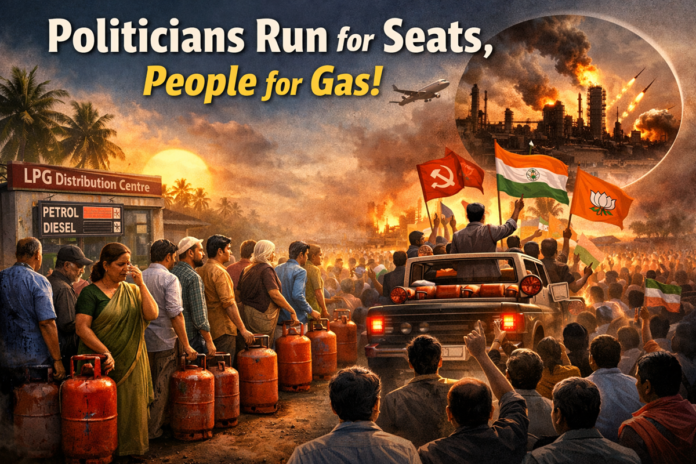
However, unlike the usual loud and vibrant election campaigns, the atmosphere here feels lukewarm and lethargic. The ongoing war in the Middle East weighs heavily on people’s minds. Rather than focusing on politics, they worry about looming shortages of oil and gas, rising prices, and the potential scarcity of essential goods. Cooking gas has already become hard to find, with long queues forming outside LPG distribution centers. Many residents are scrambling to secure gas cylinders, while others are seeking electric cookers as an alternative—though even those are now in short supply.
Concerns over an imminent spike in petrol and diesel prices add to the anxiety. Despite government assurances about the availability of fuel, fear lingers. People feel the election is unfolding at a difficult time, and their response appears half-hearted.
Hotels and restaurants are the worst hit. Many have closed, and some are on the verge of shutting down. Perhaps this is one reason why political parties are keeping away from mega rallies. Petrol and diesel are also expected to become costlier in the coming days. No doubt, this will affect the campaign badly.
While curiosity remains about who will succeed the current government, the precarious situation in the Gulf sends alarm bells ringing among families in Kerala. Many fear that if the conflict escalates, there could be a mass exodus of expatriates from these oil-rich countries—a scenario that would be heartbreaking for both Kerala’s economy and its people.
Why does this war matter so much to Kerala? The answer is simple: the Gulf countries, especially those in the Gulf Cooperation Council (GCC), are like a second home for Keralites. Almost every household here has at least one family member working in the Arabian Peninsula. Whatever happens there directly impacts Kerala. The state has faced similar challenges before, such as during Saudi Arabia’s Nitaqat nationalization drive.
Currently, about 1.77 million Keralites live and work in the Gulf. The state’s economy heavily depends on the income sent back by these expatriates—estimated at more than 2,200 crore rupees annually. The ongoing conflict poses an existential threat to these families and, by extension, to Kerala’s economy if it continues for long. Now, the people face a crucial election under the shadow of a potential economic meltdown that threatens their very livelihoods.
Kerala’s political history is unique. It was the first place in the world to elect a Communist government democratically and remains the only Indian state still ruled by a Communist party. This election is truly a do-or-die fight for them.
Fifteen years ago, Communist parties governed at least three Indian states. Today, Kerala stands at a critical crossroads: either retain Communist rule or witness the end of Communist governance in India.
The ruling Communists face a strong challenge from the center-left Indian National Congress and its allies. Meanwhile, the right-wing Hindu nationalist Bharatiya Janata Party (BJP) vies for third place. Despite being the largest political party nationally, the BJP has struggled to make significant inroads in Kerala.
The Election Commission’s hasty announcement gave political parties little time to select candidates and launch early campaigns. Nonetheless, candidates were finalized, and internal dissent was mostly contained. The Communist Party, Kerala’s largest, has favored established leaders over new faces, with old patriarchs dominating the contest. For the Congress and its alliance, this election is a last-ditch chance to regain power. Failure would make a comeback increasingly difficult.