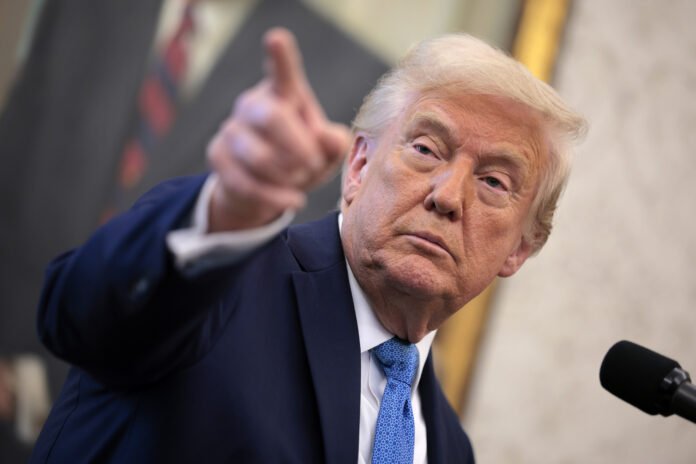

Washington – US President Donald Trump on Thursday issued a stark warning to Iran, urging it to strike a “meaningful” nuclear deal within roughly 10 days or face severe consequences, amid a massive American military buildup in the Middle East that has heightened fears of imminent conflict.
Speaking after the inaugural meeting of the Board of Peace in Washington, Trump emphasized that Iran “can’t have a nuclear weapon, it’s very simple,” adding: “You can’t have peace in the Middle East if they have a nuclear weapon.” He appeared to set a informal deadline, stating: “You’ll be finding out over the next probably 10 days,” without specifying exact actions but hinting at escalation if talks falter.
The ultimatum comes as indirect negotiations between US and Iranian envoys in Geneva show tentative progress but deep divisions persist. Iranian Foreign Minister Abbas Araqchi said Tuesday’s talks yielded agreement on “guiding principles,” while a senior US official noted Iran would soon submit a written proposal addressing Washington’s concerns. However, White House press secretary Karoline Leavitt stressed on Wednesday that gaps remain on key issues.
Washington’s demands are sweeping: Iran must fully abandon uranium enrichment — a process for nuclear fuel that can also yield weapons-grade material — relinquish long-range ballistic missiles, end support for regional militant groups, and cease using force against domestic protests. Tehran insists its nuclear program is peaceful, denies seeking atomic weapons, and views restrictions on its missile arsenal as a “red line.” It refuses to negotiate beyond the nuclear file.
Tensions have simmered since US and Israeli airstrikes in June 2025 targeted Iranian nuclear facilities and military sites, which Trump referenced Thursday, saying Iran’s capabilities had been “decimated” but “we may have to take it a step further.” Threats intensified in January 2026 following Iran’s deadly crackdown on protests that left thousands dead.
In response, the US has surged forces to the region, deploying aircraft carriers, warships, fighter jets, and stealth aircraft. A senior US official said the buildup should be complete by mid-March, positioning assets for potential strikes as early as this weekend, according to sources. Satellite imagery reveals Iran repairing and fortifying nuclear and missile sites since last summer, alongside preparations at US bases in the Middle East over the past month.
Iran, meanwhile, conducted extended naval drills in the Gulf of Oman on Thursday, with state television broadcasting footage of special forces on helicopters and ships. A Russian corvette joined the exercises, underscoring Tehran’s alliances amid the standoff. The Gulf of Oman, a critical artery for global energy shipments, has become a flashpoint, with the drills raising alarms over potential disruptions.
Russia warned Thursday of an “unprecedented escalation of tension” around Iran, calling for restraint from all sides in light of the US military presence. Poland, reflecting growing international concern, urged its citizens to evacuate Iran immediately, with Prime Minister Donald Tusk saying they might have only hours to leave.
Israel has raised its alert levels, anticipating a possible joint US-Israeli offensive that could exceed the 12-day campaign in June. US Secretary of State Marco Rubio is set to meet Israeli Prime Minister Benjamin Netanyahu on February 28 to discuss Iran.
The escalating rhetoric and deployments have driven oil prices upward, stoking fears of a broader war that could engulf the Gulf region. Gulf states, including Saudi Arabia and the UAE, have urged diplomacy to avert catastrophe, while contributing to Gaza reconstruction efforts at the Board of Peace meeting.
Trump, who received briefings from envoys Steve Witkoff and Jared Kushner on Wednesday, convened top national security officials in the White House Situation Room to weigh options. As Ramadan begins across much of the Muslim world, including the Gulf, the standoff adds a layer of volatility to an already tense period.
Analysts warn that miscalculation in the Strait of Hormuz or Gulf of Oman could spark unintended clashes, with global energy markets on edge. For now, the 10-day window looms as a critical juncture in US-Iran relations, with the potential for either breakthrough or breakdown.