
SHARJAH,— United Arab Emirates: The ruler of Sharjah on Sunday inaugurated a series of heritage and environmental projects in the Fili area, underscoring a development vision that blends conservation, education and community welfare.
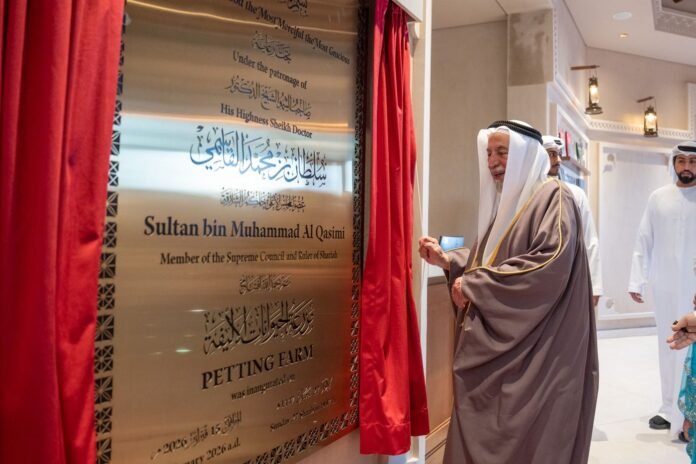
Sheikh Dr. Sultan bin Mohammed Al Qasimi, Supreme Council Member and Ruler of Sharjah, opened the new Petting Farm as part of the “Heritage Fili” project, alongside the Fili Heritage Souq and the restored Fili Fort.
The projects, set within a landscape of restored falaj waterways, palm groves and traditional architecture, reflect Sheikh Sultan’s longstanding emphasis on preserving the emirate’s natural and cultural heritage while promoting sustainable development.
Educational farm rooted in heritage
Built over 14,815 square metres near the Heritage Souq, fort and historic falaj system, the farm is designed as an interactive educational destination for families.
Sheikh Sultan unveiled a commemorative plaque before touring the facilities, which include animal barns, aviaries and open enclosures housing camels, cows, goats and sheep. Children can interact with smaller animals such as rabbits and turtles under supervision, reinforcing values of animal welfare and environmental responsibility.
The complex also features a veterinary clinic, quarantine barns, food preparation areas and dedicated staff accommodation, forming an integrated system to ensure animal health and sustainable operations. A camel rest area inspired by historic caravan routes connects the site to the region’s trading past.
The ruler also attended a bird show presented by members of the Sharjah Falconers Club.
Development anchored in values
Sheikh Sultan later inaugurated the Fili Heritage Souq, a 2,065-square-metre market comprising 13 shops and five kiosks offering handicrafts, perfumes, incense and camping equipment.
In remarks delivered at the event, he said development in Sharjah follows a clear methodology centred on human advancement and moral values, alongside social, cultural and economic growth.
He highlighted initiatives supporting families from early childhood through adulthood, including the “Rubu’ Qarn for Creating Future Leaders and Innovators” programme, and outlined future projects such as Al Madam Hospital, which will be linked to University Hospital in Sharjah.
The market includes a pottery workshop demonstrating traditional ceramic techniques, and a coffee house showcasing tools used in preparing Arabic coffee. Its architecture draws on local materials such as palm-frond “areesh” structures, mud brick and hand-carved wood, reflecting the desert environment of the Central Region.
Fort restoration and falaj revival
Sheikh Sultan also reopened Fili Fort following restoration works carried out to international conservation standards as part of the wider “Fili Heritage” revival.
The fort, originally built of rammed mud and local stone, once served as a defensive and trading outpost along caravan routes linking the coast and interior. It houses exhibits on traditional weapons, falconry, date-syrup production and daily Emirati life.
During the ceremony, Sheikh Sultan received a certificate confirming the fort’s inclusion in 2024 on the heritage list of Islamic World Educational, Scientific and Cultural Organization.
Adjacent to the fort, the historic Fili Falaj — a 1.5-kilometre underground irrigation system dating back more than five centuries — has been restored using traditional materials. The Dawoodi-style falaj, constructed in the 16th century by members of the Bani Jaber tribe, channels groundwater through gently sloping tunnels and more than 40 vertical wells.
Water distribution historically followed a time-based system known as the “athar”, measured by sundial during the day and by stars or a perforated metal water bowl at night — a method reflecting the sophisticated management of scarce resources in the desert environment.
The rehabilitation of the falaj, its Sharia’t water access point and surrounding palm farms seeks to reconnect visitors with the region’s agricultural roots and the central role of water in sustaining settlement.
Integrated infrastructure
Access to the heritage zone has been enhanced through a new 5.5-kilometre road linking Al Watan Road (E84) to Fili, alongside drainage systems, lighting and utility infrastructure designed to accommodate future expansion.
Across the projects, parking facilities have been expanded to handle visitor flows, reinforcing the site’s role as a cultural and educational destination.
The Fili developments form part of Sharjah’s broader strategy to safeguard its historical identity while fostering environmental awareness and community cohesion — an approach that reflects Sheikh Sultan’s enduring connection to nature, heritage and the human dimension of development.