
There are two kinds of haram in our lives: the one we announce loudly, and the one we negotiate quietly.
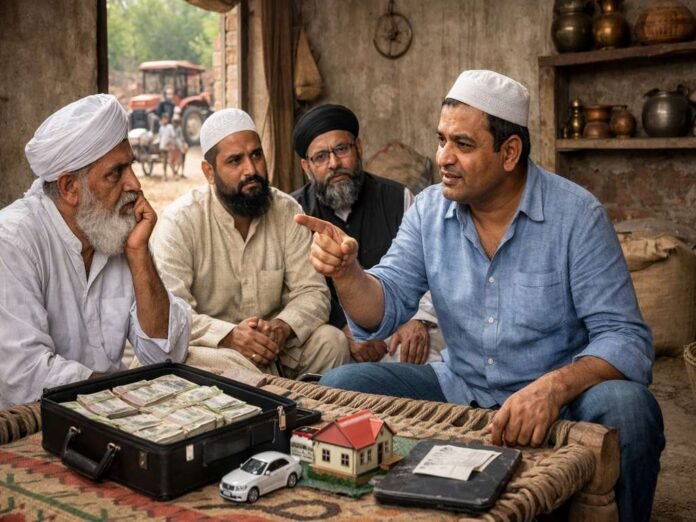
My friend Khalid—village roots in Rajasthan, life built in Mumbai, earnings made in the Gulf—returned home this time not just with suitcases, but with a story. A million-dollar lottery win. The kind that travels faster than mobile networks and reaches people who don’t even own phones.
As always, visitors came. Familiar faces. Respectable scholars. Men who usually leave with a modest ₹10,000.
This time, Khalid stretched his generosity—₹10 lakh.
And just like that, morality woke up.
“This is lottery money. Haram for us.”
Fair enough. A clear position. Clean. Firm.
But Khalid, who has lived long enough to see how money actually moves in the real world, decided to ask a few small questions.
“Your salary,” he began, “comes from the government. The government runs through banks. Banks run on interest. That is fine?”
A pause.
“The house you built—with a bank loan? The car outside—with EMI? Interest flowing in and out every month like oxygen… that is manageable?”
A longer pause.
“And donations you accept—do you check every source? The shopkeeper, the contractor, the trader… all clean, fully audited, interest-free lives?”
Silence.
Khalid leaned back, now in his element.
“What about the big businessmen?” he asked. “The ones who started with bank loans, scaled up, became multi-millionaires—sometimes billionaires. You accept their donations happily. Their money has already traveled through ten layers of interest before reaching your hands.”
No one answered.
“And those traders,” he continued, “who quietly hold back goods during shortages—during COVID, during crises, during times when people are desperate—and then sell at double the price. That’s clearly condemned. No confusion there. Yet when they donate, we don’t ask for a balance sheet.”
At this point, the room had turned into a courtroom without a judge.
We pick the obvious target—the lottery ticket. Visible. Easy to label. Easy to reject.
And the rest? We adjust. We interpret. We “understand the situation.”
Khalid wasn’t mocking faith. He wasn’t dismissing principles. He was pointing at something else—selective application.
In the end, one of them softened.
“It’s okay, Khalid saab… you can give the ₹10 lakh. We can accept it.”
But by then, Khalid had lost interest in charity and gained interest in consistency.
He smiled and said, “No… you go, study the market properly. Understand how money moves today. Next time, we’ll sit and talk again.”
And he didn’t give a single fils.
Maybe that’s the real story—not about what is haram, but how comfortably we live with the parts we choose not to examine.