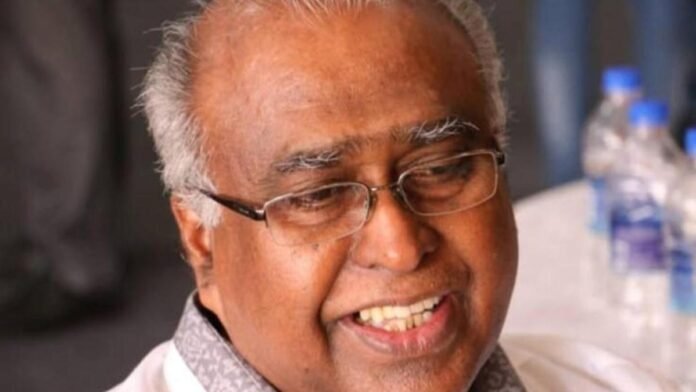

KOZHIKODE, India: Dr. K. A. Salim, the renowned hematologist and clinical oncologist from Kerala who passed away recently, was more than an eminent physician and researcher. His contribution to modern medical education and research — particularly in hematology and the study of blood disorders — was immense. For generations of medical students, he was a reference point and a guiding force.
A dedicated tutor and practitioner associated with various medical colleges in India and abroad, Dr. Salim was regarded as an authentic voice on blood-related diseases. It was he who took the initiative to establish a hematology department at Kozhikode Medical College, the largest medical college in Kerala. In many ways, he pioneered the development of hematology as a specialised discipline in this part of India. The people of Kerala owe him much for that foundational work.
What made Dr. Salim different, however, was not only his contribution to medical science but also his approach to treatment and his views on the medical profession itself.
He was deeply disturbed by what he perceived as unfair practices within the world of medicine. He spoke about what he believed was an unhealthy nexus between sections of the medical community and pharmaceutical companies. For this reason, he often suggested exploring natural and preventive approaches alongside conventional treatment.
Those who knew him will recall his frequent advice about turmeric, which he described as a natural blood purifier. He was particular that it should not be commercially processed turmeric from the market, but turmeric grown at home. He believed such practices preserved both purity and potency.
The same conviction applied to coconut oil. Dr. Salim consistently advocated the use of virgin coconut oil and encouraged others to retain traditional dietary practices. He was of the view that campaigns against coconut oil during the 1960s to 1990s were influenced by powerful soybean oil lobbies — a perception that was widely discussed in Kerala during those decades. While many in modern medicine differed with him, he stood firmly by his belief.
At one point, he also expressed reservations regarding aspects of the polio vaccination campaign. It was not that he rejected modern medicine; rather, he questioned what he saw as the growing dominance of commercial interests in healthcare.
His views on cholesterol testing and statin use were similarly debated. Whenever I met him, he strongly advised against frequent cholesterol testing, arguing that laboratory-driven campaigns often encouraged unnecessary fear. He was not against testing per se, but cautioned against what he considered excessive reliance on statins to reduce cholesterol levels. He maintained that prolonged statin use could affect brain cells and potentially lead to memory issues. He would often remind people that cholesterol itself is an essential element for the human body.
In this, some felt he may have been influenced by Dr. B. M. Hegde, the Padma Bhushan recipient and proponent of holistic medicine. However, unlike Hegde, who publicly campaigned for his views, Dr. Salim chose to remain largely aloof from public debates. He preferred what might be described as a silent campaign — expressing his convictions through personal interaction rather than public platforms.
Dr. Kassim Abdul Salim, widely known as Dr. K. A. Salim, completed his MBBS from Thiruvananthapuram Medical College in 1963 and his MD in General Medicine in 1966. He obtained his MRCP from the Royal College of Physicians, London, in 1978 and MRCPath from the Royal College of Pathologists, London, in 1982.
He held prestigious positions including Fellow of the American College of Physicians, Member of the American Society for Hematology and Member of the American Society for Clinical Oncology. He also served as Associate Professor of Medicine and Hematology at King Khalid University College of Medicine in Abha, Saudi Arabia, and later as a Consultant Hematologist with the National Health Service in the United Kingdom.
A man of reticence, deeply focused on study and research, Dr. Salim chose to think independently — even when it meant standing apart. Agree or disagree with his views, he remained a physician who tried to be different.